Lawmakers critical of higher education cuts
TONY BROWN/DAILY FORUM
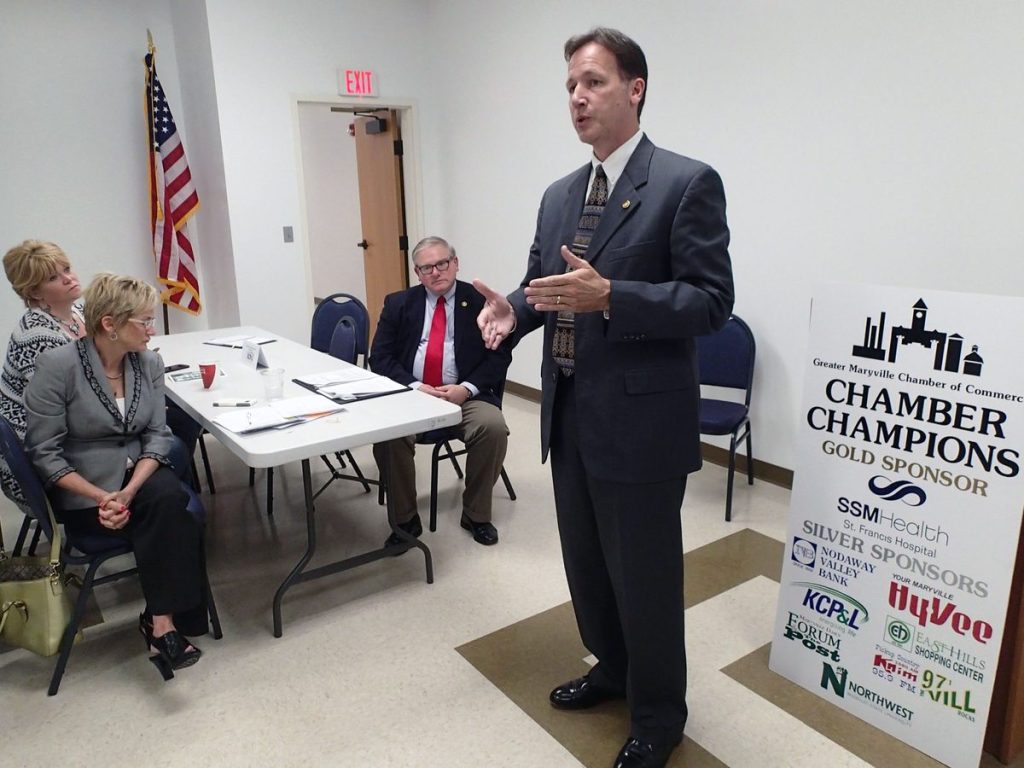
State Rep. Allen Andrews, R-Grant City, addresses members of the Greater Maryville Chamber of Commerce during a post-session breakfast meeting Tuesday at the Nodaway County Administration Center. In the wake of ongoing cuts to higher education, Andrews emphasized the importance of Northwest Missouri State University to the region’s overall economic health. State Sen. Dan Hegeman, R-Cosby, who also spoke, is shown seated at center.
About 40 local business and civic leaders gathered Tuesday in the basement meeting room of the Nodaway County Administration Center for the Greater Maryville Chamber of Commerce’s annual post-session legislative breakfast.
Both 1st District state Rep. Allen Andrews and 12th District state Sen. Dan Hegeman spoke during the event, responding to prepared questions posed by chamber members relating to infrastructure, transportation, public and higher education, healthcare and other topics.
Several times during their remarks, the lawmakers turned the spotlight on their hopes for next year, since, despite GOP supermajorities in both chambers of the General Assembly and a Republican in the governor’s mansion, the 2017 session, which ended May 12, failed to produce as much legislation as many observers expected.
Hegeman and Andrews are scheduled to be back in Jefferson City today for the remainder of a special session called by Gov. Eric Greitens devoted to consideration of a bill that would allow utility companies to offer lower electric rates to a couple of proposed metal plants in southeast Missouri.
The 75 bills approved this year by both the House and Senate were the fewest since 2000, and a number of high-profile proposals, including measures calling for increased transportation funding, more stringent regulations on abortion providers, and ethics reform — a stated priority for Greitens — were abandoned.
However, the legislation that did make it to the governor’s desk reflected cherished Republican goals.
Those bills included a right-to-work law that will let workers in union shops opt out of paying dues and a measure making it more difficult for workers to sue former employers for discrimination and harassment.
In passing the state’s $27 billion budget, lawmakers also fully funded Missouri’s public school appropriations formula for the first time in years, setting aside about $3.4 billion for K-12 education.
Elsewhere on the education front, however, proposals to expand charter schools and provide tuition tax credits for parents whose children attend private institutions — another Greitens’ priority — fizzled.
As far as rural schools in places like Nodaway County go, Andrews said the failure of tax vouchers and other measures floated under the banner of education reform is probably a good thing.
“That’s one that I’ve really had trouble with,” Andrews said. “I don’t see the data, and I’m not convinced that a lot of these reform measures are what we need for education.”
He added that pressure at the state and federal level favoring vouchers and privatized schools is likely to continue, and that such policies carry the risk of creating “tremendous costs” for public school districts, especially in outstate Missouri.
For his part, Hegeman said he was pleased to see the foundation formula fully funded, and that he believes the budget sent to the governor, based on anticipated economic growth of around 3 percent, is realistic, meaning he doesn’t think Greitens will have to withhold school dollars in order to keep the state out of the red.
“I think it (the money) will be there,” Hegeman said. “I think we sent the governor a well-balanced budget this year.”
As far as Missouri’s spending blueprint for higher education goes, that’s another matter.
Shortly after taking office early this year, Greitens withheld nearly $60 million in approved spending for four-year, state-assisted universities due to projected budget shortfalls.
Those cuts will continue next year with budgeted reductions in core spending to higher education of at least 6.6 percent.
Andrews and Hegeman said the cuts reflect legislator anger over racially motivated student unrest on the University of Missouri-Columbia campus in 2015, and they decried the effects of shrinking state support on Northwest Missouri State University.
Northwest President John Jasinski, who attended Tuesday’s session, noted that reduced levels of state support have forced Northwest to reduce spending by $66 million over the past four years.
The university has a current total budget of around $125 million a year, Jasinski said.
Andrews told the chamber group that Northwest has an estimated $617 million economic impact on the region and is crucial to the area’s economic well-being.
“If Northwest ever went away, the region would go away,” he said. “It’s that impactful, and we need to do everything we can to get behind Northwest Missouri State. Incredible things are happening there.”
Andrews continued that he is “not pleased” that a number of his House colleagues appear to consider higher education “low-hanging fruit” when it comes to balancing the state’s spending blueprint.
Acknowledging that the MU controversy served as “part of the dynamic” with regard to higher education cuts, Hegeman, too, said he has come to “resent that higher ed is where we go to find money all the time.”
He added, however, that other factors, especially continued increases in Medicaid spending, have put pressure on a number of state services and institutions in addition to colleges and universities, including public safety and prisons.
Still, Hegeman said, “I’m tired of cuts to higher education, and it’s time to push back on that.”
Hegeman and Andrews also criticized their colleagues for failing to pass a prescription drug monitoring bill designed to combat what many see as an epidemic of pain medication abuse and addiction.
The legislators pointed out that Missouri is the only state in the country not to have enacted such a law, and said that concerns over privacy, which killed a drug-monitoring proposal in the Senate, should take a backseat to public health.
“It’s a really serious issue,” said Andrews, adding that addiction to pain killers is a problem that affects senior citizens and families, “and not just the image of a typical drug user that we have conjured up in our minds.”