‘Simple, Fair and Low Taxes’ panel convenes in Maryville
TONY BROWN/DAILY FORUM
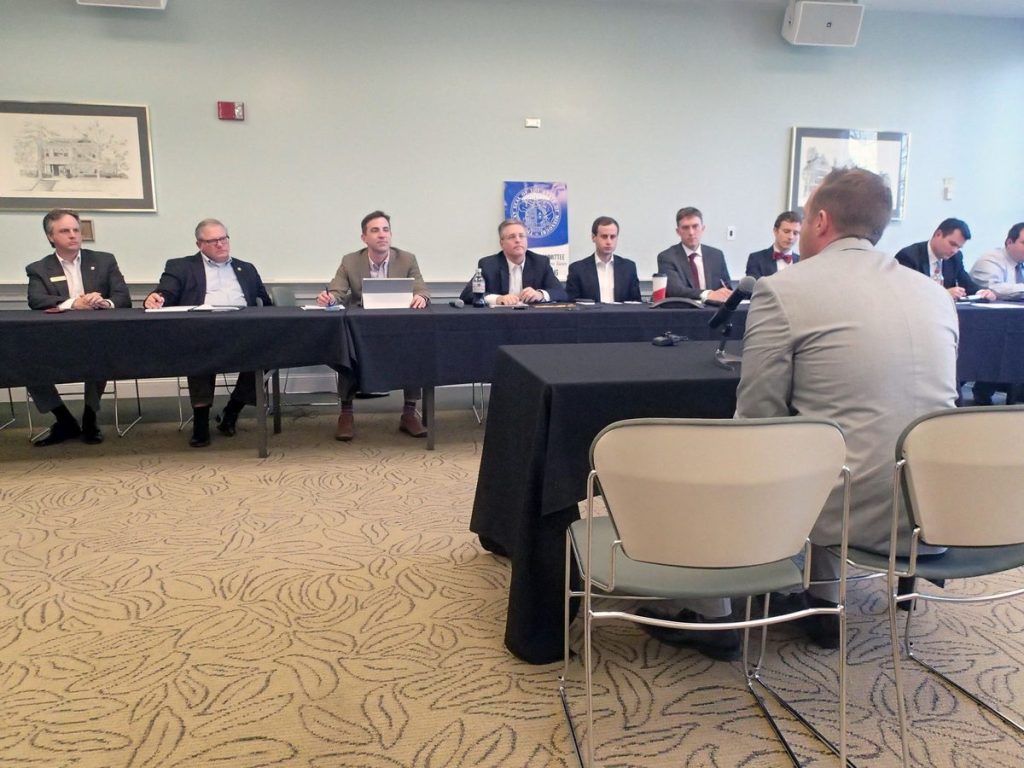
Maryville City Manager Greg McDanel speaks Wednesday evening before Gov. Eric Greitens’ Committee on Simple, Fair and Low Taxes, an all-GOP panel tasked with collecting information about Missouri’s tax code, especially with regard to about $500 million in annual tax credits that some lawmakers see as a spur to economic development and others as welfare doled out to corporations and special interests.
Eliminate, or at least shrink and simplify, a dizzying array of tax breaks benefitting some of Missouri’s most vulnerable citizens, as well as cities seeking to rejuvenate blighted downtowns and residential neighborhoods, or improve the state’s revenue outlook by slashing corporate welfare and leveling the tax-burden playing field?
That was the rather complicated picture painted Wednesday evening during two hours of citizen testimony before Gov. Eric Greitens’ all-Republican Committee on Simple, Fair and Low Taxes.
The session, one of four scheduled around the state over the next three weeks, drew a crowd of about 60 people to the J.W. Jones Student Union Boardroom on the campus of Northwest Missouri State University.
Those in attendance included everyone from ordinary Maryville residents coping with disabilities — who urged the panel to protect low-income affordable housing — to developers and lobbyists from St. Louis and Kansas City who testified that historic preservation tax credits fuel an engine powering economic growth.
City Manager Greg McDanel was on hand as well, telling the panel — which includes 12th District state Sen. Dan Hegeman and state Department of Revenue Director Joel Walters — that local tax break-eligible projects, such as the Villas at the Summit apartment complex and the West Fourth Street pedestrian corridor, have had a significant positive impact.
Villas at the Summit, which provides housing for eligible seniors and people with disabilities, offers discounted rents made possible by state and federal low-income housing tax credits.
The Fourth Street project — as well as the courthouse square streetscape; the non-profit Lettuce Dream greenhouse, which provides vocational training for people with developmental disabilities; and a proposed childcare center at St. Francis Hospital — have all benefitted from credits through the Neighborhood Assistance Program administered by the state Department of Economic Development.
McDanel’s comments drew a positive response from Hegeman, who noted that NAP credits are competitive and require support from local investors.
“That’s what I like about those programs so much,” Hegeman said, “the local buy-in.”
Defenders of other tax breaks that have had a local impact included Linda Mattson, executive director of the Children and Family Center of Northwest Missouri, who told the panel that a state program created in 1996 offers a 50-percent credit on each $100 donation to an eligible domestic abuse shelter.
Also speaking was Villas at the Summit resident Phyllis Ware, a recent Northwest Missouri State University graduate confined to a wheelchair since a debilitating accident in 2009.
Ware said that without the low-income housing tax break developers would be less likely to construct good-quality, accessible apartments available within the means of people living on limited incomes and disability assistance.
“I have a place that I can be proud of and call home,” Ware said. “Most of us are not asking for handouts or vouchers, but simply lower rent so we can afford our own home.”
Tax credits for low-income housing in Missouri total $160 million a year while historic preservation credits come to $140 million — the latter being one of the largest allotments in the nation.
On Wednesday, Excelsior Springs officials told the governor’s panel that historic preservation dollars grease the wheels of economic development by salvaging blighted buildings that spur new businesses, encourage tourism and attract private investment.
One example, they said, was the $18 million renovation of the Elms Hotel and Spa, widely credited with driving an economic revival of the city’s central business district.
Others told the committee of similar initiatives in St. Joseph, Kansas City and St. Louis as well as smaller cities like Sedalia and Chillicothe.
A couple of legislators on the panel, however, voiced skepticism that the tax breaks under consideration are yielding the kind of economic benefits propounded by supporters.
“There are multipliers on multipliers,” said Rep. Jay Barnes, R-Jefferson City, referring to the assumed creation of jobs, consumer spending and non-tax break businesses emerging from state-subsidized redevelopment. “There is not a program in the world for which a contractor or an accountant or a lawyer can’t come up with a multiplier effect.”
Sen. Will Kraus, R-Lee’s Summit, posed a similar query with regard to low-income housing.
“Is this the best way to provide housing for people,” Kraus asked, “or is there a better way?”
One of the last tax-break proponents to speak before the panel was James E. Farrell, a St. Louis lobbyist hired by Historical Preservation for Missouri.
Farrell told the committee that preservation tax credits had helped fund $8.2 billion worth of projects since 1998, an expenditure that by 2010, he claimed, had created 43,000 jobs.
“This program has been one of the most successful in Missouri,” Farrell said.
Following upcoming sessions in Hannibal, Cape Girardeau and Springfield, the committee is to submit a report of its findings to Greitens by the end of June.