
Nurturing nature: Overhaul sought for city park
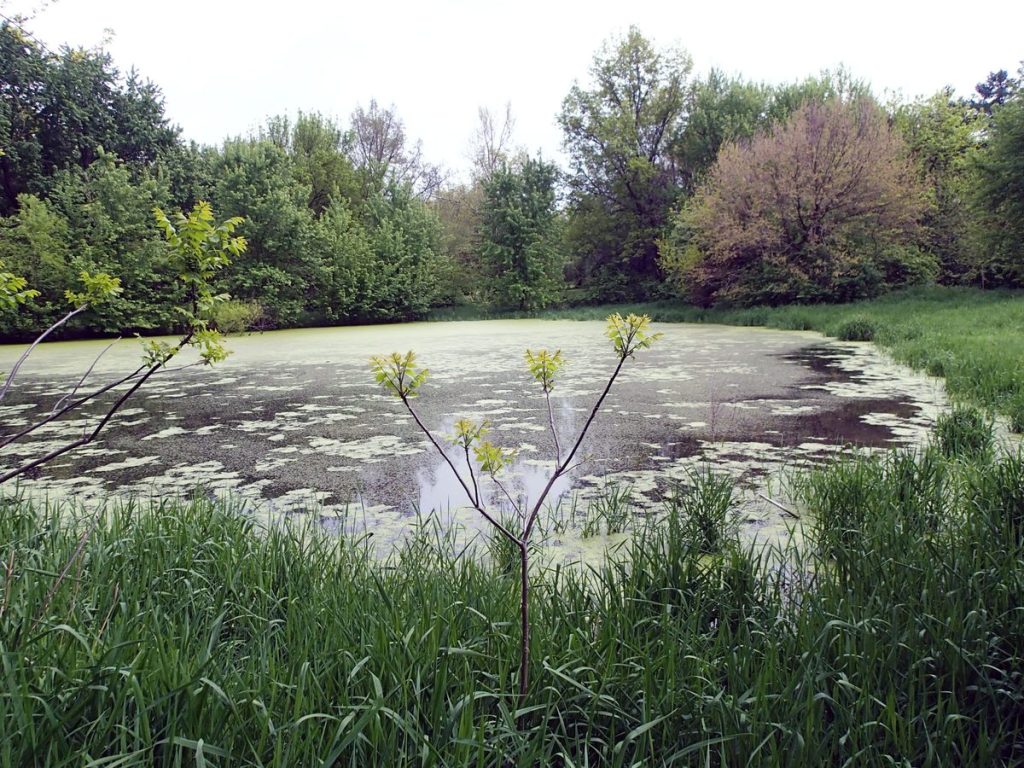
TONY BROWN/DAILY FORUM
Only four feet deep and covered with algae, the pond at Robertson-Crist Park in north Maryville is one of the prime objectives for improvement in a grant-funded initiative to transform the 10-acre tract into a nature preserve filled with native flora and fauna and offering a variety of educational opportunities for local young people.
Not counting Mozingo Lake, which is under the control of the City Council rather than the quasi-independent Parks & Recreation Department, Maryville has 10 municipal parks.
And one of those — perhaps the least known and least used — is about to undergo major changes.
Robertson-Crist Park, a 10-acre woodland spreading like an upside-down staircase north from the 500 block of Prather Avenue, has been the stepchild of the park system since the tract was acquired by the city in the late 1970s.
Donated by two families who owned the land, the Robertsons and the Crists, the park contains no playgrounds and no playing fields; just trees, grass, some underbrush and a small pond.
That is by design.
According to Parks & Recreation Director Aaron Dobson, the agreement ceding the parcel to municipal control spelled out that the acreage was to remain pristine, a small bit of undisturbed nature in the midst of a neighborhood dominated by single-family houses on carefully subdivided lots.
The original vision has remained in place to this day — sort of.
Except for a mostly enclosed shelter house and a few picnic tables, Robertson-Crist Park consists of little more than a healthy collection of trees and bushes and a few patches of mowed grass.
However, the park is hardly representative of nature at its best. The pond, for one thing, has silted in to the point where it’s only about four feet deep.
Also, says Dobson, Missouri Department of Conservation officials walking through the park on a recent inspection “shook their heads” at the number of invasive species that have crowded out plants native to this part of the state.
So, Dobson and his staff have been preparing over the past several months to give Mother Nature a helping hand.
The result is approval of a $36,000 Gladys Rickard Charitable Foundation grant, including about $7,000 in local matching funds from Parks & Recreation ($5,000), the Northwest Missouri State University School of Health Science and Wellness ($1,000), and the Nodaway County Health Center ($950).
That money will be used to dredge, drain, restore and stock the pond; plant and create favorable habitat for native flora and fauna; and construct mulch-covered trails.
While plans to reinvigorate the park have been underway for some time, Dobson said the project hinged on approvals from the U.S. Army Corps of Engineers — especially with regard to the pond — and the state Department of Natural Resources.
Those agencies have now signed off on the project, and work is expected to begin this summer as soon as Parks & Rec completes its evaluation of competitively submitted bids from contractors.
Dobson said initial tasks will likely include dredging and draining the pond and using the resulting sludge to bolster the dam and raise low-lying areas of parkland that turn to mud following a storm.
The overall goal is to channel runoff toward the pond while keeping other parts of the park relatively dry.
Additional chores will include selective tree-trimming to remove large branches that could pose a danger to park patrons and the planting of native flora, such as milkweed, to encourage the proliferation of butterflies, hummingbirds, songbirds and other forms of wildlife.
A few select trees may be planted, Dobson said, but the park’s forest stand is already one of its strongest features.
More than 40 tree species exist in Robertson-Crist, including a selection of pin oaks, elms and bald cypress.
Dobson said one of the central goals for the pond, which is to be restored over time to a depth of around eight feet, is establishment of a fish habitat tailored for young anglers.
He said that the Missouri Department of Conservation has tentatively agreed to stock the pond with native species, and that youth-oriented fishing derbies and other events are a definite possibility.
Such activities, he said, will help build enthusiasm for the sport among a new generation of fisherfolk who will eventually try their luck at city-owned Mozingo Lake, one of northwest Missouri’s premier sport fishing destinations.
Resurrecting Robertson-Crist, Dobson said, will also create opportunities for young people involved in Boy Scouting, Girl Scouting, 4-H and other organizations.
Youth service projects, he said, could include the construction of bird houses and “bat boxes,” habitats designed to attract wildlife that feed on mosquitoes and other insects.
In addition to contributing to the park’s resources, Dobson said he hopes young people will benefit from planned amenities such as an outdoor classroom that would be shared by local schools, the university and the Maryville Public Library.
While Dobson is obviously excited about Robertson-Crist, he is also aware that his plans for the park won’t come to fruition overnight. Work, he said, will likely start this summer, but implementing his full vision will take years.
However, the mere existence of a nature park in a town as small as Maryville presents a unique opportunity.
“It’s not common to have a nature park even in cities larger than we are,” Dobson said. “This is not something everybody has.”




