
Most Nodaway bridges sound, MoDOT says
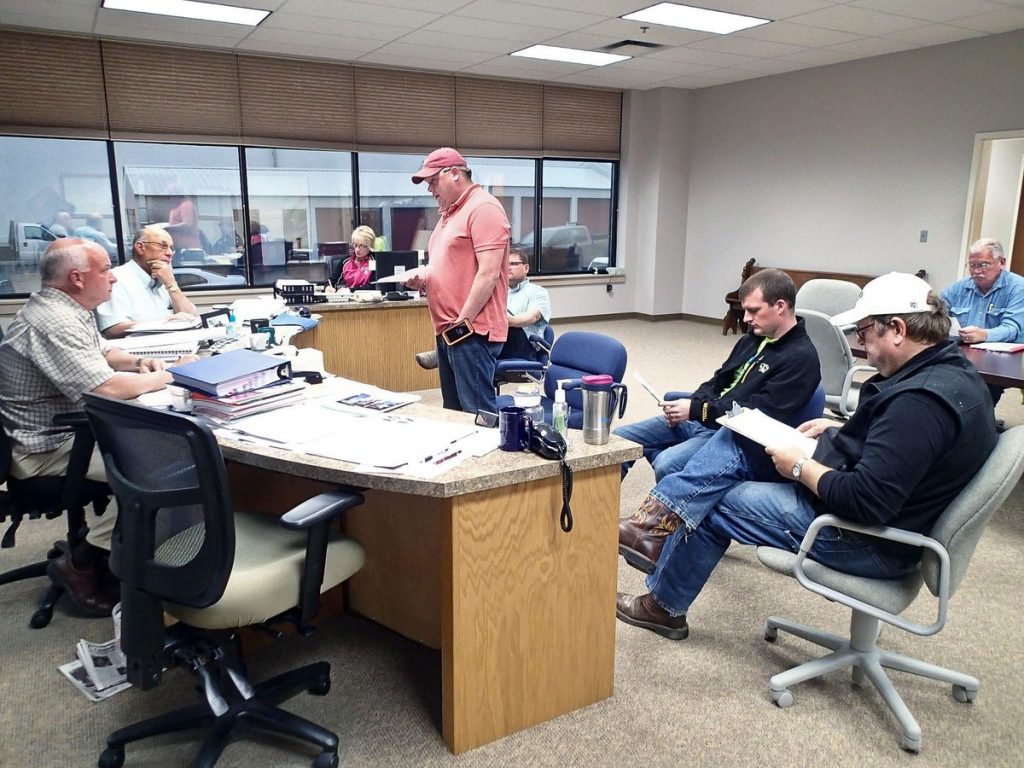
TONY BROWN/DAILY FORUM
A team of Missouri Department of Transportation engineers and inspectors is shown meeting with members of the Nodaway County Commission last week while summarizing findings from a recently completed bridge survey. The report states that 87 percent of the county’s gravel- and dirt-road bridges are in fair to excellent shape. Conducted every two years, the inspection effort included every county-owned span more than 20 feet long. With about 350 bridges and scores of tube crossings, Nodaway County maintains one of the largest rural transportation infrastructure systems in Missouri.
On the time-honored academic scale used by high school teachers everywhere, Nodaway County has earned a B-plus with regard to the state of its bridges.
According to the results of a recent Missouri Department of Transportation inspection, 87 percent of the county’s bridges are in fair to excellent shape on a scale of one to nine.
Given the fact that the state’s fifth-largest county, geographically speaking, has more bridges than just about any similar rural political subdivision in Missouri, that’s not bad, members of the four-person inspection team told the County Commission on Friday.
The survey embraced gravel and dirt roads but excluded state-owned spans on lettered routes and highways.
Conducted every two years, the report embraced every bridge in the county more than 20 feet long. That comes to 308 bridges, though the total number of structures, figuring in shorter spans, exceeds 350.
County Road and Bridge Supervisor Ed Walker said load limits have been imposed on more than half those bridges. But even so, MoDOT officials say, Nodaway is in better shape than many other counties in a state where rural transportation infrastructure is an increasingly troublesome issue.
For example, the average age of a gravel- or dirt-road bridge in Nodaway County is 28 years, which compares to 50 years across the state as a whole.
MoDOT rated 198 Nodaway bridges at between seven and nine on its nine-point scale. Another 72 spans are in fair condition, having earned a rating of either five or six.
Only 38 structures — 12 percent of the total — were classed as deficient, earning ratings of between one and four. However, 21 of those are on the upper (better) end of the scale with a rating of four.
Given the size of Nodaway County’s rural transportation system, those numbers show that the current County Commission — and its predecessors — have made a solid effort to spend taxpayer money wisely.
But not perfectly.
In summarizing the report, MoDOT bridge inspector Lynn Anderson said the team found eight bridges constructed between 2001 and 2005 that contain girders of narrower width than specified in the plans. How did that happen? No one seems to know.
Most of the non-conforming spans were built in 2003 and 2004, and the longest-serving commissioner, Robert Stiens, didn’t assume office until those projects were either complete or well underway.
“It certainly wasn’t done on purpose,” said Steins, who added that if mistakes were made the only option, at this point, is to move forward.
“If we need to post them (with weight limits) then we’ll have to post then,” Stiens said. “It doesn’t matter. It’s in the past, and we’ve got to deal with what we’ve got to deal with in the future.”
Five bridges were identified by MoDOT as in need of immediate attention and classed as CIF, which is bureaucratic shorthand for “critical inspection finding.”
Of those, two are closed, two have already been repaired and one will have to be replaced.
MoDOT labeled six bridges with a “control inspection finding,” or CIF, meaning that repairs or upgrades should proceed as soon as possible.
Still, said Scott Stephens, MoDOT’s Northwest Region bridge engineer, Nodaway is in pretty good shape compared to other agriculture-intensive counties.
“With that many bridges inevitably you’re going to have some problems,” Stephens said.
The MoDOT inspection comes at a time when rural transportation infrastructure is attracting attention statewide.
Almost all of the money used to build rural bridges in Missouri comes from the motor fuels sales tax, a revenue stream that has narrowed in recent years as more drivers switch to fuel-efficient vehicles.
The tax — at 17 cents a gallon the fourth-lowest in the nation — hasn’t increased since 1996.
An article in the April edition of “Today’s Farmer” magazine, published by MFA, notes that funds for gravel- and dirt-road bridges are drying up even as row-crop harvest volume continues to expand.
In practical terms, that increased production means rural bridges and unpaved roads must now handle, or fail to handle, the much-larger tractors, implements and trucks used to plant seeds and transport the harvest.
Bridges constructed 30 years ago for two-ton grain trucks are now groaning under the weight of fully loaded 18-wheelers, which have become standard equipment for producers carrying their grain to market.
According to the “Today’s Farmer” report, Missouri produced 350 million bushels of corn in 1996, a mark that swelled to 600 million bushels in 2016.
Efforts to raise Missouri’s fuels tax have languished in the normally ag-friendly state Legislature, the magazine reported, even as such farming lobbies as the Missouri Soybean Association report majority support among producers for an increase.
Missouri’s Corn Belt neighbors all have significantly higher fuels taxes, with Illinois collecting 34 cents per gallon for gasoline and 35 cents for diesel. The Kansas rate is 24 cents (gasoline) and 26 cents (diesel), while Iowa collects 30 cents and 32 cents.




