
Peltz gives Lunch and Learn lecture on stress
SUBMITTED PHOTO
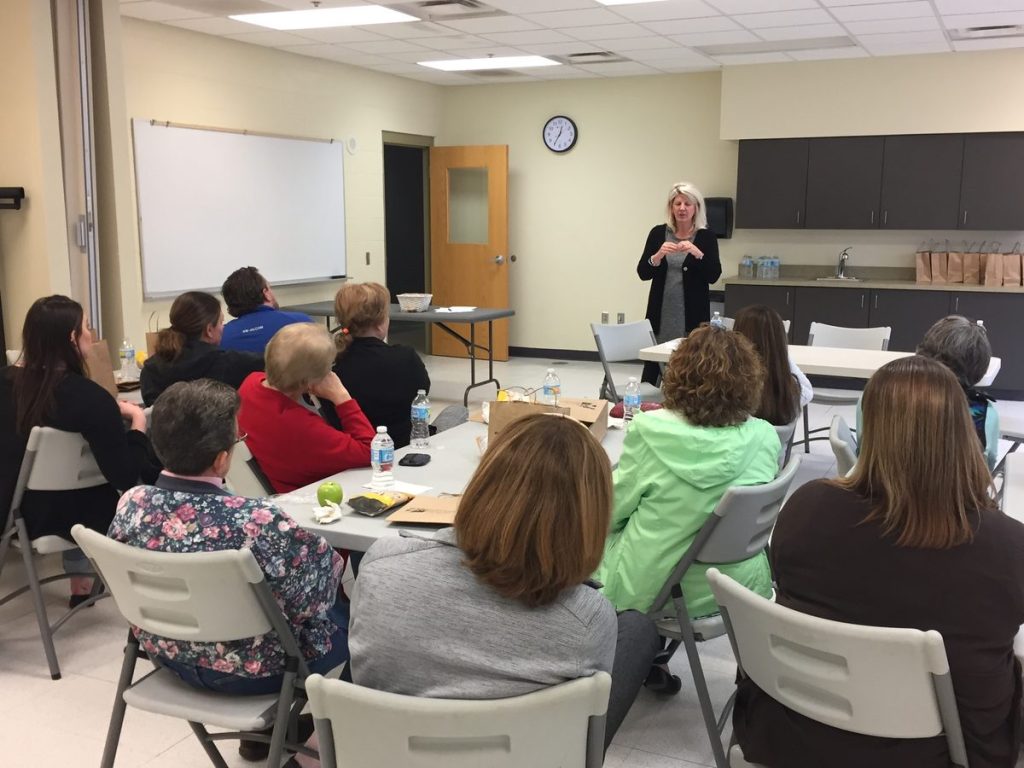
Kristen Peltz, assistant director of Wellness Services at Northwest Missouri State University, shares information about the different types of stress people experience, during the monthly Lunch and Learn at the Maryville Community Center. Long-term stress, according to Peltz, can be harmful to a person’s health.
Everyone feels stress occasionally, but there are right and wrong ways to deal with it. There are also different levels of stress, and its important to be able to differentiate between them.
That was the topic of this month’s Lunch and Learn, sponsored by SSM Health St. Francis Hospital in Maryville and hosted at the Maryville Community Center. The featured speaker was Kristen Peltz, assistant director of Wellness Services at Northwest Missouri State University.
Peltz first discussed with the audience the two components that go into stress.
“The first one is obviously the emotional aspect, and it’s a very uncomfortable emotion,” Peltz said. “It’s usually underlying fear, anxiety, even sadness and loneliness.
“The second aspect is physiological, which takes it deeper than just the emotional level. You start to feel it manifest in physical ailments, such as muscle tension, headaches, and the like.”
Peltz said stress goes beyond the “caveman brain” impulses of fight or flight.
Peltz then went on to debunk several myths about stress, including that stress looks the same in everyone, that coping mechanisms are similarly universally applicable, that all stress is bad, and that stress is unavoidable in all cases. She also mentioned that people could have stress without showing symptoms, and that even minor symptoms of stress warrants a check-up to evaluate a person’s ability to cope so that minor stresses don’t evolve.
Peltz then explained that there are three main types of stress, the first and least severe of which is known as acute stress. Acute stress covers all everyday stresses, such as deadlines and unexpected mishaps.
The second and third levels of stress, however, can be dangerous to one’s health.
“The second type is episodic stress, and that’s stress that hangs around you and doesn’t seem to go away,” Peltz explained. “Episodic stress stays in the back of our heads and manifests itself in making us think that something could go wrong just around the corner, always.
“The third type is chronic stress, and that’s where stress gets you to a point where you feel like you can’t get out. This is usually people who grew up in difficult situations, dysfunctional families, poverty, and other situations, and they feel like there’s no escape from their stress.”
Peltz said that it was important to do several things in order to make sure that acute stress didn’t evolve into something worse.
“It all starts when you give yourself permission to admit something is wrong,” Peltz said. “Then you can start to assess the situation and really get a handle on what you need to do in order to reduce and relieve your stress.
“That may mean talking to someone you trust, going to therapy, or other routes of focused coping. No two solutions will ever be the same, but the biggest thing you need to remember is to practice self-care.”
The next Lunch and Learn will take place Friday, May 19 at the Maryville Community Center. The lecture will cover the benefits of heart calcium scoring and a new procedure available at SSM Health St. Francis that helps you discover your heart’s calcium score.