Culture wins Part 4 of 5: Quinlin pushes athletes to go the extra mile


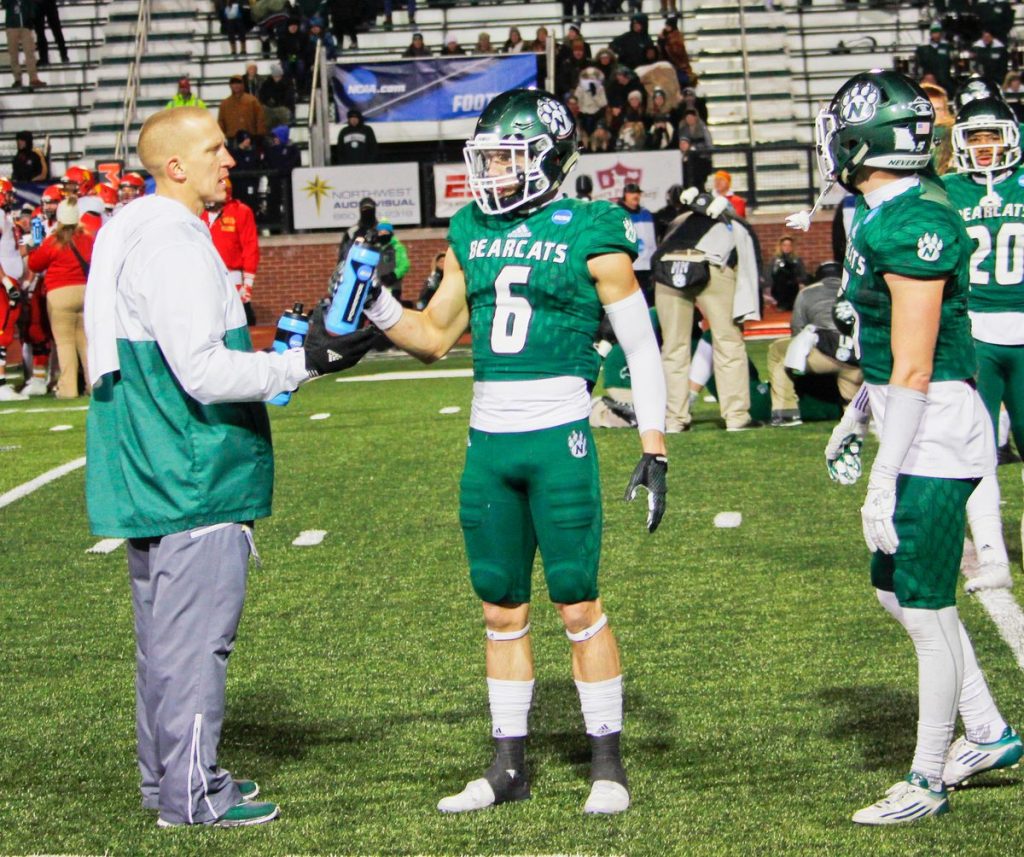
DAILY FORUM FILE PHOTO
Northwest Missouri State University strength and conditioning coach Joe Quinlin, left, brings Kevin Berg some water during the Bearcats’ national semifinal against Ferris State last season. Quinlin has become a key part of getting athletes ready to compete.
While the athletic department is made up of different athletes representing different teams, all of them work with Joe Quinlin, the head of the strength and conditioning program at Northwest.
Quinlin had the advantage of already knowing what the expectations were when he took over the role. He played football under legendary football coach Mel Tjeerdsma from 1997-2000, winning back-to-back national championships as a player.
Following his time at Northwest, he earned a master’s degree from West Virginia before returning to Maryville in 2004. He was employed by the City of Maryville as a strength and conditioning coach before assuming the same role with the Bearcats.
He has been a part of the culture for a long time.
“A lot of it is just understanding what we expect out of our athletes,” he said. “The culture is our expectation. Two years ago, Mel (Tjeerdsma) said he wanted to have all the athletic programs in the top half of the conference.
“As a strength staff, we want to embrace that too. We want everybody to compete. Yes, we want to win national championships, but we want everyone to have that standard. The culture around here is that we want to be able to come in and compete in every competition we have.”
With football in particular, Quinlin is one of the first stops for incoming freshmen. Tjeerdsma, Adam Dorrell, current football coach Rich Wright, and all the other coaches on campus trust this man and his staff to turn their athletes into battle-tested warriors.
Incoming athletes have one very big thing to learn in college — the pace.
“There’s so many different variations of high school strength programs as far as ‘come in when you can’ and all that,” he said. “We have a 2,000-square foot weight room and we have 450 athletes that we need to get through there. Freshman year is very militant-like. If we’re warming up at a certain time, we need them to be there 10 minutes before.
“It’s all on a tempo. That tempo challenges them mentally and physically. I’m trying to push that tempo and challenge them. The football guys especially have just never worked at that pace before.”
Intensity is also at another level from high school. Brett Dougherty, who will be a senior on next year’s Bearcat men’s basketball team, said he learned that very quickly as a freshman.
“The biggest thing that throws you off at first, is the talking and the communication,” he said. “When we have morning workouts during the preseason, we’re yelling and we’re cheering each other on the entire time. It goes the entire workout. As a freshman, you don’t expect to have to be yelling like that at six in the morning.
“It’s something that coach Mac (Ben McCollum) asks us to do. If we’re not doing it, then conditions will be a little bit tougher. It’s about helping out your teammates. Getting each other through those workouts is a cultural thing. I feel pretty confident saying that there can’t be a whole lot of tougher programs. Joe puts us through some pretty tough workouts. Mac is all about mental toughness, and he’s going to test that.”
Quinlin, whose wife Kelly is the head athletic trainer for the university, as well as all the coaches expect the athletes to be early or on time for their workouts. If they aren’t on time, Quinlin said there are disciplinary steps taken. He also made the point to say he works around family issues or sickness.
When an incoming freshman goes to Quinlin for the first time, they fill out Bearcat Standard sheets, which include their position as well as the starter’s workout numbers in various exercises from the year prior. Quinlin uses that to show what areas need to be worked on.
A lot of high school athletes come in more physically ready than one might think, but there are always weaknesses.
“In high school, you’re always the biggest and the strongest kid,” he said. “Well here, you can still be the biggest and strongest, but get outworked by a defensive back who is in a little better conditioned shape.”
The term is strength and conditioning, but according to Quinlin, the majority of the work is strength training. The conditioning works itself out based on the pace of the strength workouts. Some of the strength workouts include routines working on hamstrings, glutes, core, backsides, and shoulders.
Making sure the players don’t stray into overly unhealthy eating habits is another major part of the process.
Student-athletes, depending on what season and time of year it is, are required to text Quinlin pictures of what they are eating for breakfast before 9 a.m. each morning. Quinlin then helps the student-athlete make adjustments, if needed.
Quinlin knows everyone is different, so he and his staff try to specialize a plan for each athlete.
Logging their food for each meal on pen and paper or in a computer is also part of the tracking plan.
“If it’s eggs and gravy and biscuits for example, we’d say ok maybe cut the gravy and biscuits in half and eat more eggs, and get a fruit option with some water or milk to drink,” he said. “If it’s a defensive lineman, you may need to eat pizza a few nights a week to get your caloric intake level to where we need it. We don’t have a full-time nutritionist, and I don’t have time to follow all of them around to see what they eat. That’s where technology comes in handy. We try to get them to be better eaters in five years than they were when we came in.”
According to Quinlin though, there is no food on the planet that is worse for bodies in too large of quanity than a beverage — beer.
Quinlin also said this is important for life after they graduate.
A lot of it comes down to portion size. He wants his athletes to watch how big of portions they are consuming, especially with dishes providing a higher amount of calories.
Another test of how the athletes are doing comes down to a simple pinch test. Devoid of any fancy machinery to test certain health levels.
Quinlin or a member of his staff pinch an athlete around the abdominals.
“It’s pretty easy to tell if they aren’t eating correctly when you do that,” he said.
Even if the caloric intake is high, athletes tend to burn 4,000 to 5,000 calories per day, depending on the season and the time of year.
One session with Quinlin could burn between 800 to 1,000 calories depending on the athlete. In Quinlin’s mind, the games should come easier to the athletes than the actual workouts before the games.
“I try and make our workouts harder than what we’re going to see on the field or what we’re going to compete at,” he said. “That way, we’re not surprised by anything in a game or practice. That’s our goal. I’d rather you feel a lot more comfortable during the game.”
Arriving into a championship culture that was already established helped Quinlin.
For him, it’s a matter of not letting the standards slip.
“It’s more maintaining that level as far as what I expect out of them,” he said. “I know where were at. I know that passion of being a Bearcat has always been pretty big to me. I don’t want to let that fall. We’re trying to bring everybody along with football and basketball.”