Maryville’s Oglesby discusses journey to being a Division I official


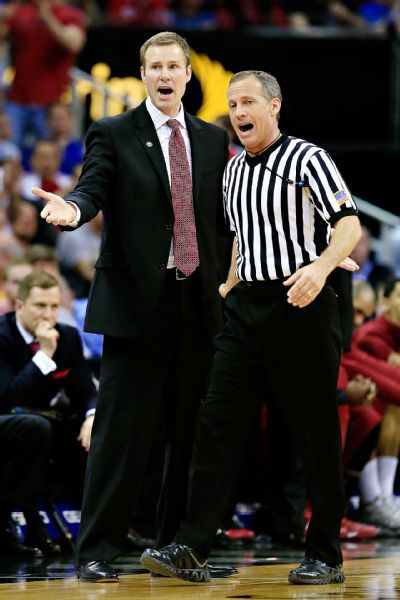
Terry Oglesby talks with then Iowa State coach Fred Hoiberg during the 2014-15 season NCAA Tournament game.
The Maryville Daily Forum caught up with Maryville resident Terry Oglesby, a long-time NCAA college basketball official after his trip to the Final Four, where he served as an alternate official. Questions were asked by sports reporter David Merrill.
DF: How long have you been an NCAA official?
TO: I’ve been refereeing 30 years, starting with junior high and high school. Then I went up the ladder to NAIA and NCAA Division II then up to Division I. I’ve been at the Division I level for about 15 to 16 years. College in general, probably 20 of those 30 years.
DF: What type of training do you need to go through?
TO: How you get hired in college is you have to go to a camp or a clinic. For the Big 12, they have four of those camps in the summer. There’s about 360 guys that come to this camp in the summer, and they may hire eight or nine out of that tryout camp every year. Every conference has their own camp. Most of them have more than one. After you get on staff, you have to take a test on the computer. It’s about 60 questions and the NCAA makes you take it. You have to take a background check, a physical, that sort of thing.
DF: How many conferences have you worked for as an official?
TO: I’ve never worked in the Pac 12 or the ACC. I’ve had those teams, but never worked for the conference as an official. I’ve had Duke and UCLA different places, but I’ve worked for the Big 12, Big 10, Big East, SEC, and the Missouri Valley and some other smaller mid-majors.
DF: Was this your first Final Four?
TO: Yes, it was
DF: What was that experience like?
TO: Let’s back up one step. Last year, I did a Sweet 16 game, and that was as far as I’ve been. I moved up this year and did an Elite 8 and it was in Kansas City. That was pretty cool for me being from here. It’s hard to get to the Elite 8. There’s 30 officials left for that weekend, so it was special for me to go to Kansas City because I got to take some of my family members, and they don’t get to see many of my games. I’m on the road a lot. To get to the Final Four, there’s 10 guys left at that time. There’s six who worked the semifinals, three that worked the finals, and one standing by that does both.
The Final four was a different experience. They try and keep you away from everybody. They put you up in a hotel, it was a 45-minute ride down to the arena. We had a 10-motorcycle brigade leading us to the game. It was crazy. It was like the President. They blocked off the interstate. It was unbelievable. I’ve never seen anything like it. That was different for me.
We get to the locker room, there’s nothing really different about that part, but we get there plenty early and we take pictures. Now when we go out and walk out onto the court. Most places you walk out of the tunnel and you’re 20 feet from the court. We walked out of the tunnel and we’re still 100 yards from the court, because it was in a football stadium. It held 77,000 people. Some of these seats seemed like they were a mile away. I’m going, this is crazy in comparison to other games. That was a great experience. My job, as a standby was to be fully dressed and be at the table. Obviously, if someone got hurt, I was going in, but also to sit at the monitor and help with reviews. It was the best seat in the house.
DF: What’s the Number 1 thing you’d like the public to know about officiating?
TO: It’s hard. Everybody wants to scream and yell about a call or two, but guess what? We’re going to miss a call or two. We’re human. We try and get every call right, but it just doesn’t happen. Everybody thinks we’re out to get their team if we miss a call. That game moves so fast. As a referee, I don’t know who I’m calling that foul on. Some people think every ref goes out beforehand and decides who’s going to win the game. It’s not that way because we are observed and graded on every game. Nothing gets by these people. Everything is on replay, it’s on TV, it’s in HD. You can see everything. If you’re starting to miss calls, you won’t be around. We don’t go out thinking we’re going to go out and do one thing for one team and one thing for another team. I think some people think that.
DF: This whole John Higgins thing became kind of a national story. What are your thoughts on that whole situation?
TO: I know John very well. I worked my first Division I game with him. He lives in Omaha, so I’ve known him since I started. He’s a really good guy and a really good referee. He’s one of the best in the country obviously. I think it happened to John a little more because he’s so well-known. The other two guys were in the game, but they don’t even know who worked with him. They didn’t get the death threats or the phone calls. They just know John because he’s worked a lot of big games. He’s easily recognizable because of his hair and looks or whatever.
DF: Were you shocked it got to that level?
TO: I was. It’s ridiculous honestly. Again, these people think we go out there and try to cheat the other team. That’s just not true. You can go back and watch that game. Was there a call or two that went against Kentucky? Probably. There were probably a couple that went against North Carolina too. When it gets to that point with the death threats, that’s overboard. I talked to John that weekend and his biggest thing was his family. He was of the mindset of — if they want to threaten me, fine, I can take it. He’s got a young kid who is 10 or 12 years old and a wife at home. That would make you think about it.
DF: Have you ever been criticized to that level or even close?
TO: No. I’ve seen stuff on Twitter or seen stuff in the paper about Terry Oglesby gave the worst technical or whatever, but never death threats or person phone calls. But it could happen to anybody. They can find your phone number anytime they want.
DF: There’s a picture from the Associated Press of you standing near the bench with Bob Knight’s arms around you. Can you explain what was going on there?
TO: You probably can’t quote any of those things he was telling me. It was the first time I had ever worked a Bobby Knight game, and he was at Texas Tech. My two coworkers were telling me to not stand in front of him. He’s one of the coaches who sits on the bench and does most of his coaching sitting down. Most of the coaches are up and down moving, so you’re never in their way. They told me he sits right at the free throw line extended, so don’t get in his way. First part of the game, I’m out of his way. The game starts to get heated and I’m just refereeing where I’m used to refereeing. As I watch it back again now, there were three other times where he stood up to move me, but the ball went the other way. That time, he stood up and grabs me. This was during live ball and it wasn’t a light grab. He says, “Are you going to get the **** out of my way? I’m trying to coach my ****** kids and you’re standing in my way.” My response was “yes sir, Coach Knight.”
DF: Was there any thought to giving him a technical?
TO: No. Although, he was an intimidating guy on the sideline, but here’s the thing. It’s not about me. No one goes there to watch me. If I can get out of the coach’s way and let him do his job and let me do my job, great. If he grabs me and says to get out of the way, OK. I’m not going to turn around and call a T. I learned this too. From high school to college to Division I, there’s a lot of things that we let go at the Division I level that we never would have at the high school level. There’s cursing going on, but as long as it’s not personal toward me, or showing me up, they’re doing their thing. They get paid a lot more to do what they’re doing than what I get paid, so as long as it doesn’t cross a line, it’s fine.
DF: During March Madness, everyone does their bracket pools. Are you allowed to do one as long as there is no monetary prize at stake?
TO: I don’t know that we’re not, but I don’t do one. They are very strict about doing an office pool or anything like that because it could turn out to where, if something happened, they could say I have Carolina picked to win it all, and all of a sudden I’m refereeing their game. I don’t think it’s taboo if it’s for nothing, but it doesn’t do me any good to do one. They would frown on that.
DF: Now that the season is over, would you have picked North Carolina to win the national championship?
TO: I would say they’d be in the top few. As everybody sees in the national tournament, anything can happen in one night. I couldn’t tell you that for sure, but they’d be in the top five or six, but that’s what great about the NCAA tournament. I don’t think a lot of people would have said Oregon was going to beat Kansas, but that night, Oregon was better than Kansas.
DF: From your perspective as an official, should college athletes be paid?
TO: I don’t think I have an answer as an official, but I have a personal opinion on it. It varies a little bit. College athletes are getting paid. They are getting room and board and tuition. I get that. But I’ve also seen college athletes who can’t afford to drive through McDonald’s to get something to eat when some of these universities are making millions of dollars off these college athletes. I’m good with a stipend of some kind. What that is, I don’t know because I haven’t done enough background research on it. The only thing I don’t like about it is it doesn’t create an even playing field. If some universities can give $3,500 and some can’t, we all know where the good athletes are going to go. So, I’m a little worried about the playing field and how even it is. Kids are going to go where they get a $3,500 stipend. That’s going to make a lot of decisions.
DF: During the season, what is a normal week like for you?
TO: Crazy. During the season, if I have four games a week, I’ll catch the first flight out of Kansas City, whatever time it is. I get to the site and check into my room, and get a nap or a workout in and then go to the game and come back to the room. Then I’ll get up and do the next thing the next morning. Some people ask me how New York was for example. I don’t know. I saw the airport and I saw my motel room, and I saw the arena. The travel is the worst part of the job. I can honestly tell you, having done Division I for 15 or 16 years, there hasn’t been a game where I found myself wishing that game was over like an office job. I seriously love to referee. When you can do something you love to do and make money at it, you’re lucky. I’m lucky. There’s times where I don’t want to get up in the morning and catch a 4 a.m. flight like everyone else. The glitz and glamour of hotels doesn’t do much for me anymore. Even if I go with my family. My wife and kids are excited about going to a hotel and all that, and I’ll be like ‘oh boy another plane ride.’
DF: What is that like doing the job with a family? You have kids that play sports in the Maryville community.
TO: First of all, if I didn’t have a great wife, I couldn’t do what I’m doing. She takes care of everything when I’m gone. She’s the rock of our household because she’s here. The good thing about reffing for 16 years is I have some leeway. I can block off dates. This year, I blocked off all the football games at the ends of the season. I blocked off 12 to 14 basketball games. You get to pick your availability a little bit. Six or seven years ago, they’d let me have those off, but they might not give me games to make up for it. Now I have some flexibility. Do I miss some things? Yes, but people with other jobs miss some things. This is my job.
DF: How many other Division I refs have day jobs?
TO: Not very many at the level I work right now. It’s hard to get off of your day job and work 60 or 70 games. The guys who do have other jobs usually own their own business or in some kind of insurance or banking, but it’s hard to do.
DF: During the NCAA Tournament, how do they decide where to send which refs?
TO: There’s one guy who is in charge of the NCAA Tournament and his name is J.D. Collins. That’s his job, is to assign the refs for the NCAA Tournament. He has four regional guys who work under him who go out and watch all the referees who go out. They watch them on tape and observe them. They cut it down to 90 for the tournament. Then they have guys at the sites who observe. I don’t know how he makes his decision or what goes into it.
DF: Is there anything else you’d like to get out there?
TO: Again, the biggest thing that I survive with is people don’t go out there to watch me referee. We’ve all seen officials who try and draw attention to themselves. Nobody goes to watch us. Here’s the key to reffing basketball: You have to be able to ref with confidence without arrogance. People will sniff out arrogance. Especially these big-time coaches. If they pick up on your arrogance, they won’t want you there. The other thing. There’s a lot of people who have helped me along the way. There’s a lot of guys in this area who I reffed high school with who could have done what I’ve been doing. A guy named Mark Bridges from Albany. He’s passed away now, but he could have done what I’m doing. He decided not to go that route, and it takes a family backing. The commitment that I’ve made to do that, the area. I made the commitment to do what I’m doing there’s other guys who could have done the same thing.
Bob Lade was the head of the recreation department at Northwest. He started me reffing in intramural. He was way ahead of his time as far as having associations and things like that. He walked me through the first years of basketball officiating. I always like to put his name out there. If it wasn’t for him, wouldn’t be sitting here right now. He’s probably the No. 1 guy whose helped me. He’s now the head of officials in the NAIA.