
Voters choose Martin, Lipiec; OK sales, library tax questions

TONY BROWN/DAILY FORUM
City Council candidates and municipal officials sit around a table at the Nodaway County Administration Center listening as returns were announced following Tuesday’s municipal election. Pictured clockwise beginning in the foreground are Assistant City Manager Ryan Heiland (back to camera); City Councilman-elect Benjamin Lipiec; City Manager Greg McDanel; Gabrielle Hawkins and her husband, City Council candidate Kevin Hawkins; Mayor Jason McDowell; City Councilwoman Rachael Martin; and Martin’s husband and daughter, Spencer Martin and Quinn Martin.
Maryville voters filled two open City Council seats and approved a pair of tax questions in Tuesday’s municipal election.
Chosen to serve on the city’s governing board for the next three years were one-term incumbent Rachael Martin, who received 638 votes, and newcomer Benjamin Lipiec, who came in second with 635 votes.
Trailing the four-candidate field were Michael Baumli with 441 votes and Kevin Hawkins with 396.
Incumbent Tim Shipley elected not to seek a second term.
All vote totals are unofficial until certified by the county clerk.
Martin, 30, works as a banking center manager at Bank Midwest. She and her husband, Spencer Martin, are the parents of a 2-year-old daughter and are expecting their second child this month.
Martin grew up in Villisca, Iowa, and has lived in Maryville since 2005. She was elected to the council in 2014 and currently serves as mayor pro tem, acting for Mayor Jason McDowell in his absence.
Her other civic affiliations include board seats for the Greater Maryville Chamber of Commerce and Maryville Downtown Improvement Organization. She is also a member of the St. Francis Hospital Gala Committee.
After graduating from Villisca Community High School in 2005, Martin attended Northwest Missouri State University, where she earned a bachelor’s degree in marketing in 2011.
Benjamin Lipiec, 33, was born and raised in Maryville. He and his wife, Manda Lipiec, have four children, three at home and one in college. He works as a sales supervisor for Nucor LMP Steel.
Lipiec is a board member and past-president of United Way of Nodaway County and Big Brothers Big Sisters of Nodaway County and current president of The Source, a local reproductive health clinic.
After graduating from Maryville High School in 2002, he attended Northwest Missouri State University, where he earned a bachelor’s degree in financial computing in 2007.
Martin said she was “very grateful” to voters for returning her to the council for a second term and that she is looking forward to “wrapping up several projects that are underway and starting some new ones.”
She said she was especially pleased that voters solidly backed extending the city’s capital improvement sales tax, which will likely allow the council to move forward on a couple of multi-million-dollar initiatives, including a new fire and police station.
Lipiec said he was “excited” about beginning his first council term in a few days, adding that he believes the city is poised for “new challenges and opportunities.”
“I’m ready to work with the group to make Maryville successful,” he said.
Tax issues on the ballot included the above-mentioned renewal of Maryville’s existing one-half-cent capital improvement sales tax, which was set to expire in Sept. 2018.
Voters overwhelmingly approved the proposal 897 to 392.
“The City of Maryville would like to thank voters for the opportunity to continue major infrastructure investments and replacement of equipment to provide basic services,” said City Manager Greg McDanel after the returns were in.
“The extension of the capital improvement sales tax will allow for proper maintenance of streets, dynamic improvements to South Main Street, and provide an adequate facility for our law enforcement officers and firefighters that represents our sincere appreciation for their service.”
Citizens were asked to renew the levy, which brings in about $1 million annually, for a period of 20 years, a time frame city officials said is needed to properly structure debt financing for larger projects.
Over the decade since its last renewal, the levy has paid for millions of dollars in street reconstructions, asphalt overlays, fire trucks and other vehicles, as well as special initiatives like the award-winning West Fourth Street pedestrian corridor.
Major street rebuilds funded with capital improvements revenue include portions of South Main, West 16th Street, South Depot Street and South Munn Avenue.
The tax has also provided matching funds for federal and state grants used to construct seven paved hiking and biking trails in various parts of the city.
In addition to a new police-fire headquarters, voter approval of the tax renewal will allow the city to move forward with at least two other large-scale projects: traffic-flow improvements on South Main Street between South Avenue and the north entrance to Walmart and a proposed $2 million asphalt overlay initiative that will repave 11 miles of city streets.
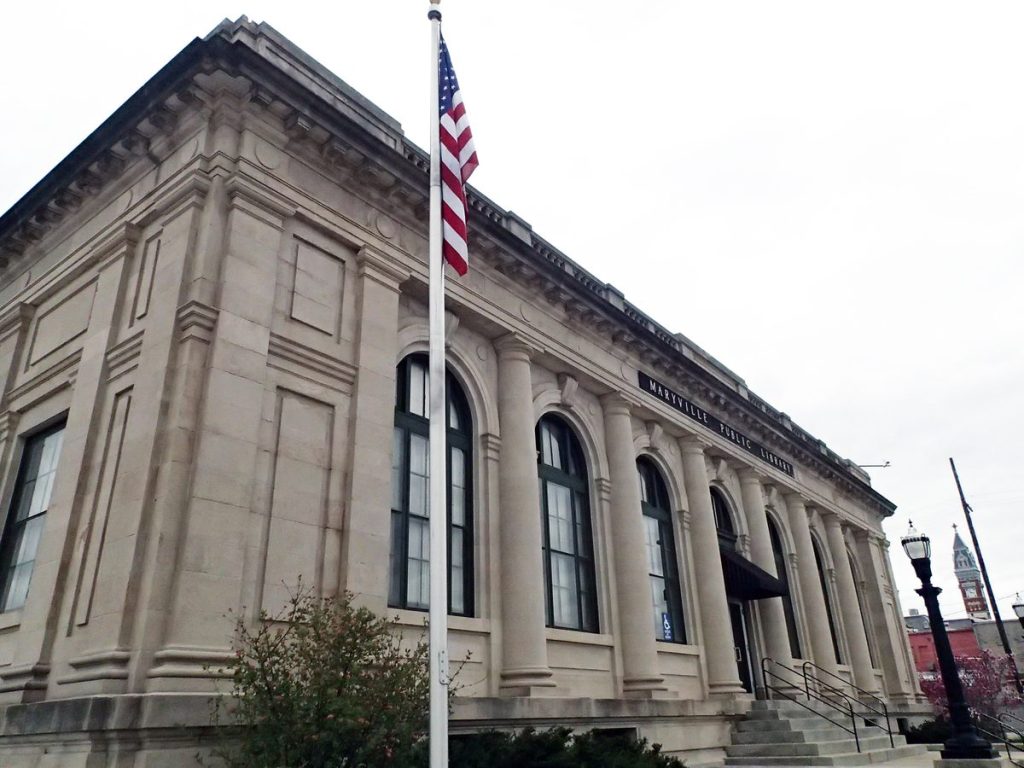
On other fronts, voters passed a 12-cent per $100 of assessed valuation increase to the Maryville Public Library’s property tax levy by 941 votes to 366.
During a series of presentations leading up to Tuesday’s vote, Library Director Stephanie Patterson stated that the library had not received a levy increase since 1962, when voters set the rate at 25 cents.
That ceiling was later lowered to 16 cents following adoption of Missouri’s tax-limiting Hancock Amendment, which ties government revenues and expenses to a percentage of personal income.
The ballot measure restores the 1962 rate and adds an additional 3 cents, bringing the total levy to 28 cents per $100 of assessed valuation.
Patterson said property taxes make up 85 percent of the library’s $278,000 annual budget, which she described as insufficient to cover anticipated roof replacement for an addition built on to the library’s main structure in 2000 and funded through private donations.
In 2016, the library re-roofed the original part of its building, a former post office, paying for the project with $68,000 taken from reserves.
Now that the tax hike has passed, it will add about $150,000 a year to the library’s total income, which also includes a small amount of state aid and occasional grants.
Had the measure failed, Patterson said, it is possible the library would have been forced to move to a smaller, less costly building.
A third tax measure on the municipal election ballot called for renewal of a 15-cent per $100 of assessed valuation property tax levied by Polk Township, a political subdivision that includes Maryville and extends across a square-shaped area reaching about five miles beyond all four sides of the city limits.
The proposal passed 1,044 votes to 371.
Polk Township’s primary responsibility is for the maintenance of rural gravel roads inside its borders. However, the county subdivision is also responsible for paved portions of Jade Road on the east side of Maryville and Icon Road to the west.
The levy, which produces around $200,000 a year, represents about a third of the township’s budget, most of the rest of which comes from state motor fuels taxes returned to Nodaway County by the Missouri Department of Revenue.
TONY BROWN/DAILY FORUM
The Maryville Public Library will likely stay in its current home, the former federal building and post office at the corner of Fifth and Main streets, following voter approval Tuesday of a property tax levy increase that will add about $150,000 a year to the library’s $278,000 budget. The tax hike raises the library’s levy 12 cents, from 16 cents to 28 cents per $100 of assessed valuation.