Elks donate deer hides in effort to aid vets
TONY BROWN/DAILY FORUM
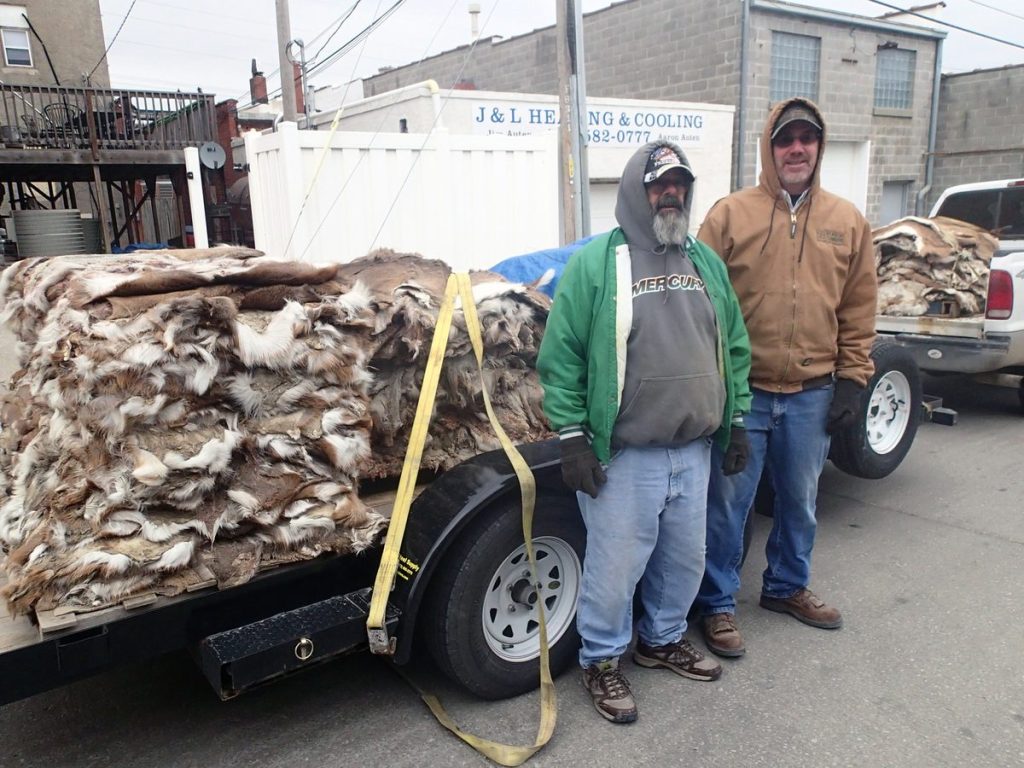
Chuck Mudge, left, state chairman of the Elks’ Veterans Leather Program, stands beside Maryville Lodge No. 760 Exalted Ruler John Nelson Thursday after the two men helped load more than 100 locally harvested deer hides onto a trailer that Mudge hauled to town behind his pickup truck. The hides will ultimately be turned into butter-soft leather and stitched into wheelchair gloves for use by disabled veterans nationwide.
Members of the Maryville Elks Lodge delivered on a promise to the nation’s veterans this week, handing over more than 100 salted, hair-on deer hides to Chuck Mudge of Perryville, state chairman of the Elks’ Veterans Leather Program.
The hides, harvested and donated by area hunters during the 2016-2017 season, will be transformed into supple, premium quality leather gloves for use by disabled veterans who must use their hands to manipulate wheelchairs.
At the beginning of the collection effort, Lodge No. 760 Exalted Ruler John Nelson said the local group hadn’t participated in the hide drive for several years, and that one of his goals after being elected to lead the 300-member organization was to put the program back on track.
Now that the local program has been successfully reestablished, Nelson said Thursday he wants to double the number of hides donated next fall and winter.
“This is the first really good year I’ve had up here,” said Mudge, referring to increased hide totals throughout the Missouri Elks’ Northwest District. “Several lodges have just started, and they’re doing really well.”
In addition to Maryville, the district embraces Elks groups in Brookfield, Cameron, Chillicothe, Excelsior Springs, Milan and Trenton, and Mudge said about half those lodges participated in the 2016-2017 drive.
Mudge, who also serves as a national vice president for the program, pulled into the parking lot adjoining the local lodge at 115 N. Main St. on Thursday morning with the bed of his pickup truck and a flatbed trailer already loaded with several stacks of hides.
Lodge 760’s contribution had been placed on a skid and was lifted onto the trailer using a small loader.
Besides Maryville, Mudge’s collection tour this week included stops in Cameron, Milan, Excelsior Springs, Mexico, Louisiana, Columbia and Warrensburg.
Mudge said he expects Missouri — traditionally one of the program’s leaders — to contribute about 5,000 hides this year. Once gathered, the scraped, folded, and salt-impregnated skins are shipped to tanneries where they are de-haired and processed.
The finished leather is then transported once again to a factory, which cuts, trims and sews the creamy, butter-colored material into both fingerless and full-finger protective wheelchair gloves.
Mudge said it requires about 3 square feet of deerskin to make a pair of gloves, and that on average only two pairs can be made from each hide.
In 2015-2016, participating lodges in 17 states collected more than 17,000 hides, which were turned into gloves for nearly 3,000 disabled veterans, including about 70 from Missouri.
Another 27,000 square feet of leather donated by the Elks was used to supply free craft kits distributed to recovering veterans in care centers and hospitals.
One of the most challenging parts of the program is prepping the newly harvested hides so that they can be stored for several weeks without spoiling.
This requires local Elks Lodge members to examine each hide after the hunter brings it in and scrape off any remaining fat or flesh. The skin is then cured with salt and folded with the deer hair facing out.
It’s a messy, greasy, time-consuming task, but is the only part of the process carried out at the lodge level. All tanning, manufacturing, and distribution costs are covered by the Elks’ National Foundation.
Established as “Gloves for Wheelchair Veterans,” the Veterans Leather Program dates back to 1948 when Elk Lodges in California launched a hide-gathering program in that state.
Sixty-nine years later, Elks officials say, the federal government still does not budget funds for leather wheelchair gloves for residents and patients in veterans’ homes and hospitals.
“While there is a committee of Elks on the job, therapists will never experience a shortage of leather,” the Elks National Veterans Service Commission has pledged.