Relay for Life keeps cancer on the run
TONY BROWN/DAILY FORUM
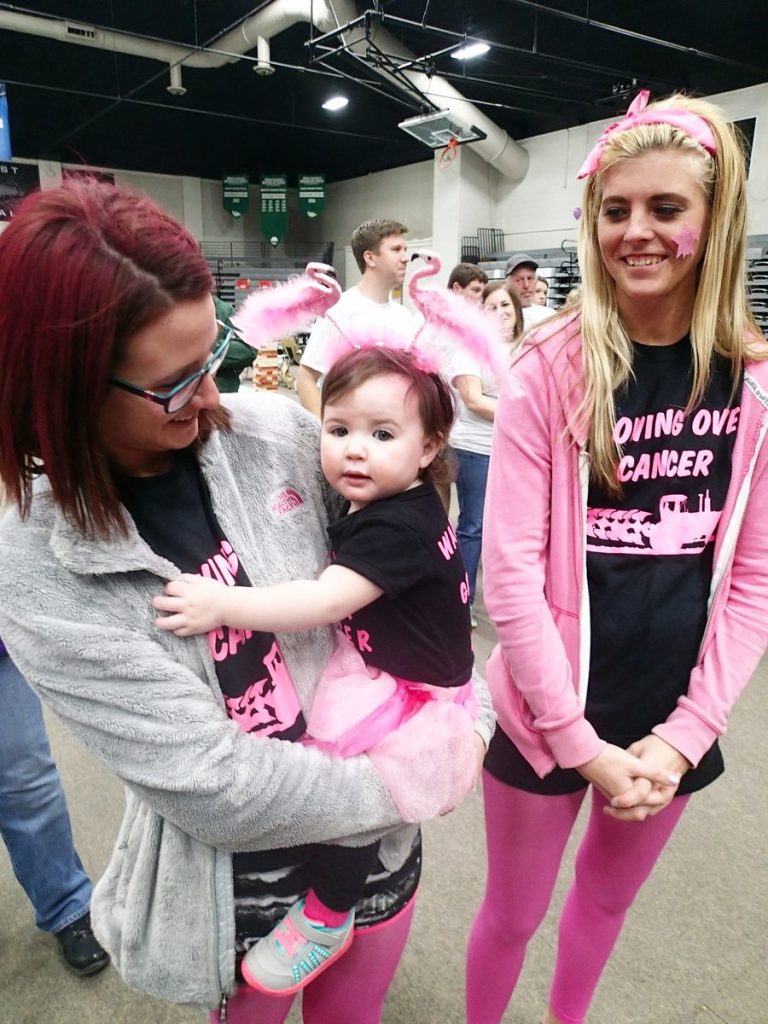
Nikki Owens holds Ashton Heinen, age 1, during Saturday’s Relay for Life, an American Cancer Society fundraiser at Bearcat Arena. Members of the Owens, Heinen, and Sockrider families attended the relay in support of their aunt, grandmother, and great-grandmother Carol Sockrider, a 25-year breast cancer survivor. Most of the clan wore bright purple-pink tights and T-shirts that read “plowing over cancer.”
The lucky, the grateful, the spared, the caring, the healed and the hopeful — people with some of the most-proven hearts and deepest souls in Maryville — gathered in Bearcat Arena Saturday for the 26th annual Relay for Life, a fundraising event for the American Cancer Society.
The gathering, always a mixture of whimsical humor, deep sadness, easy camaraderie, and inspiring emotion, brings together about the most disparate group of people one can imagine: young and old, rich and poor, college educated and school-of-hard-knocks.
But almost all have at least a few things in common — experience as a cancer survivor, the loss of a loved one to a merciless disease, long days and endless nights spent doing the emotionally and physically draining work of a caregiver, and, increasingly often, the memory of that lighter-than-air moment when someone in a white lab coat looks into your eyes, smiles a little, and says the magic words “cancer free.”
Perhaps more than any other public ritual in this little college town, the Relay for Life is about simple gratitude — gratitude mixed with a deep, abiding hatred for a disease that has taken so much from so many.
And it is a day, above all, for families, like the Sockrider-Owens-Heinen clan, which showed up in lurid purplish pink tights and black T-shirts blazoned with a pink image of a tractor beneath the phrase “plowing over cancer.”
The family, one of 13 teams who sold pizza, brownies, cupcakes, cookies and other treats throughout the 12-hour marathon fundraiser, was there to support their grandmother, mother, great-grandmother and aunt, Carol Sockrider, a cancer survivor for the past 25 years.
“We’ve got to beat cancer somehow,” Sockrider said. “I’ve got daughters, granddaughters and great-granddaughters, and I don’t want them to have to go through what I did.”
Relay for Life is a national undertaking, and hundreds of similar events take place each year from coast to coast. But the society’s Maggie Hubbard, who helps organize several relays each year, says Maryville’s day dedicated to cancer survivors has a special place in her heart.
“This is my favorite one,” Hubbard said. “The college students really get behind it, and the kids keep it fun and exciting. Also, the community is just awesome and really supports the cause.”
Last year’s Maryville relay raised more than $30,000 for cancer research and support programs for patients and caregivers. That number will likely decline a bit in 2017 because most Northwest Missouri State University students have gone home — or to some welcoming Southern beach — for spring break.
But not all of them.
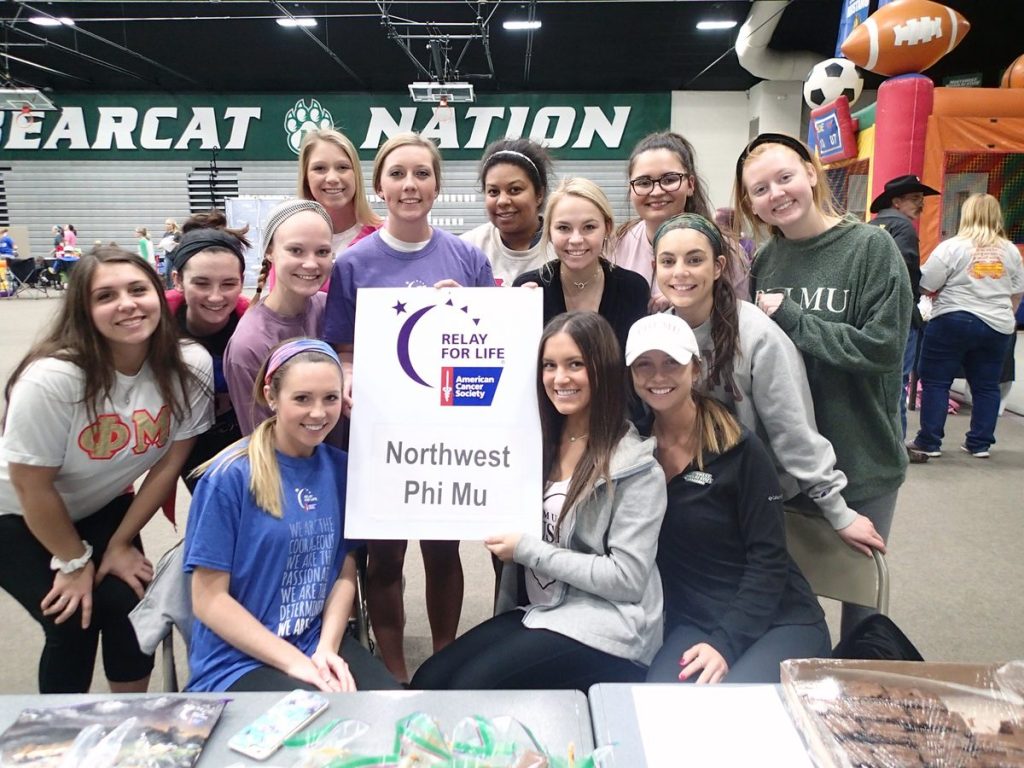
A group of 13 Phi Mu sorority sisters were on hand to sell sweet treats and take turns walking around the arena track in a traditional show of solidarity with cancer patients, survivors, caregivers and families.
Phi Mu sister Katie Sears was among those attending the event. The Northwest marketing major from St. Joseph lost a grandmother to cancer, has another grandmother who is now cancer free, and a step-grandmother currently in remission.
Asked why she wasn’t in Texas or Florida soaking up the sun, Sears quickly replied, “This is more important.”
Also attending the relay was Maryville native Anna Summa, a two-time cancer survivor who said the society’s Hope Lodge in downtown Kansas City very probably saved her life.
Hope Lodge is a hotel-like facility that gives cancer patients and their caregiver a place to live while undergoing outpatient therapy at hospitals in the metropolitan area.
Summa said she and her husband, Kent, handled her first bout with cancer fairly well, but that the second diagnosis five years later, a rare type of leukemia, turned into a very rough road.
“It was very aggressive and came on very quickly,” Summa said. “I thought I was coming down with the flu on Friday, and then on Monday my oncologist told me that if I didn’t get better in a couple of days I wouldn’t be here anymore.”
Summa ended up spending six months as an in-patient at North Kansas City Hospital, but the chemotherapy she received there precipitated a stroke, causing her to lose control of the left side of her body.
The only remaining treatment involved arsenic trioxide, a regimen that Summa’s insurance would not cover if she was an in-patient.
Shuttling back and forth to Kansas City for treatment was a “logistical nightmare,” Summa said, so the family called the American Cancer Society hotline and was advised to make arrangements with Hope Lodge.
“I lived there with my mother, who was my caregiver, for six months and it never cost a dime,” Summa said. “And it was just a 10-minute drive away from my treatment.”
But more than easing the financial burden, Summa said Hope Lodge offered a supportive environment filled with resilience, perseverance and hope when such qualities were in short supply.
“You really go to war and battle this disease,” Summa said, “and then you have people there in the trenches with you.
Summa checked into Hope Lodge about the same time as four other critically ill patients. Today, she is the group’s only survivor. She recalled returning to the lodge after therapy feeling defeated and depressed, and then encountering someone who was even worse off.
“You were living with people who were going through similar things,” she said. “They would smile, they were encouraging. It was a support system like you would never find anywhere else.”
In remission for nearly three years, Summa grew emotional when talking about what the Maryville relay means both to survivors and families.
“It means so much to me, talking to these teams,” she said. “Every dollar really, really counts. These people are the reason people like me are still here. I’m incredibly proud of our community. Every dollar raised here today is going to help somebody.”
TONY BROWN/DAILY FORUM
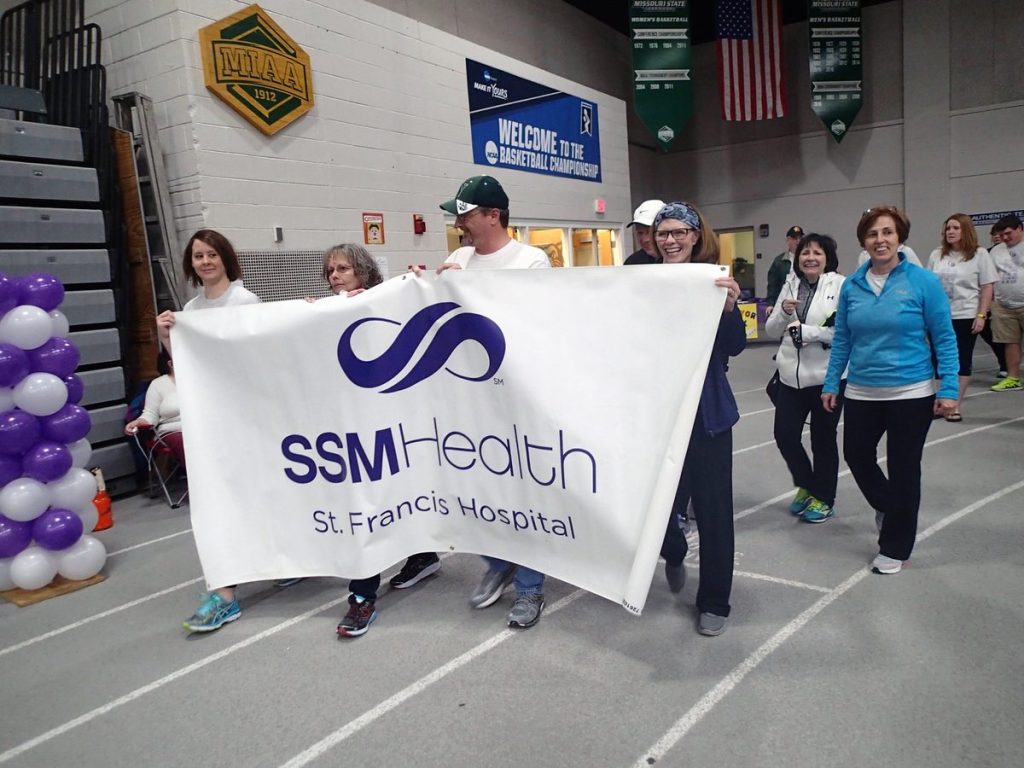
The SSM Health St. Francis Hospital team marches around the Bearcat Arena track during Saturday’s Relay for Life anti-cancer fundraiser. This was the 26th year for the event, which annually raises as much as $30,000 for cancer research and support services for patients and caregivers.
TONY BROWN/DAILY FORUM
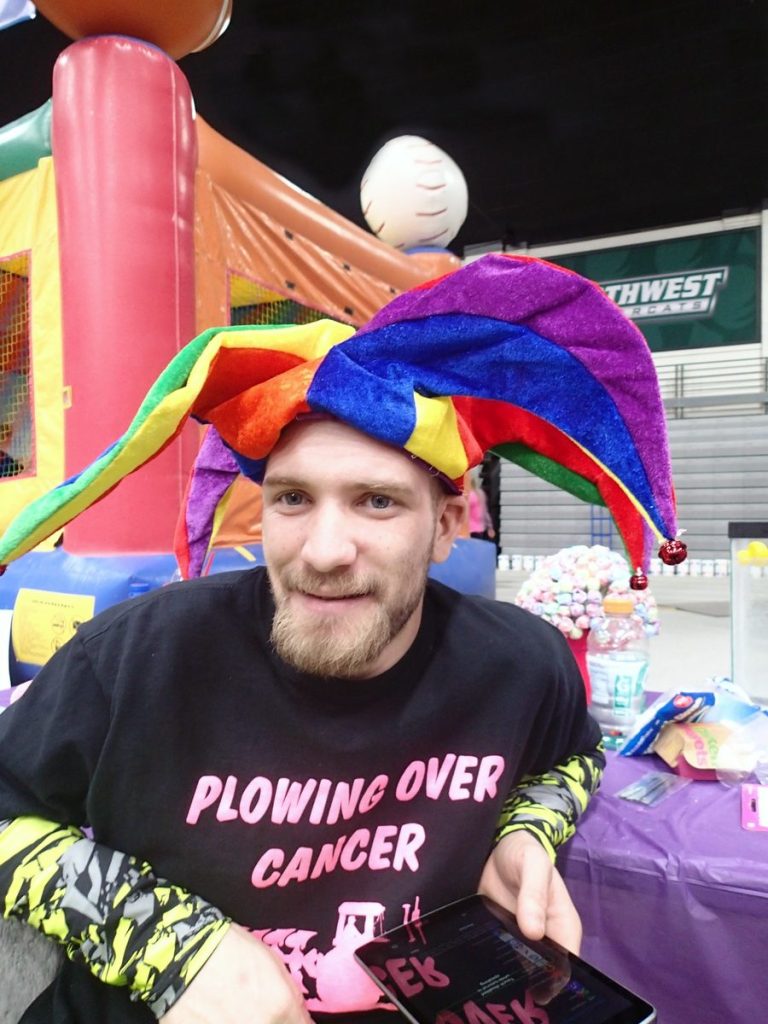
He may have looked like a court jester, but Brian Heinen was deadly serious about raising money for the American Cancer Society during Saturday’s Relay for Life. Heinen’s family team sold cupcakes and cookies during the 12-hour marathon fundraiser in addition to operating a bounce house and selling chances on a “rubber duck” drawing that offered candy as the prize.
TONY BROWN/DAILY FORUM
These Phi Mu sorority sisters from Northwest Missouri State University decided that giving back was more important than kicking back on the first day of spring break, when many of their classmates were headed for the beach. Instead, the group spent 12 hours selling snacks and walking around the track at Bearcat Arena to raise money for the American Cancer Society.
TONY BROWN/DAILY FORUM
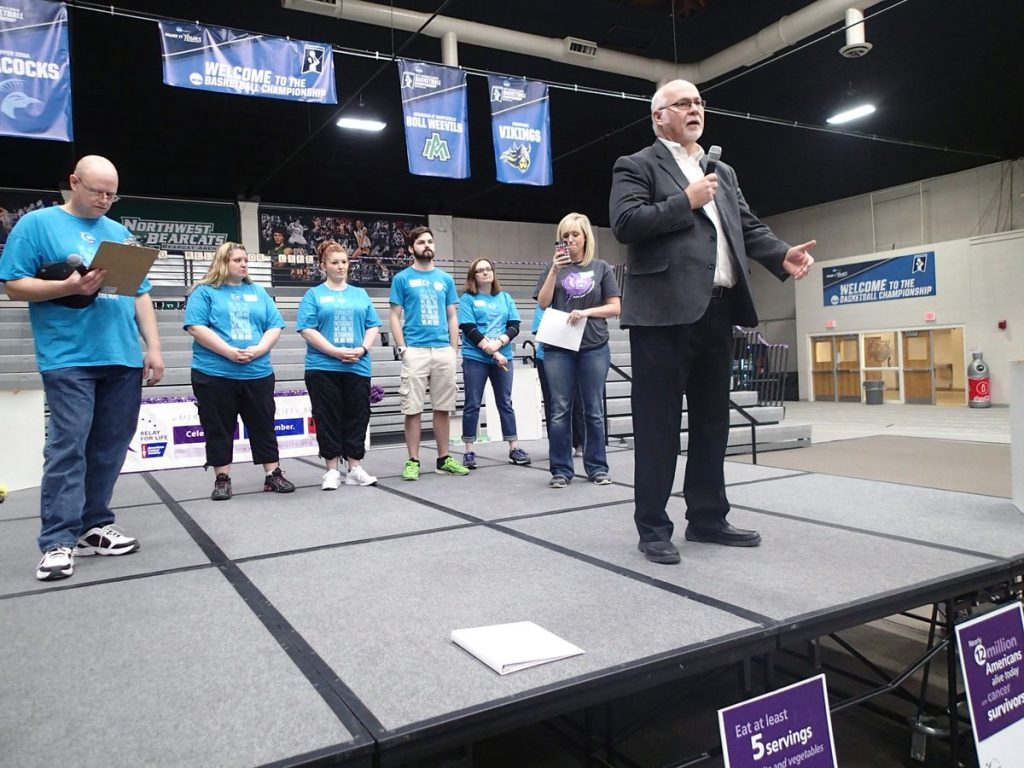
The Rev. Joe Ledbetter, pastor of the First Baptist Church of Maryville, offers an inspirational message during opening ceremonies at this year’s Relay for Life fundraiser for the American Cancer Society.