Students get a glimpse of government in action
TONY BROWN/STAFF WRITER
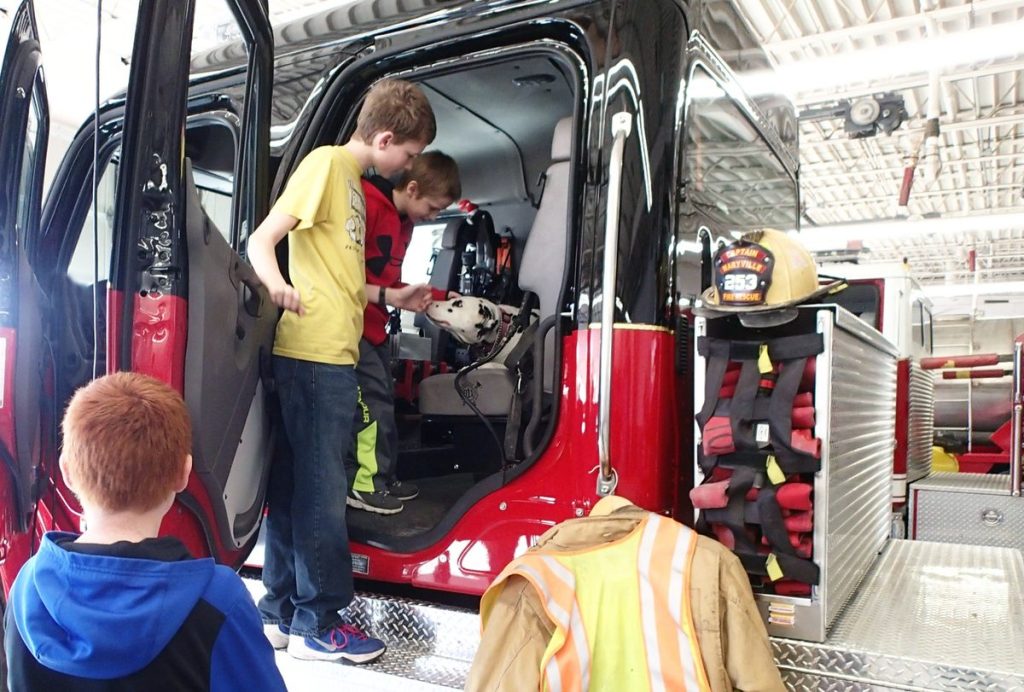
Students from the Jefferson and West Nodaway school districts greet Higbee, a Dalmatian who serves as the mascot for the Maryville Public Safety fire division. The group was among about 200 young people from schools across Nodaway County who participated this week in the American Legion’s annual County Government Day.
About 200 young people from seven Nodaway County schools spent much of Wednesday at the courthouse, County Administration Center, and Maryville Public Safety headquarters, where they acquired a first-hand glimpse of the workings of local government and the role of public service.
Held each year about this time, County Government Day is a tradition for area students. Most of the young participants are eighth graders, though schools occasionally send other grades as well.
Northeast Nodaway High School, for example, usually sends a class of sophomores studying U.S. and state government in their civics class.
The event has long been hosted by members of the American Legion and Legion auxiliaries. Organizers this year included Arlene Masters of the Maryville Post 100 Auxiliary and Catherine Auffert of Parnell.
Divided into groups, the students spent several hours rotating through three government buildings, where officeholders and other officials talked about their jobs and the various ways they strive to serve the public.
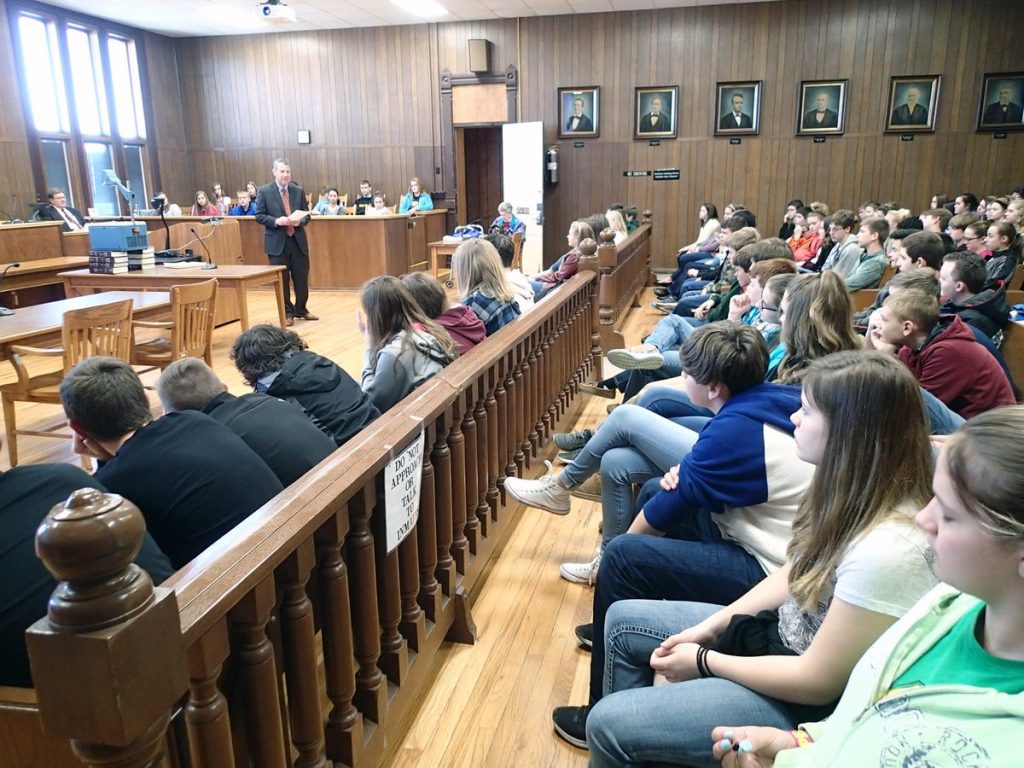
Much of the day was spent in the large upper-story courtroom in the courthouse, where Presiding Circuit Judge Roger Prokes and Associate Circuit Judge Doug Thomson spoke at length about the judicial system.
The two judges then guided students through a simulated trial during which a jury of 12 teens decided a hypothetical case involving the underage possession and consumption of alcohol.
Prior to the simulation, Thomson talked about how Missouri’s system of circuit courts operates, explaining how the Fourth Circuit embraces five counties: Nodaway, Atchison, Holt, Worth, and Gentry.
He continued that each circuit, including the Fourth, contains several divisions, each designed to deal with a range of cases ranging from felony and misdemeanor crimes, to civil actions, small claims, and probate matters involving estates, guardianships and conservatorships.
Thomson further described how attorneys petition the court to hear lawsuits, and summarized the process of discovery, depositions, and testimony that leads to the facts of a case being decided by a judge or a jury, who must then determine whether or not to award damages.
Turning to criminal cases, Thomson told his young audience how prosecuting attorneys file complaints alleging that a crime has been committed, and that urge him to issue an arrest warrant.
If the warrant is issued and an arrest is made, Thomson described how he and other judges set bond so that the accused can be released from custody. He added that he often imposes conditions on bond that, for example, require the accused and the defendant — especially in a case involving violence — not to meet or communicate until the case is resolved.
“That means no talking, no texts, and no Facebook,” Thomson said. “It means they have to stay away from each other until this thing is over.”
The judge explained that one key difference between civil and criminal cases is that in a lawsuit one citizen is alleging the loss of property or money as the result of a “mistake” made by the person being sued.
In a criminal proceeding, by way of contrast, the charge is filed on behalf of the people of the State of Missouri — not the victim. Other concepts addressed by Thomson and Prokes included the state’s burden of proof, reasonable doubt, and the presumption of innocence.
Toward the end of his talk, Thomson also made a case for the law as a profession, telling his young audience that “being an attorney in a rural practice is a great occupation.”
He added that there is a “tremendous need” for lawyers in small towns across the state, and that the demand for attorneys outside of Missouri’s big cities constitutes “a tremendous opportunity for young people.”
If, that is they are willing to pay a price.
The road to becoming a lawyer — finishing high school, four years of college, and three years of law school before taking the bar examination — might seem long to an eighth grader, Thomson said, but can be well worth the investment in time, effort, and money.
“I would urge you to keep going to school as long as you can,” he said. “Once you have an education, no one can ever take it away from you.”
After their courtroom session, the students attended similar, shorter, programs listening to presentations by the three-member County Commission, County Clerk Karen Leader, dispatch supervisor Jessica Sigman, Maryville Public Safety Officer Ian Myers, and fire division Capt. Phil Rickabaugh.
Schools participating in this year’s County Government Day events included Jefferson, South Nodaway, North Nodaway, Northeast Nodaway, West Nodaway, Maryville Middle School, and St. Gregory’s School.
TONY BROWN/DAILY FORUM
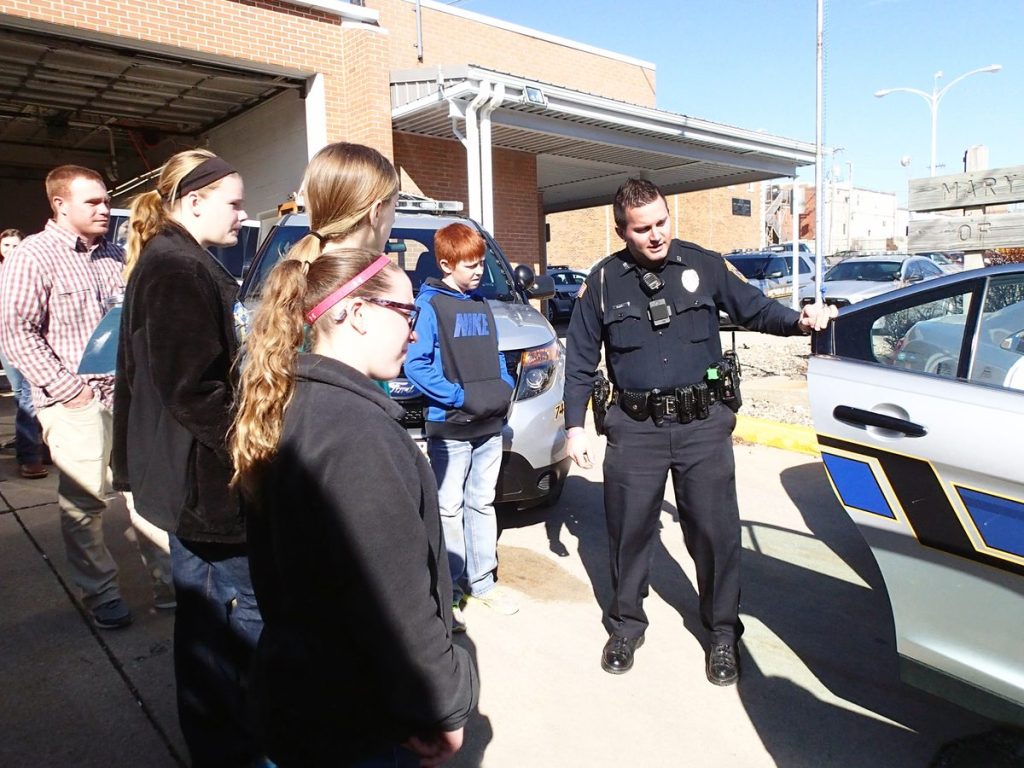
Maryville Public Safety Officer Ian Myers answers questions about one of the department’s patrol cars during County Government Day. The annual event introduces area students to the various functions of local government, including law enforcement, fire protection, the court system, and the administrative roles of various elected officials.
TONY BROWN/DAILY FORUM
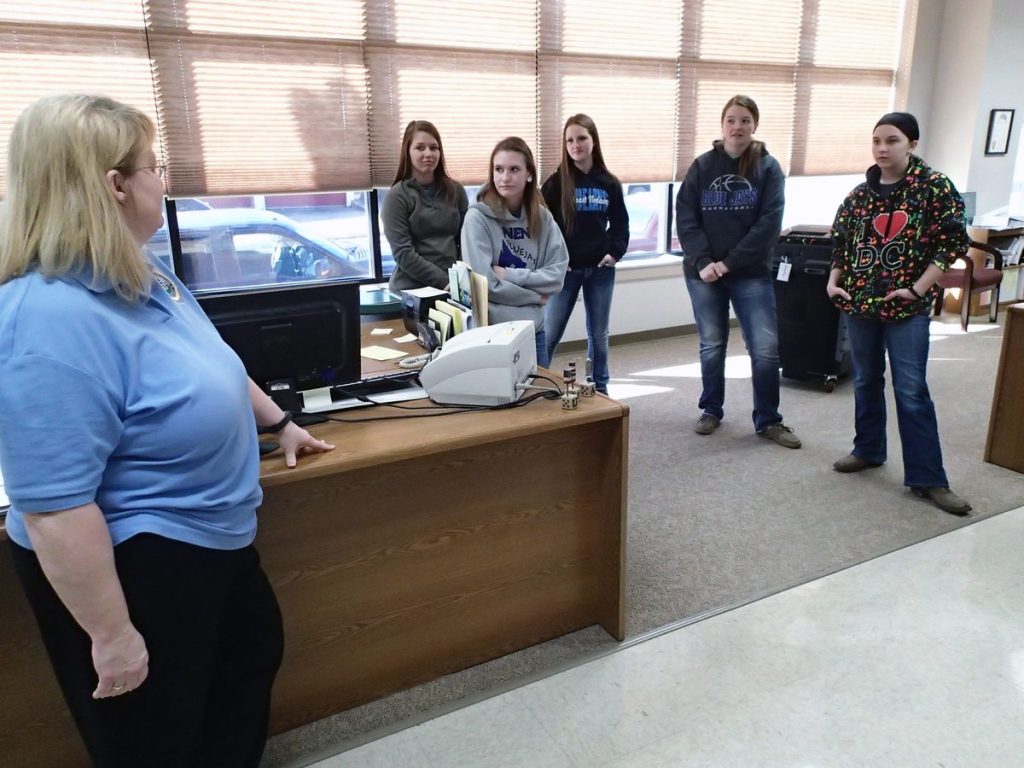
Nodaway County Clerk Karen Leader, left, talks to a group of Northeast Nodaway High School sophomores during one of several County Government Day sessions hosted by her office on Wednesday.
TONY BROWN/DAILY FORUM
Associate Circuit Judge Doug Thomson, standing at left, addresses more than 100 students from Maryville Middle School and St. Gregory’s School during a County Government Day presentation in the main courtroom on the second floor of the Nodaway County Courthouse. Thomson talked to the young people about how both civil and criminal cases move through the court system prior. He then helped conduct a simulated trail decided by a “jury” of 12 eighth graders.