Century-old bloom fades at Plant House
TONY BROWN/DAILY FORUM
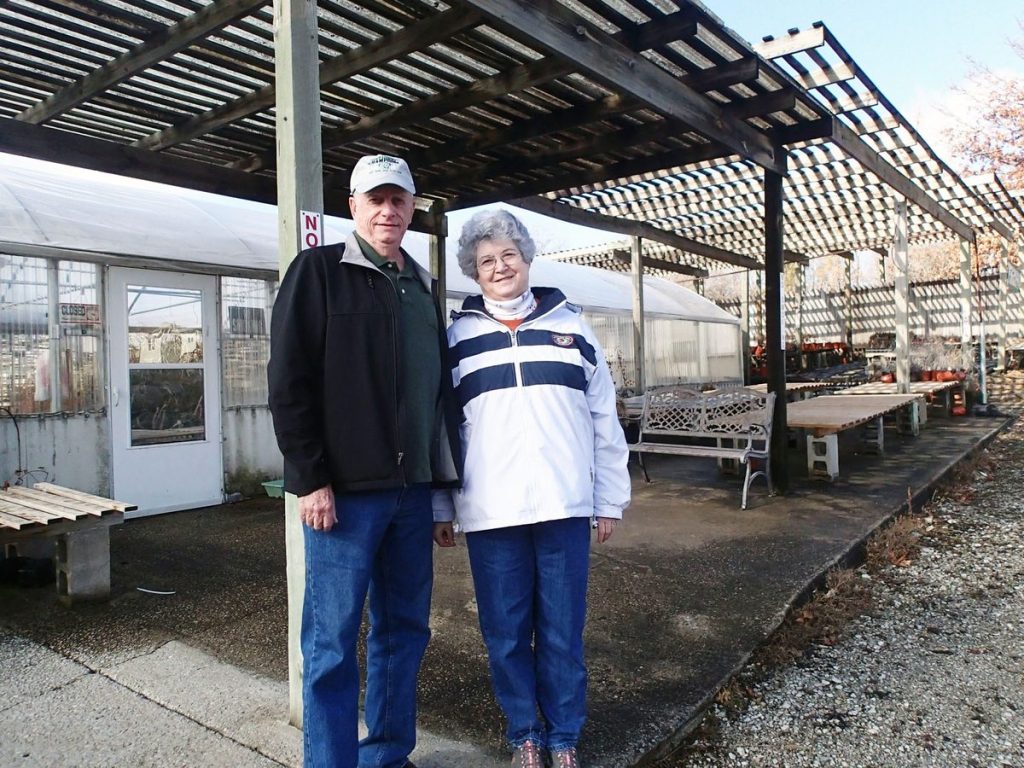
Rego and Winifred Jones stand in front of The Plant House, the now-closed greenhouse operation owned and managed by their family since 1966. Though “retiring” from the family business, Rego Jones plans to keep teaching horticulture at Northwest Missouri State University, and said he and Winifred will continue acting as “plant promoters” within the local gardening community.
When February’s chill gives way to the March wind this spring, and area gardeners begin to think about seeds and sprouts and the bounty of flowers and home-grown produce to come, one bit of gardening tradition will have disappeared in Nodaway County.
After just more than 100 years of operation — 50 of them under the ownership of the same family — The Plant House greenhouse has closed.
Owners Rego and Winifred Jones recently announced plans to shutter the business their family purchased in 1966.
Rego Jones’ parents bought the operation following the death of its founder, Royal Kuster, who began growing and selling plants and flowers north of Maryville on the east side of old Highway 71 — now North Main Street — in 1915.
The sole remaining business related to the Jones family’s various horticultural enterprises, which once included Maryville Florists and the Myers-Watson flower shop and greenhouse in St. Joseph, is the Plant Place, a retail shop and greenhouse in Cameron owned by Rego Jones’ sister.
Rego and Winfred sold Maryville Florists in 2003 to their former employee, Keitha Clapp, who continues to run the shop today at the same location at 214 N. Main St.
Standing inside their now-barren greenhouse on Saturday, the sun-dappled interior filled only with dried stalks, empty wooden platforms, and clay pots, the couple reflected on the business that has been the center of their lives since the early 1970s.
Rego Jones started working at The Plant House while still in high school, but after getting married in 1968, he and Winifred spent three years in Japan, where Rego served in the Air Force as a linguist-analyst.
While overseas, Rego — already leaning toward the idea of horticulture as a profession — got the chance to spend time at the renowned the Kyoto Botanical Garden, one of the premier plant conservatories in the world.
After returning to Maryville in 1972, the couple joined Rego’s parents, the late Harold and Evonne Jones, at The Plant House, and the young veteran went back to school, earning undergraduate and graduate degrees in chemistry/biology and biology at Northwest Missouri State University.
Those were good years, the couple recalled — filled with the challenges and rewards of growing both a business and a family. Shortly after buying the business, Harold and Evonne moved the operation to the west side of the highway, and eventually built a total of 12 greenhouses there.
Change was a constant, Rego recalled, as glass greenhouses gave way to fiberglass then various kinds of plastic. Heating fuels, potting media, and containers continued to evolve as well.
Serving both wholesale and retail customers, The Plant House started out offering a dozen or so varieties, a number that soon grew into the thousands, with millions of individual plants, seedlings, and sprouts sold each year.
With a huge inventory of flowers, vegetables, perennials, and shrubs, The Plant House became a one-stop shop for gardeners of all stripes throughout the region, and by 1980 had become a largely retail enterprise
Winifred recalled that working in the greenhouse was both fun and fulfilling.
“I enjoyed meeting all the people and helping the customers,” she said. “The planting and transplanting were nice. And in the winter, it was always green here, and warm if the sun was out, like being in the tropics.”
In addition to accepting a growing role on the business side of the family enterprise as it expanded and opened new locations, Rego Jones retained his passion for learning the science behind how plants reproduce and grow.
After finishing up his master’s degree at Northwest, Jones joined the agriculture faculty as a part-time instructor. His combination of academic training and thousands of hours of hands-on experience made him a natural both in the classroom and in the field, and he was soon asked to teach full time.
Now a senior instructor with Northwest’s newly reorganized and rapidly growing School of Agricultural Sciences, Jones teaches a variety of courses on such topics as plant propagation, landscape design, greenhouse crop production, and plant disease.
He also sits on the board of Lettuce Dream, a local non-profit that recently completed two hydroponic greenhouses on the east side of Maryville. Lettuce Dream, which went into production last year, has the stated goal of providing vocational training opportunities to people with developmental and cognitive disabilities.
Jones, who has no intention of retiring from the university, said the decision to let go of the family business was tough to make, but that the time had come for the couple to slow down a little and concentrate on other priorities, like traveling and spending more time with grandchildren.
“People depend on us, and I hate to see them have to go somewhere else,” Jones said of what was Maryville’s only commercial greenhouse operation.
Still, he said, he and Winifred plan to stay in Maryville and continue acting as “plant promoters” within the local gardening community.
Despite the decision to close, Rego noted that 2016, The Plant House’s 50th year under Jones family ownership, was one of the business’ most successful in terms of both product mix and customer response.
“It’s nice to go out on top,” he said
Jones added that now is an exciting time to be a gardener, and that he has seen a resurgence in horticultural pursuits, especially among young people who want to grow their own food using organic, chemical-free methods.
“Everybody likes to get outdoors and dig in the dirt,” Jones said.