Council ponders future of lake camp, signage policy
TONY BROWN/DAILY FORUM
A low occupancy rate and possible new marketing strategies for the group camp at Mozingo Lake Recreation Park were among topics discussed during what amounted to a “visioning” session this week by the Maryville City Council. Other proposals — all in preliminary stages — included rezoning for a portion of the Campus Town neighborhood east of Northwest Missouri State University and a possible overhaul of the city’s signage ordinance.
With priorities set and the budget passed for the 2017 fiscal year, the Maryville City Council this week took time out to strap on its vision goggles and consider future initiatives.
None of the discussion during Wednesday’s regular session — pushed back a couple of days due to the Christmas holiday — involved proposed ordinances or even definite plans.
Rather, the council mostly sat and listened as City Manager Greg McDanel and Assistant City Manager Ryan Heiland offered broad overviews of several issues that the governing board will now ponder in preparation for decisions to be made later on.
Discussion items on the agenda included possible steps for raising the profile and occupancy rate of the group camping facility at Mozingo Lake Recreation Park, potential rezoning within the Campus Town special overlay district to the east of Northwest Missouri State University, and the possibility of updated policies and regulations governing the use of commercial signage.
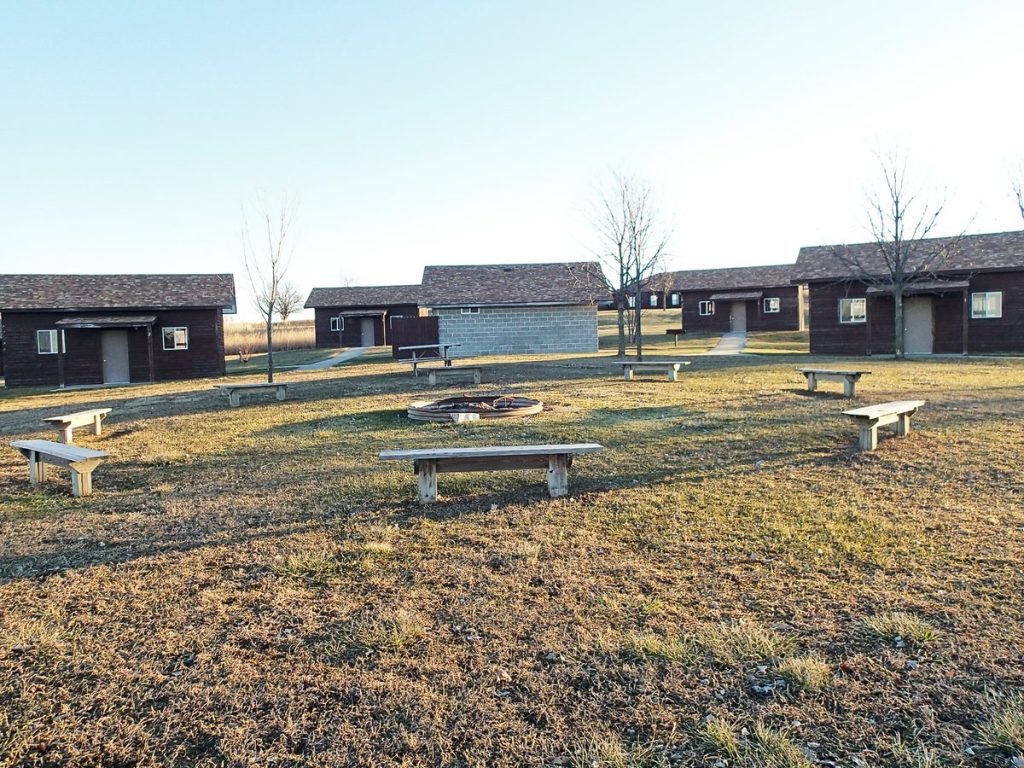
In bringing up the Mozingo group camp, McDanel and Heiland both suggested that the facility, which consists of five heated and air-conditioned cabins, a bathhouse, and a large multipurpose building equipped with a commercial-grade kitchen, is underused.
Heiland said the occupancy rate for both cabins and the multipurpose building is around 15 percent, and that booking is problematic due to an existing policy stating that youth groups can “bump” other organizations until six months prior to a scheduled event at the camp, which can be reserved up to a year in advance.
In addition, Heiland said policies governing camp use are unclear or problematic in a number of areas.
Among other things, the lakeside park’s other rental cabins must be booked before families and individuals can reserve group camp cabins. Also, alcohol, while allowed in the multipurpose building, is prohibited in the cabins themselves. Thirdly, Heiland said, no policies exist governing special events.
Though he recommended no specific changes, Heiland said it may be time for city staff to start considering ways to increase occupancy while still providing incentives that encourage use of the camp by youth organizations, which has always been its stated purpose.
“There may be ways to open it up more to a wider range of people,” Heiland said. “It would be great if more people were using that part of Mozingo.”
While the camp has always been rented out by various Scout and church groups, in recent years it has attracted a number of adult-oriented organizations and events, including the Bird Hunters United field trials, which attract championship-caliber upland game hunters from several Midwestern and Western states.
McDanel said that with some policy tweaks and improved marketing he believes the group camp could be far better utilized than is presently the case. He added that raising the camp’s profile might also boost revenues.
The city manager suggested that the city needs to “separate ourselves from what is not working” by adopting policies that appeal to all groups but keeping prices as low as possible for youth organizations.
He added that the council might want to consider implementing group camp changes on a pilot basis for a year or so, which would leave the board free to alter or get rid of any procedures or regulations that prove unsatisfactory.
As it now exists, the group camp can accommodate 64 campers and up to 100 people during meals or events in the multipurpose building. The compound also embraces a fire-ring, tent-camping area, shelter house, and views of the lake.
Even so, McDanel said the compound lacks the amenities to compete as a youth camp against other area facilities, such as Camp Geiger, a Boy Scouts of America facility near St. Joseph that each summer serves hundreds of young people from several states.
With that in mind, McDanel recommended that the council seek a “middle ground” for the Mozingo camp that balances the needs of area youth while maximizing occupancy rates.
Moving on to the Campus Town overlay district, the council heard a proposal for possible rezoning of a two-block-wide strip between Walnut and Fillmore streets east of the Northwest campus, which is currently zoned R-2, a designation that prohibits duplexes.
McDanel told the council that the strip, which divides higher-density areas to the east and west, contains mostly rental homes, and that the current zoning designation discourages new development in the area.
The Campus Town overlay was created in 2012 and designated in the city’s comprehensive plan as an area suitable for “infill and redevelopment” in the form of higher-density rental housing. That goal was furthered by creation of the Campus Town Redevelopment Incentive Program, which waives debris disposal charges and construction fees for developers who tear down old houses and replace them with new residential structures.
McDanel asked the council for permission to contact residents living in a portion of the R-2 strip between Sixth and Seventh streets in order to gauge the level of support for, or opposition to, possible rezoning to R-2M, which would permit duplexes but exclude multi-unit apartment complexes.
If residents oppose the change, he said, it is unlikely the city would try to proceed. The existing R-2-zoned strip in its entirety stretches north to south from Twelfth to Second streets.
Finally, the council was asked to consider a possible overhaul of the city’s sign ordinance, which McDanel said is characterized by “a lack of consistency and direction.”
McDanel and Heiland both said numerous abandoned or damaged signs exist in Maryville, and that any new regulations would likely address those problems. Other issues include the growing number of temporary signs and signs geographically separated from the businesses they advertise.
During the presentation, the two city administrators emphasized that undamaged signage for existing businesses would be allowed to remain, but that any new signs or replacements would be subject to the new regulations, which have yet to be written.
McDanel said he envisions any signage effort as “more partnership and less enforcement” and proposed a “sign grant” line item in the municipal budget that would provide eligible business owners with funds for improvements.
“The idea is not to limit the creativity of a business in marketing its products, but putting that in a frame that reflects what you want for the community,” he said.
TONY BROWN/DAILY FORUM
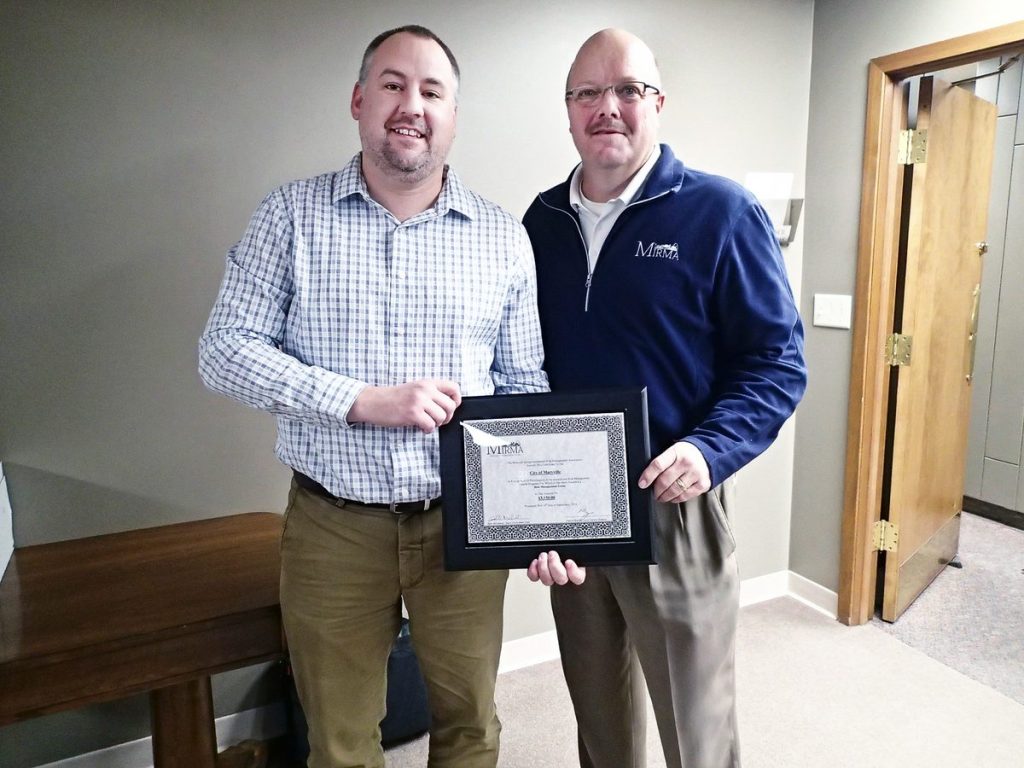
Maryville Mayor Jason McDowell, left, accepts a plaque from Jeff Arp of the Missouri Intergovernmental Risk Management Association. The plaque symbolizes a $3,150 MIRMA risk-management grant that Maryville Public Safety will use to purchase a new dash-mounted patrol car camera. MIRMA regularly issues such grants in an effort to reduce risks faced by police officers, firefighters, and other personnel serving its member cities.