County, city positions harden in tax dispute
TONY BROWN/DAILY FORUM
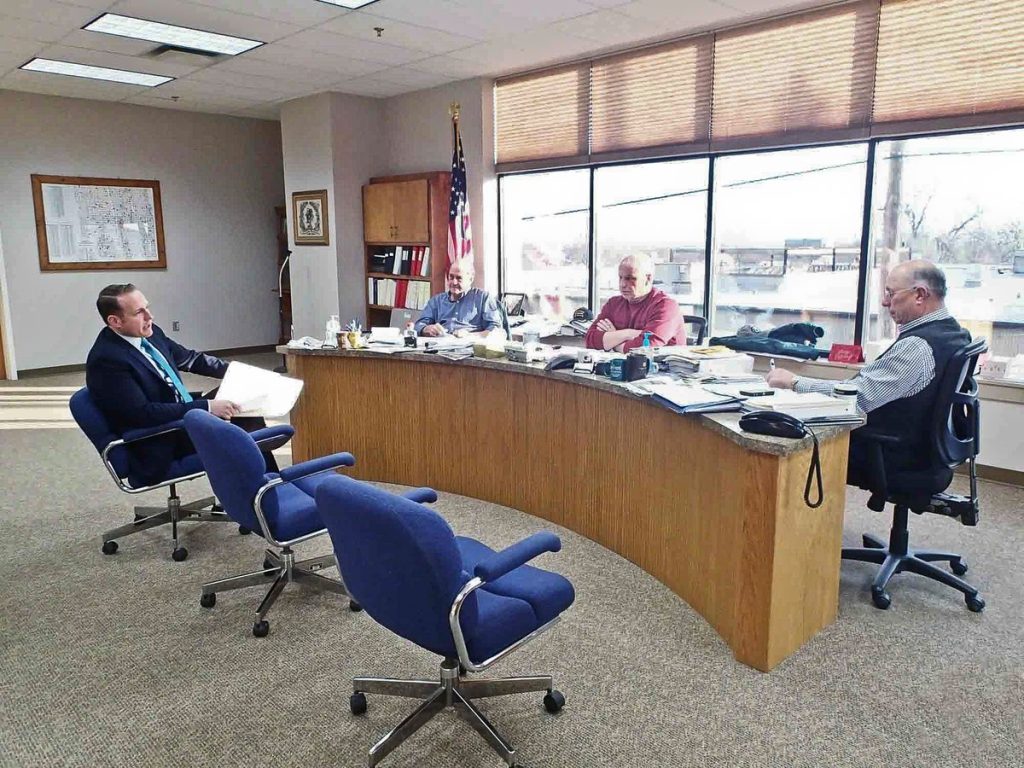
Maryville City Manager Greg McDanel, left, is shown meeting with the Nodaway County Commission on Wednesday during a discussion in which the governing board, on the recommendation of Prosecuting Attorney Robert Rice, declared it would decline to divert a portion of road gravel sales tax toward repayment of tax increment financing debt. McDanel told the commissioners that the diversion is required under state law, and that the county would start receiving bills as of January 2017.
Maryville City Manager Greg McDanel and the three-member Nodaway County Commission met Wednesday for the second time in two weeks to discuss a city-county dispute over the proposed use of a portion of road gravel sales tax revenues to pay off municipal debt associated with a local tax increment financing district.
The city, which created the Town Center TIF district in 2005, claims that under state law a portion of the half-cent county sales tax, approved by voters in April 2014, must be applied to the debt. Maryville borrowed the money in order to pay for infrastructure related to redevelopment of the Town Center retail complex, which is anchored by the Hy-Vee supermarket.
Following the first meeting between McDanel and the commission on Nov. 30, the commission made a consensus decision to withhold gravel tax revenues from the city pending investigation into the matter by Nodaway County Prosecuting Attorney Robert Rice.
On Wednesday, Rice informed both McDanel and the governing board that, in his opinion, the county should not use the gravel tax, which brings in around $950,000 a year, for any purpose other than the maintenance of rural roads and bridges, and that to do so would be a violation of county ordinance.
The prosecutor dismissed the city’s contention that about $30,000 a year from gravel tax revenues must, under state statute, be used to pay off TIF debt as “their interpretation of the law.” He added that he has been unable to find “clear case law” supporting the city’s view.
Should the city decide to take the matter to court, apparently its only remaining option, Rice said his recommendation to the commission would be to “fight to protect the funding for our roads and bridges.”
For his part, McDanel pointed out that the city conducted its own review of the matter through Gilmore & Bell, a law practice specializing in municipal government, and that the firm’s findings support the city’s contention that it is owed a portion of what the tax brings in.
Rice responded that Gilmore & Bell’s position was merely “another attorney’s opinion” and in no way binding.
“There is not a case out there that says their attorney is right,” he said.
Whether or not the commission pays, McDanel said the city plans to begin submitting bills to the county next month.
And while the city manager indicated earlier that filing suit over the disputed funds might not be in the best interest of taxpayers, he said after Wednesday’s meeting that legal action remains a possibility.
McDanel said he was “disappointed” by the commission’s stance, and that the next step will likely be to place the matter before the City Council, which will make any decisions with regard to legal action.
As allowed under Missouri’s open meetings law, McDanel said that discussion will likely be conducted behind closed doors and in the presence of municipal counsel.
South District Commissioner Robert Stiens, who acts as the county’s lead official on road and bridge matters, said after the meeting with McDanel that he recognizes the gravel tax would never have passed in the first place without support from voters living inside the Maryville city limits.
“The city helped us pass that, and I don’t want to be too hard on the city,” said Steins, who nevertheless added that voters were clearly told “this money would only be used for gravel.”
The ballot language from 2014 bears that out, stating that any revenues would be used “solely for, and specifically to, the purpose of laying and maintaining road rock on all county gravel roads …”
However, the ordinance implementing the tax contains somewhat broader language and states that sales tax revenues can be expended on “road, highway, or bridge maintenance, repair, or construction on any road, highway, or bridge within Nodaway County, Missouri, by majority vote of the Nodaway County Commission.”
Stiens said Wednesday that in his view the intent of the ordinance is that gravel tax funds be spent solely for maintaining unpaved roads located outside Maryville and the county’s other incorporated towns.
The county has been aware of the Town Center TIF requirements from the start, and a fraction of the revenue from two other half-cent sales taxes used to fund general county government operations has been diverted for TIF debt service since 2005.
City Hall’s position is that the gravel tax falls under the same obligation.
State law would seem to support that view, and states that a portion of sales taxes collected inside the TIF district on behalf of participating entities must be diverted in order to repay debt incurred to finance redevelopment.
However, the Missouri Legislature complicated the matter by passing an exception to the TIF formula that exempted “economic activity” sales taxes as of August 2014.
Voters approved the gravel tax in April 2014, prior to the exemption. But the tax was not implemented until Oct. 2014, which — along with the limiting ballot and ordinance language — is the reason the commissioners believe the revenue is off limits.
TIFs work by freezing property taxes in blighted areas at a pre-development level and allowing cities to borrow against the “tax increment,” that is the difference between the district’s “blighted” assessment and its enhanced valuation once redevelopment work is carried out and the debt paid off.
In creating the Town Center TIF 16 years ago, the city borrowed $2.5 million for infrastructure improvements related to rejuvenating an aging retail area near the corner of South Main and South Avenue. The debt was refinanced at $1.7 million last year, meaning that what was a 20-year obligation will now likely be paid off in 2023 or 2024.
If the county did hand over a portion of the gravel tax in each of the next seven years, those payments would total a little more than $200,000.
McDanel said earlier that it is in the city’s and county’s best interest to pay off the TIF debt as soon as possible, since depreciation could lower the property’s assessed value as time goes on. He went on to say that restoring the TIF district to full assessment would produce additional property tax revenue benefitting the city, county, and Maryville R-II schools.