
Lawmakers see mandate for GOP agenda
TONY BROWN/DAILY FORUM
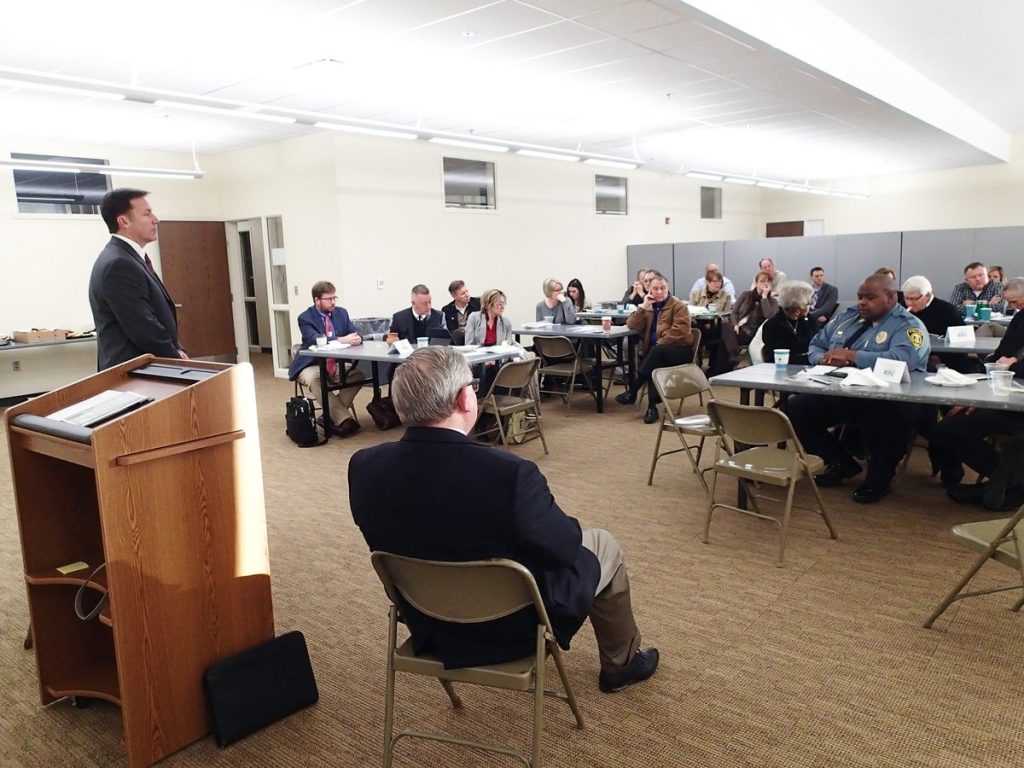
State Rep. Allen Andrews, left, and state Sen. Dan Hegeman, seated to Andrews’ right, address local business, civic, and education leaders Thursday during the Greater Maryville Chamber of Commerce’s annual pre-session legislative breakfast. Both lawmakers said a Republican governor and GOP supermajorities in both houses of the General Assembly make it likely that pro-business legislation with regard to right-to-work, tort reform, and other issues may well become law after the Legislature returns to work in January.
“It’s exciting,” said state Rep. Allen Andrews Thursday at the start of the Greater Maryville Chamber of Commerce’s pre-session legislative breakfast on the campus of Northwest Missouri State University.
Andrews, whose 1st District includes Nodaway County, was talking about the anticipation many of Missouri’s Republican lawmakers feel heading into the 2017 session, which begins Jan. 4. The GOP has supermajorities in both the House of Representative and the Senate and a Republican governor for the first time in eight years.
But a political “trifecta” in Jefferson City, Andrews was quick to add, heightens the pressure on the General Assembly to get things done.
Failure to move forward on a number of fronts, including right-to-work, tort reform, Medicaid, education, and environmental deregulation, he said, could and should lead voters to hold legislators responsible if they are unable to turn a big portion of the state Republican agenda into law.
“We have no excuses for not getting good things done,” said Andrews, who was joined at the annual gathering of local business and civic leaders by Sen. Dan Hegeman, a fellow Republican who represents the 12th District.
Preparing to begin his second two-year term in the House, Andrews said there is a feeling among GOP lawmakers that a “fresh fire” is moving through the capital, and that lawmakers are in the mood to make things happen.
“What I’ve heard people say in the past is that ‘we’d be able to get this bill through if we had a Republican governor,” Andrews said. “Now we do.”
Hegeman said he, too, believes Republicans are eager to get down to business in 2017, but he added that some uncertainty remains as Gov.-elect Eric Greitens works to assemble his team during the transition process.
Those doubts aside, Hegeman said he is optimistic that “we can get some good reforms through the Legislature that have been languishing for the last few years,” including a bill or bills that would make it harder to sue businesses and corporations.
An unfriendly legal climate, Hegeman said, means Missouri has “not been an effective place” for business. The senator added that he wants to see legislation that will bring “some reasonableness back to the lawsuits out there and the judiciary.”
Right-to-work — legislation that would ban “closed shops” requiring employees to join a labor union — is another top priority, said Hegeman, who believes the lack of such a law makes Missouri unattractive to industry, especially smaller companies with payrolls consisting of 50 employees or so.
“They don’t even look at the state of Missouri,” Hegeman said of small to mid-size manufacturing operations, which he called precisely the kind of companies mostly likely to move to rural areas.
He added that he sees right-to-work as a personal liberty issue.
“Shouldn’t an employee have a right to decide if they belong to a union or not?” Hegeman asked, adding that he wants unions to operate more like the livestock, dairy, and row crop associations farmers join voluntarily in order to lobby lawmakers and strengthen markets.
Turning to Medicaid, Hegeman said the Legislature needs to look at ways to trim public healthcare costs, noting that Gov. Jay Nixon this week blocked nearly $43 million in Medicaid spending in order to balance the state budget in the face of lagging revenues.
The senator acknowledged that the Medicaid question is tricky for rural areas, since reduced spending can mean less money for small-town hospitals.
One solution, Hegeman said, might be to rein in pharmaceutical costs by allowing the wider use of generic drugs to treat mental illnesses as well as physical maladies.
Moving on to education, Hegeman said he would like to see Missouri strengthen its career and technical education programs, many of which require only two years of post-secondary education rather than four.
He said he is sponsoring legislation that would allow school districts to use vocational/technical curriculums and skills assessments developed for industry-recognized certificates and credentials.
As for Andrews, who sits on the House Higher Education committee, the Grant City lawmaker warned that a number of GOP lawmakers appear hostile to new spending for state colleges and universities, and that he intends to be especially vigilant in protecting the interests of Northwest Missouri State University.
Andrews said “enhancing” the climate for higher education in Missouri is key to helping middle class families, whom he described as having suffered significant declines in both income and accumulated wealth since 2000.
Strengthening education at all levels, Andrews said, “has everything to do with the middle class” and the creation of a stronger, less-regulated economy in which “those capitalistic principles once again take hold.”
Both legislators criticized what they see as overregulation on the part of state and federal environmental agencies, and said they’re hoping Republican control in both Jefferson City and Washington, D.C., will lead to a “common sense” attitude with regard to restrictions on development and heightened requirements for water and wastewater treatment.
“We’ve gone beyond where we need to be and continue to raise the bar,” Hegeman said of clean water rules handed down by both the U.S. Environmental Protection Agency and the state Department of Natural Resources. “It’s become a tremendous burden on our small communities, the Burlington Junctions and the Barnards and the Gentrys.
“The regulations need to be pushed back down to a reasonable standard that we can afford to do.”
Andrews said he recognized that government needs to protect the environment, but agreed with Hegeman that current rules are too stringent.
“Regulations are a good thing,” he said. “They provide for order, safety, and security. But we have a climate of overregulation.”
On other fronts, Hegeman commented on proposals to roll back state unemployment benefits and voiced support for making it easier for businesses to deny benefits to workers who are fired for cause.
One approach, he said, would be to tie the length of benefits eligibility to the jobless rate, meaning that benefits would be extended during periods of high unemployment and cut back as the economy improves.
In one of the more novel statements made by either lawmaker, Andrews, who sits on the House Corrections Committee, suggested boosting the state Department of Corrections budget — especially with regard to prison guard salaries — by putting inmates serving time for non-violent crimes to work in manufacturing plants.
Andrews proposed an inmate wage of $5 an hour, $1 of which the prisoner would keep with the remaining $4 dollars going to DOC. Furthermore, each day an inmate worked would reduce his or her sentence by one day in an effort to emphasize “rehabilitation, not incarceration” as a core goal of Missouri’s corrections system.
He characterized the plan as an alternative to higher taxes, and said similar “market-based solutions” should be sought for “everything in government.”
Andrews went on to say he envisioned a time in which a significant number of government institutions and facilities would operate as “profit centers.”
Steve Bratt, vice president and plant manager at the local Kawasaki Motors plant, said he proposed a similar scheme to Department of Corrections officials several years ago and was told it wasn’t feasible.
“It’s the system that won’t allow you to do it,” Bratt said.
In response to another comment from the audience with regard to finding new revenue for the state’s transportation system, especially farm-to-market roads and bridges, Hegeman said there are a number of proposals floating around the Capitol, but that nothing is likely to happen without a statewide vote.
In November, Missouri voters solidly defeated Proposition A, a proposal that would have phased in a 23-cent-per-pack cigarette tax increase over five years with the proceeds going for transportation infrastructure.
Hegeman said the most popular highways legislation at the moment appears to be a proposal for giving voters a chance to approve a 6-cent addition to Missouri’s existing 17-cents-a-gallon fuels tax, which has remained unchanged for 20 years.
TONY BROWN/DAILY FORUM
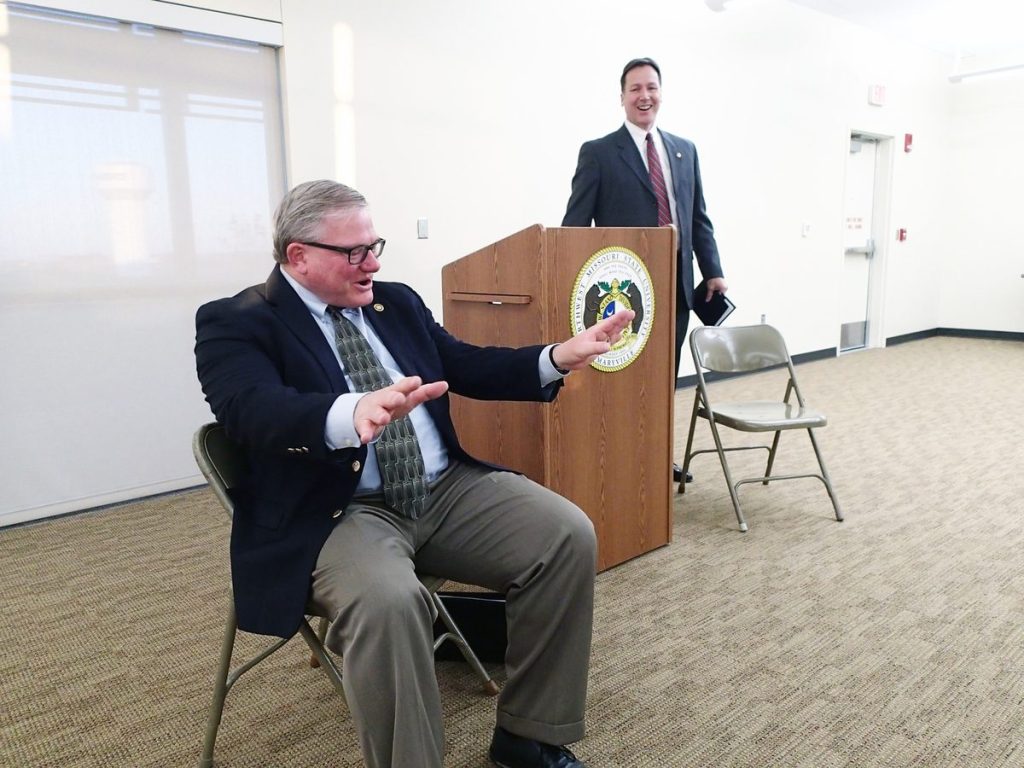
State Sen. Dan Hegeman, left, and state Rep. Allen Andrews react to a comment from the audience during the Greater Maryville Chamber of Commerce-hosted legislative breakfast Thursday at the Hubbard Center for Innovation and Entrepreneurship on the campus of Northwest Missouri State University.




