
Kander uses ‘Army voice’; calls for end to gridlock
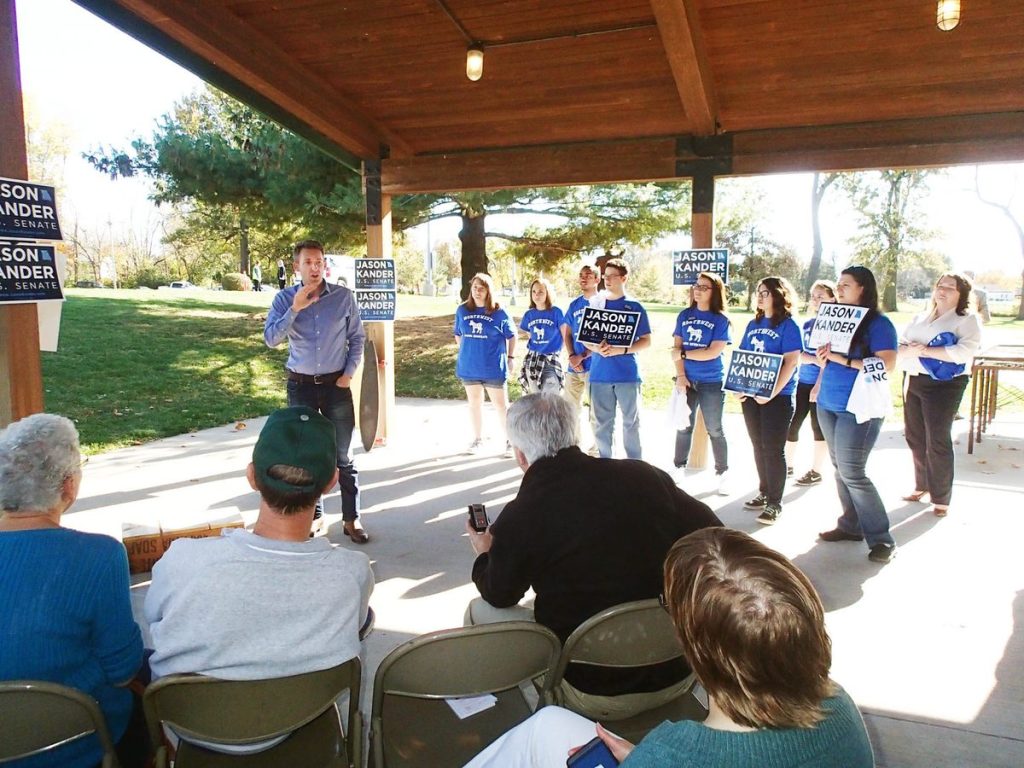
TONY BROWN/DAILY FORUM
Missouri Secretary of State Jason Kander, who is running for U.S. Senate in a close race against incumbent Roy Blunt, talks Thursday to students and other Maryville residents in College Park on the campus of Northwest Missouri State University. The Maryville stop — Kander’s second in Nodaway County during the campaign — was hosted by the university’s Young Democrats club.
Democratic U.S. Senate candidate Jason Kander, the youthful U.S. Army veteran who is running a dead-even contest against Republican incumbent Roy Blunt in one of the nation’s most closely watched races, made a second campaign stop in Maryville Thursday afternoon where he was greeted by an enthusiastic group of Northwest Missouri State University students and other local supporters.
Discarding a faulty wireless microphone, Kander, who is Missouri’s secretary of state, told the crowd at the Raymond J. Courter College Park Pavilion that he would simply use his “Army voice.”
Kander’s time as an intelligence officer — he served with distinction in Afghanistan and was ultimately promoted to captain — has been a factor in the campaign, especially since the airing of a television ad showing Kander assembling an assault rifle blindfolded.
In the spot, Kander criticizes Blunt for attacking his views on gun control before going on to say he supports both the Second Amendment and background checks “so that terrorists can’t get their hands on one of these.”
After assembling the rifle, Kander takes off the blindfold, looks at the camera and says, “I approve this message because I’d like to see Senator Blunt do this.”
Blunt, who did not serve in the military, received three draft deferments in the 1960s during the Vietnam War.
On Thursday, Kander again referenced his Army service by claiming that the U.S. Congress currently contains fewer veterans than at any time since World War II.
A lack of lawmakers who have served their country in uniform, he said, along with a corresponding lack of the values such service teaches, is one of the things that has contributed to “gridlock so deep and so severe it has caused gridlock in our national conversation as well.”
Claiming membership at age 35 in the millennial generation, Kander said a federal government consumed by partisan battling has led many young people to turn their backs on politics and adopt the notion that the system is broken beyond repair.
“It’s the only vision of American politics you’ve seen,” he said, “this stuck-in-the-mud version.”
But voting to remove longtime officeholders like Blunt, Kander said, holds out the possibility of a Congress that will make solving the nation’s problems a priority over keeping their party in power.
One of those problems, he said — tailoring his message to fit his young audience — is college affordability, which he claimed Blunt has blamed on extravagant student lifestyles.
That drew a somewhat rueful laugh from the Northwest students, many of whom were wearing Young Democrat T-shirts bearing a newly famous quote by first lady Michelle Obama: “When They go low, we go high,” a reference to the mudslinging and name-calling that has set this campaign cycle apart for any other in recent American history.
Unlike Blunt, Kander said, he supports legislation that would lower interest rates for college loans and allow them to be refinanced.
He told of meeting one student on the campaign trail who was working three minimum-wage jobs just to stay in school, and whose father, a recent Ph.D., had gone bankrupt paying off college loans of his own.
Too many parents, Kander said, have been delaying retirement in order to put their children through school, while too many grandparents were being forced to raid retirement accounts to pay college bills across two generations.
“College has to be affordable,” Kander said, “or middle class families are going to struggle under that debt for generations.”
Kander then reiterated how close the campaign is — a race that less than a year ago most observers expected to be a Republican blowout.
“It’s going to come down to who puts in the most work,” said Kander, who called on students and others in the crowd to “knock on doors and make phone calls” during the closing days before the election.




