Study ties sports complex to jobs, economic impact
TONY BROWN/DAILY FORUM
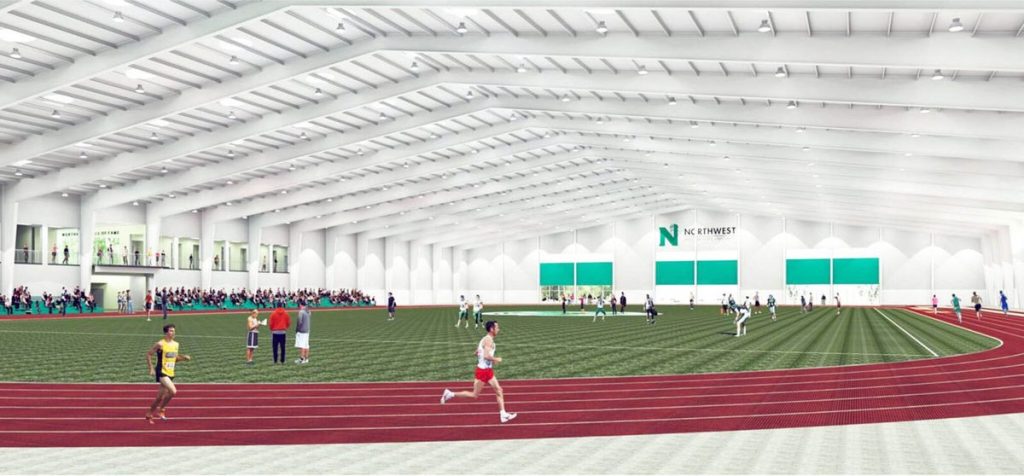
This computer-aided architect’s drawing shows the interior of a planned athletics and events complex at Northwest Missouri State University. The $20 million center, which would receive funds through a proposed bed tax going before voters on Nov. 8, would create nearly $24 million in added income — the equivalent of 946 jobs — between 2017 and 2035, according to an economic impact study commissioned by Nodaway County Economic Development.
A recently completed economic impact study reviewing a proposed 137,000-square-foot athletics and special events center at Northwest Missouri State University indicates the $20 million facility could create the equivalent of 946 new jobs and add nearly $24 million in income across the Maryville region over the next 18 years.
The facility, tentatively named the Northwest Multipurpose Complex, or NMC, is to be partially financed with proceeds from a 5 percent transient guest tax, or “bed tax,” that would add about $4 a night to the cost of staying in a local hotel room.
Local voters are being asked to approve the tax, which requires a simple majority to pass, during the Nov. 8 general election.
If enacted, the levy will generate an estimated $215,000 annually, $150,000 of which would be handed over to Northwest in support of NMC construction and maintenance during each of the next 23 years. The remaining $65,000 is to be spent in support of still-undetermined initiatives designed to promote tourism and encourage economic development.
Commissioned late this summer by Nodaway County Economic Development at a cost of $15,000, the study was performed by EMSI, the same Idaho-based firm that compiled similar reports last year on Mozingo Lake Recreation Park and Northwest Missouri State University.
The Mozingo study showed that the 3,000-acre city-owned reservoir and recreation area attracted
470,000 visitors a year and generated a total of $9.5 million in local sales.
Northwest, EMSI found, has a $617 million economic footprint in terms of “added regional income.”
NCED Executive Director Josh McKim said Wednesday EMSI research in connection with the proposed complex predicts that $19.3 million in capital spending used to build and equip the facility will generate $23.8 million in added income, assumed to be equivalent to 946 new full-time jobs.
McKim said EMSI’s job equivalency estimate is cumulative, meaning that the same jobs are counted each year between 2017 and 2035. This means that the actual employment yield associated with the center is more on the order of between 50 and 60 permanent jobs for workers in this area.
EMSI divided the multipurpose complex’s economic impact into three categories: short-run capital spending, long-run operations spending, and long-run visitor spending.
Short-run capital spending includes actual construction during 2017-2019, a process that EMSI says will produce $1.2 million in total added income, or the equivalent of 62 new jobs.
Long-run operations spending embraces the period between the center’s opening in 2019 through the year 2035.
Employment demand and associated day-to-day spending should create an $11.1 million impact, according to the EMSI report, or the equivalent of 387 jobs over a decade and a half.
Finally, visitor spending during the facility’s first 16 years of operation — that is money spent by people attending events at the center, staying in hotels here, and buying meals at local restaurants — is projected at 11.6 million, or the equivalent of 497 jobs.
Assuming the creation of 60 new permanent jobs associated with the center, additional payroll for the Maryville area would increase by around $1.8 million, based on the county’s average $31,400 wage. This totals $43 million in additional communitywide payroll over the 23 years a portion of the bed tax would be used in support of center financing and maintenance.
McKim said EMSI indicated jobs associated with the complex would be of three types: those directly connected to facility maintenance, operations, and administration; “indirect” jobs held by people who supply the center, or events held there, with goods and services; and “induced” jobs related to increased economic activity, such as a new restaurant.
In commissioning the study, McKim said the NCED board decided it was important to provide voters with research-based numbers that would give voters some idea of the economic value of a large indoor athletics venue on the Northwest campus that is also designed to house conventions, trade shows, agricultural expos, concerts, and other large-scale events.
In the course of trying to educate voters about the bed tax proposal, McKim said he has been asked about the appropriateness of using tourism and economic development dollars for what will essentially be a campus facility.
“This is a major project, a major initiative that we are requesting the citizens of Maryville to approve,” McKim said. “We think an educated voter is a good voter, and we thought it was important that voters be given every single bit of information we can give them.”
He added that it was also important that voters be exposed to a “third-party analysis” of the project conducted by an outside organization.
“These are pretty good numbers,” McKim said, “I’m a conservative guy, and I try to understate the impact of these kinds of things, but I am pretty comfortable with this. It’s not that we doubted the (economic impact) would be there, but we wanted to quantify it.”
Beyond the numbers, however, McKim said he believed the multipurpose complex would have a significant “quality of life” effect on Maryville, a somewhat intangible factor he nevertheless described as “tremendously important” in recruiting quality workers and enterprises to the area.
A roofed, three-acre complex capable of housing everything from concerts to athletic events to youth activity camps to cultural and commercial expositions will be a major plus, McKim said, in keeping Maryville on the radar screen across an economic region embracing 10 states or so.
“As I look across the region I see a lot of different things like this going on in communities our size or even smaller,” McKim said. “There is a wide range of things we could do if we had an expo facility like this.”