SSM Health raises wage floor to $11 an hour
TONY BROWN/DAILY FORUM
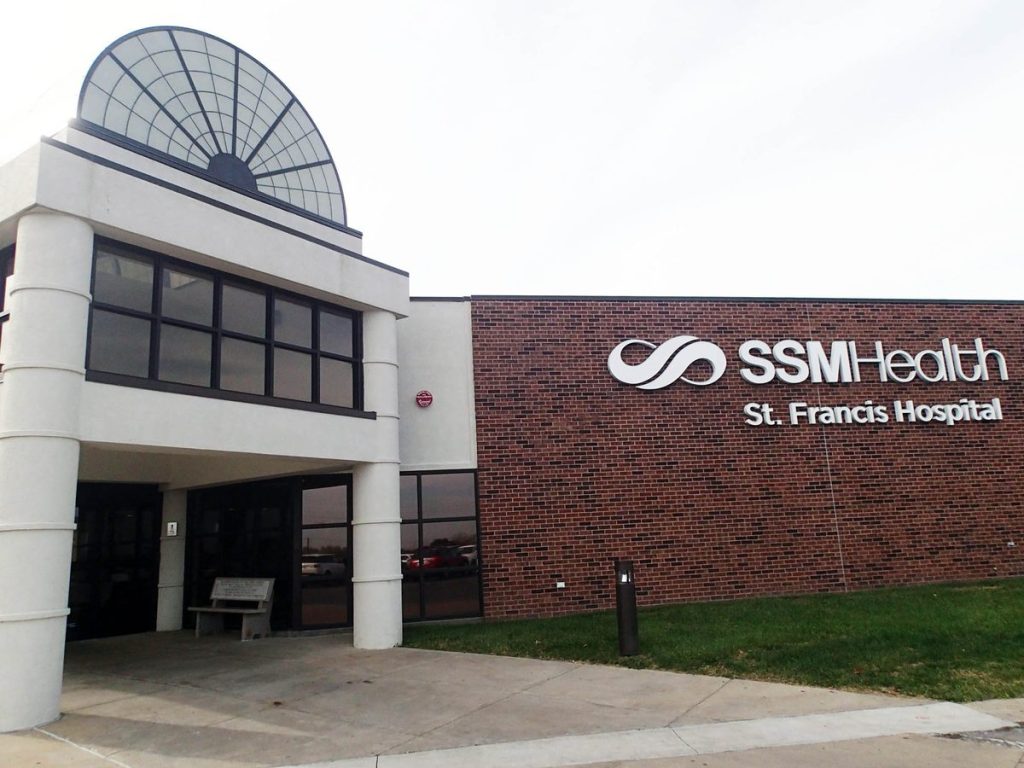
SSM Health, the not-for-profit healthcare system whose institutions include St. Francis Hospital in Maryville, has announced that it is boosting its minimum wage to $11 an hour. The increase will impact nearly 1,100 workers systemwide, including those in Maryville. According to a corporation release, that totals 3.5 percent of SSM Health’s total workforce of more than 33,000 people.
ST. LOUIS, Mo. — SSM Health, the St. Louis-based corporate parent of SSM Health St. Francis Hospital in Maryville, has announced that it will raise its system-wide minimum wage to $11 an hour.
SSM Health operates hospitals and other healthcare facilities in Missouri, Illinois, Oklahoma, and Wisconsin. The wage increase takes effect in January 2017.
“As a mission- and values-driven organization, we are committed to providing strong market-based wages and benefits for all of our employees, with special consideration for those who are most economically vulnerable,” said William P. Thompson, SSM Health’s president and CEO, in a prepared statement.
“We value all of our employees and the incredible work they do on behalf of those we serve, and we believe providing a fair and socially just minimum wage is the right thing to do.”
The wage increase will impact nearly 1,100 workers employed by the SSM Health system, including those in Maryville. According to a corporation release, that comes to 3.5 percent of SSM Health’s total workforce of more than 33,000 people.
The release stated that the increase will “benefit individuals who serve in a variety of important roles, including aides, transporters, dietary and environmental services workers, receptionists, and others.”
SSM Health officials say the wage hike is in line with longstanding efforts to “support employees and improve their quality of life” through initiatives that embrace tuition reimbursement, continuing education, discounted health insurance for eligible workers, an employee emergency relief fund, healthy lifestyle coaching, legal consultation, and financial planning.
“When our employees have the resources and support they need to take care of themselves and their loved ones, they are better able to provide exceptional care and service to our patients,” Thompson said.
Sponsored by the Franciscan Sisters of Mary, SSM Health owns 18 hospitals and has affiliations with more than 40 rural hospitals. The organization also owns two nursing homes and has a variety of partnerships with physicians.
The $11 standard is significantly higher than the current federal minimum wage of $7.25 and state minimum wages that range up to $8.25 across the four-state SSM Health system.
Missouri’s minimum wage is $7.65 an hour and supersedes the federal wage floor.
However, employees of retail or service businesses in Missouri with gross annual sales or business done of less than $500,000 can be paid less.
Under state law, Missouri’s minimum wage increases or decreases based on an annually applied cost-of-living factor.
On Jan. 1, 2015, the state raised its minimum wage from $7.50 per hour to $7.65. In 2014, the wage was raised to $7.50 from $7.35.
Minimum wage as an economic and social issue has acquired growing prominence since 2012 when more than 100 fast-food workers from McDonald’s, Burger King, Wendy’s, Domino’s, Papa John’s, Kentucky Fried Chicken, and Pizza Hut walked off their jobs in New York City to protest low pay and poor working conditions.
Then, in April, 2013, more than 200 fast-food workers went on strike in New York City with similar job actions following in Chicago, Detroit, St. Louis, Milwaukee, and Seattle.
Later that summer, strikes resumed in all those cities as well as Flint, Michigan, and Kansas City.
On Dec. 4, 2014, thousands of fast food workers struck in 190 U.S. cities with their leaders calling for a $15 an hour national minimum wage and the right to union representation and collective bargaining.
In addition to fast food workers, “Fight for $15” protests over the last couple of years have included caregivers, airport workers, and employees at discount and convenience stores.
In a story published by “Business Insider” this summer, reporter Hayley Peterson wrote that several of the nation’s biggest companies were raising wages in an effort to retain their lowest-paid workers.
According to Peterson, these corporations included Starbucks, Wal-Mart, McDonald’s, JPMorgan, Target, and TJ Maxx.
She wrote that in addition to offering higher pay to low-tier employees, several major companies also announced improved benefits, retooled scheduling protocols, and training opportunities.