Home rehab added to local Habitat efforts
TONY BROWN/DAILY FORUM
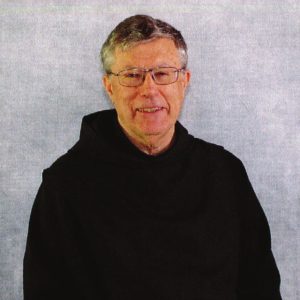
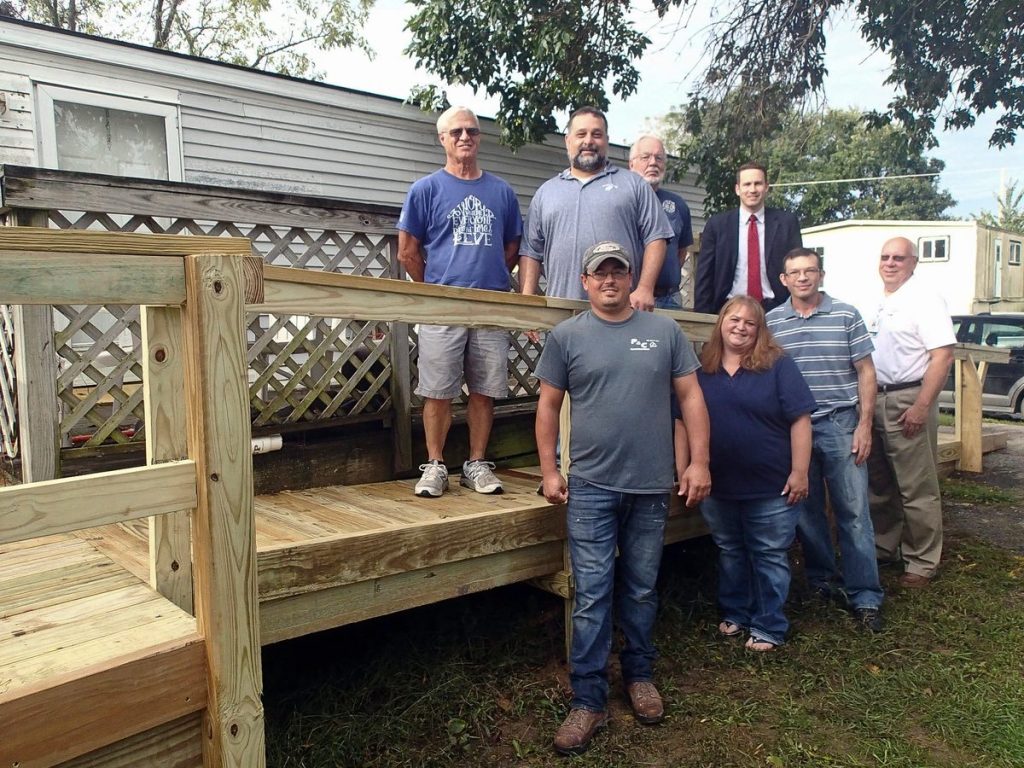
Board members and volunteers with Habitat for Humanity of Nodaway County gathered on Friday to celebrate completion of the organization’s first-ever existing-housing rehab project — a new accessibility ramp at the home of Carolyn and Christie Wright on Jaquar Road just north of Maryville. Pictured front row left to right, are Mike Coffelt, construction supervisor; Christie Wright; the Rev. Jonathan Mitchell, Habitat board member; and board member Michael Baumgartner. Pictured back row from left are board member Joe Ford; board member Jay Mackey; construction volunteer Wayne Snyder; and Thrivent Financial representative Curtis Behrend.
In an effort to find new ways to improve housing conditions for low-income individuals and families, Habitat for Humanity of Nodaway County has launched an initiative aimed at rehabbing existing residences in addition to building new ones.
While Nodaway Habitat recently acquired a lot in the 1300 block of East Jenkins Street in Maryville, which will become the site of the non-profit organization’s ninth single-family home, organization volunteers on Friday took some time to celebrate completion of Habitat’s first-ever rehab effort.
Completed in just a few days, the project added a new access ramp to the mobile home of Carolyn Wright and her daughter Christie Wright on Jaquar Road on the north edge of town.
After suffering a stress break to a bone in her leg, Carolyn Wright, 65, spent an extended period recuperating in a local nursing facility. She’s back home now but has limited mobility and uses a walker.
Habitat board member Joe Ford said adding a ramp was a relatively easy project with which to inaugurate the rehab initiative, which like the new-home program aims to provide improved housing to local residents using volunteer labor and no-interest loans, which are repaid over time by the recipient.
Ford said the addition of rehab work to Habitat’s mission is meant to accomplish a couple of things.
First, it will allow the organization, which because of limited resources is only able to build a house every other year, to help more people.
Second, Ford said, board members are hopeful that moving forward with rehab projects in “off” years when no home is built will increase awareness about Habitat, which doesn’t garner a lot of publicity except when a project is under way.
While the access ramp — in addition to new rear stairs and a new storm door — at the Wright home was installed using volunteer labor, Ford said other types of rehab work, such as roofing and window replacement, will likely require either hiring professionals or finding contractors willing to donate their time and expertise.
Potential rehab projects, he said, could include most kinds of exterior repairs, including roofing, painting, sidewalks, decks, and weatherization.
A third reason for instituting the rehab program, Ford said, is that it will allow Habitat to continue serving people who live outside Maryville.
In the past, the organization has built homes in several outlying Nodaway County communities such as Ravenwood and Skidmore. But Ford said the board recently decided to keep future new-construction projects inside Maryville.
One reason for that is economics. Most Habitat homes are constructed for young, working families who prefer to be as close as possible to their workplaces. Since the majority of the county’s jobs are in Maryville, that’s where it makes the most sense to locate affordable housing.
Also, when better job opportunities arise elsewhere, homes in rural Nodaway County can be tough to sell, especially under the mortgage structure used by Habitat.
Habitat families purchasing a home sign two mortgages, one to pay back the actual cost of construction and another based on the home’s estimated market value. The second mortgage, which is always higher, is the one that has to be paid off if the house is sold in fewer than five years.
The idea is to keep new homeowners from “flipping” their new residence shortly after acquiring it.
Sometimes, however, families have a legitimate need to move, and selling a house at market value can be a tough proposition in rural parts of the county where homes generally go for considerably less.
In addition, Ford said it is hoped limiting Habitat’s new-home construction to Maryville, the group’s primary donor base, will provide the organization with increased visibility, leading both to more volunteers and increased financial support.
With the first rehab project completed, Nodaway Habitat is now turning its attention to its next new-construction effort.
Joshua and Alea Mullins and their three children were named late last year as the organization’s newest recipient family. Their home was originally to be constructed in Burlington Junction.
Problems associated with the donated lot, however, forced the board to look for a new location, and an acceptable lot was purchased earlier this summer on the east side of Maryville.
When completed, the new structure will be the first four-bedroom home ever built by Nodaway Habitat in an attempt to accommodate the Mullinses, who are expecting their fourth child.
Habitat for Humanity of Nodaway County is a non-profit, nondenominational Christian housing ministry that provides affordable housing for individuals and families in need.
Partner families invest hundreds of hours of “sweat equity” by helping to build their new homes and the homes of others or by assuming other volunteer tasks.
In addition, Habitat receives support from numerous private donors, churches, and corporate sponsors.