Summer ranger recalls glory of national parks
TONY BROWN/DAILY FORUM
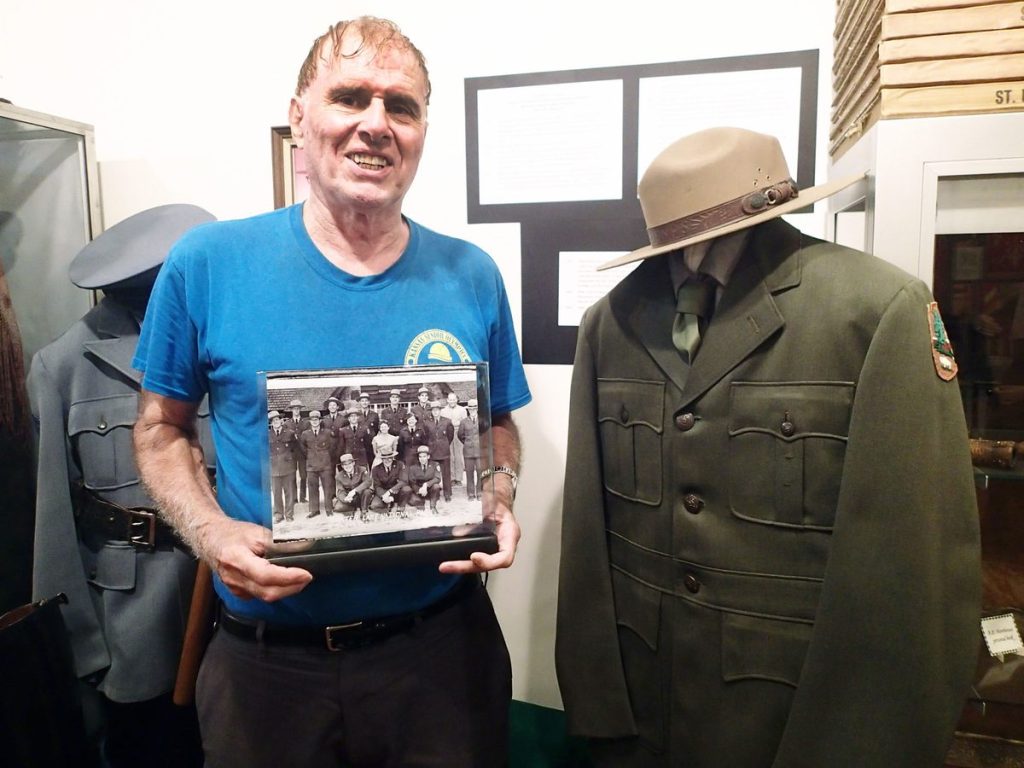
David Easterla, emeritus distinguished university professor of biology at Northwest Missouri State University, stands beside the National Park Service Uniform he wore during summers spent as a seasonal ranger and naturalist interpreter in California, Utah, Oregon, Texas, and Montana. Easterla recently donated the uniform to the Nodaway County Historical Society Museum. The photo Easterla is holding shows him with a group of fellow rangers at Crater Lake National Park in 1960. Easterla appears standing in the back row, fourth from right.
If the Nodaway County Historical Society Museum’s most recent acquisition could talk, it would tell the story of a local man’s lifetime love affair with the glories of the natural world and what remains of America’s Western wilderness.
Now 78, retired Northwest Missouri State University biology professor David Easterla’s academic career stretched across more than 50 years and two very different centuries.
And while much of that time was spent in the classroom or at a desk doing the lecturing, reading, writing, and research that form the core of professional scholar’s life, the memories he treasures most seem to be of countless days spent in the field observing what he still calls “the glories of Mother Nature.”
On many of those days, Easterla wore the dark green woolen uniform of the National Park Service, the agency in which he spent 15 summers working in various capacities, but especially as a seasonal ranger and “naturalist interpreter.”
That uniform and its matching brown “Smoky Bear” hat now reside on the museum’s top floor. And while it’s just another of several sets of military-style garb displayed there, this one represents Easterla’s encounters not with death, violence, and danger, but the reaffirming splendor of life in all its beauty and diversity.
Over the course of those summer stints with the NPS, Easterla’s basic job was to share — through the lens of scientific expertise — his essential sense of wonder at how trees grow, grass waves in the breeze, antelope run, glaciers move, birds fly, and insects crawl.
“Basically it was a paid vacation,” he says now, a little wistfully. “On your days off you could go into the backcountry. There were a lot of unique areas basically off limits to the public — and for good reason. They would have been trampled to pieces. I wouldn’t take anything for those 15 summers.”
Easterla started working as a naturalist interpreter in 1960 while still a graduate student at the University of Missouri-Columbia, where he earned undergraduate and graduate degrees in wildlife biology.
Later on, after he began teaching, he returned every summer he could through 1983, ending his service in Kings Canyon National Park in the rugged southern Sierra Nevada Mountains of California.
Other stops over the years included Crater Lake National Park near Medford, Oregon; Bryce Canyon National Park in Utah; Glacier National Park in Montana; Big Bend National Park in Texas; and Lava Beds National Monument, also in California.
A scientist above all, Easterla did a lot more than just talk to groups of tourists about the local flora and fauna — though he did plenty of that, and claims today that the experience proved invaluable as his classroom career progressed.
But as his scientific knowledge grew, the young teacher found himself increasingly skillful at being in the right place at the right time to experience some of nature’s most elusive sights.
In 1964, for example, he encountered what is perhaps North America’s rarest mammal, the spotted bat, and managed to take the first color photographs of a living specimen.
Then, during one of his eight summers at Big Bend National Park, Easterla discovered a new species and subgenus of beetle, which was named Easterla’s Cave Beetle (eleodes easterlai) in his honor.
Also at Big Bend, in between leading bird walks, bat walks, campfire programs, reptile lectures, and geology programs, Easterla found enough “spare” time to compile extensive annotated checklists cataloguing the park’s mammals, birds, snakes, and reptiles.
“Looking back, I really enjoyed talking to the general public and opening their eyes to the wonder of nature,” Easterla said, adding that the National Park System remains today a refuge for plants and animals that are “endangered and slowly disappearing.”
Given the current political climate, when some politicians and activists openly talk of turning national parks over to the states so they can be sold to private business interests, Easterla wonders if the glories he observed as a young man will survive to be enjoyed by future generations.
“Times are changing so fast,” he said. “There are a lot of things that you can no longer find outside of nationally preserved areas. I hope we are going to be blessed with this in the future.”