
Emergency panel considers need for quake plan
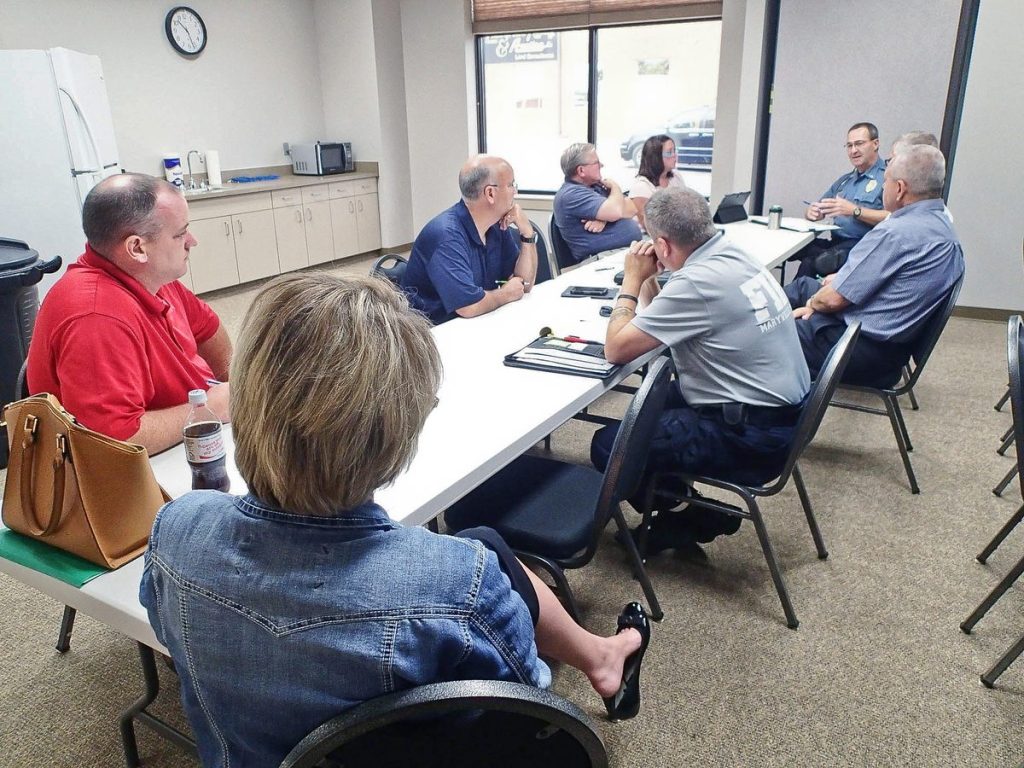
TONY BROWN/DAILY FORUM
Members of the Local Emergency Planning Committee met Wednesday in the Nodaway County Administration Center. Agencies and institutions with a seat on the panel include the Maryville Treatment Center, Kansas City Power & Light, the Northwest Missouri State University Police Department, Maryville Public Safety police and fire divisions, SSM Health St. Francis Hospital, Nodaway County Health Center, Nodaway township fire and rescue units, Nodaway County Ambulance District, and the Nodaway County Sheriff’s Office.
Representatives from law enforcement, healthcare, crisis-response agencies, and city and county government gathered Wednesday at the Nodaway County Community Building for the quarterly meeting of the Local Emergency Planning Committee.
The ad hoc group, which gathers four times a year, is charged with working out strategies aimed at improving coordinated, inter-agency responses in the wake of severe weather, active-shooter incidents, public health emergencies, and other calamities.
While scheduled months ago, Wednesday’s meeting turned out to be timely, since one topic on everyone’s mind was Saturday morning’s 2.1-magnitude earthquake, which rattled Nodaway County along with much of the rest of the nation’s heartland.
Reprising her comments to the Daily Forum earlier this week, county Emergency Management Director Christy Forney, who chairs the committee, said neither Nodaway County nor the City of Maryville has a plan in place for responding to earthquake-related damage or injuries because such events are so rare.
In fact, the only earthquake procedures currently on the books relate to Maryville’s proposed role as a refugee center should a major temblor strike along the New Madrid Fault in southeast Missouri.
Friday’s event was seen by many geologists as related to the underground storage in north central Oklahoma of wastewater used to extract oil and natural gas through a process known as hydraulic fracturing — often referred to as “fracking.”
The process has been linked to a surge of quakes in recent years, with Friday’s event considered perhaps the second largest ever.
In that light, both Forney and Northwest Missouri State University Police Lt. Mike Ceperley suggested to the committee that it may be time to move earthquakes higher up on the list of potential northwest Missouri catastrophes.
For one thing, Ceperley said, natural fault lines linked with occasional seismic activity in this region do exist and carry at least the potential for true disaster.
The Nemaha Ridge, sometimes called the Nemaha Uplift, extends from approximately Omaha, Nebraska, to Oklahoma City, Oklahoma, and is associated with the seismically active Humboldt Fault Zone.
It is also tied to the Proterozoic Midcontinent Rift System, which stretches into northeastern Kansas.
Ceperley noted that the Nemaha fault runs almost directly beneath the Cooper Nuclear Station, a boiling water-type nuclear power plant located 60 miles west of Maryville on the Nebraska-Missouri border.
Should a severe emergency occur at the plant, such as a radiation leak, employees there are to be evacuated and sheltered at the Lamkin Activity Center at Northwest Missouri State University, Forney said.
“There are fault lines in this area,” Ceperley said, noting that, prior to this weekend, minor quakes with magnitudes ranging between 2 and 3 have been felt in Burlington Junction and other Nodaway County communities within the past 20 years or so.
Just what form an earthquake plan would take has yet to be decided, but committee members suggested it might be similar to disaster blueprints for tornadoes and other severe weather events. The effort would also likely include a public education component covering the evacuation of weakened structures and other precautions.
On other fronts, the group discussed the possibility of acquiring one or two large, trailer-mounted generators that could be used to power emergency shelters following severe storms, such as the one that knocked out power across much of the county in the early morning hours of Thursday, July 7.
Forney said the electricity outage was especially persistent in the southern parts of the county, but that efforts to get a powered shelter up and going in Skidmore were delayed until late Friday night due to delays associated with transporting a generator from St. Joseph.
The generator is one of two such machines available for use by any of the 15 counties in the Region H disaster response area. However, Forney believes Nodaway County would be better off with a couple of generators of its own.
Rapid deployment can make a big difference in a crisis, she said, especially in the county’s smaller towns where options for keeping people forced out of their homes cool in the summer and warm in the winter — as well as ensuring access to water and restrooms — are limited.
“We should have had the Skidmore (community) building up in an hour and a half,” Forney said. “It should have been that easy, and it wasn’t.”
On other fronts, Forney said she would like to use funds provided over several years by the Cooper Nuclear Station — in exchange for facilities used for evacuation training — to purchase equipment needed to connect storm warning sirens in Nodaway’s outlying communities to the Sheriff’s Office dispatch headquarters.
While about half of the county’s small towns are patched into the system, which allows the sirens to be remotely activated, five or six are not. Communities where sirens must still be manually activated include Pickering, Ravenwood, Skidmore, and the Tri-C area embracing Conception, Conception Junction, and Clyde.
Forney said the requisite hardware and software needed to upgrade the non-networked sirens will cost around $2,500 each, and that her office could likely provide about half that, leaving the towns themselves to come up with the remainder.
Also discussed during Wednesday’s meeting were efforts at Northwest Missouri State University to prepare for possible passage by the state Legislature of a proposal that would permit the carrying of concealed weapons on college campuses.
Ceperley said the measure failed narrowly this year but could well become law in the near future.
To that end, he said, Northwest is planning to hold open forums later this month for students and faculty with an eye toward preparing the university community for the possibility that people who wish to carry guns on campus will be able to do so.
“The writing is on the wall,” Ceperley said. “It’s coming, and we don’t want to wait and then try to play catch-up. That’s never a good place to be.”
Other emergency planning and training events set for this fall include a planned disaster exercise at SSM Health St. Francis Hospital during which staff will respond to the simulated crash of a helicopter into the hospital building resulting in damage and injuries.
St. Francis emergency management coordinator Marcus Casady said the simulation is scheduled to take place Oct. 5-6.




