Saturday service offers believers a “Catalyst’ for faith
TONY BROWN/DAILY FORUM
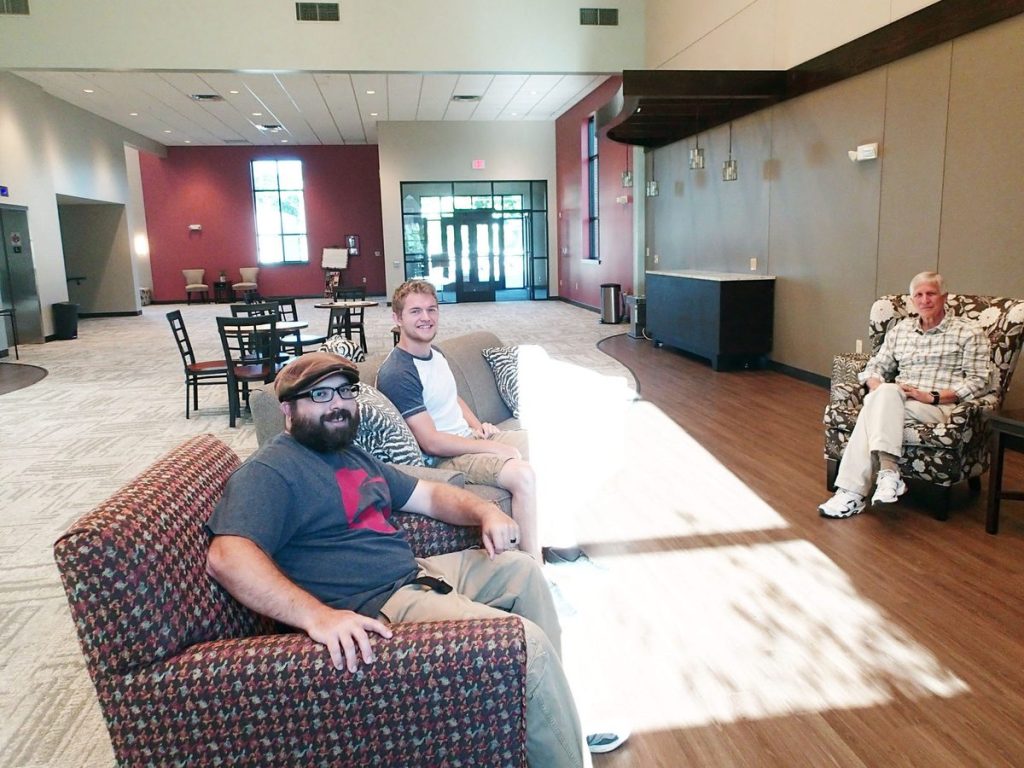
The pastoral team of the First United Methodist Church of Maryville, pictured sitting in the faith community’s newly completed “Gathering Space,” has been working to organize a Saturday evening service that, rather than relying on traditional or contemporary worship forms, emphasizes group discussion, relationship building, and dialogue. Shown from left are Director of Ministries Chris Komorech, Director of Worship Paul Derks, and the Rev. Scott Moon, FUMC pastor.
According to its website, the self-proclaimed goal of the First United Methodist Church of Maryville is to help people “meet life at the crossroads.”
In an effort to translate that vision into reality for those seeking either to find their faith or make it stronger, the church, located at 102 N. Main St. just south of the square, will begin experimenting later this month with a new kind of worship service.
The most obvious departure for the gathering, which has been titled “Catalyst,” is that it will take place on Saturday evening instead of Sunday morning with the first Catalyst service set for 7 p.m. Saturday, Sept. 10.
But there are other differences as well.
While churches in many denominations have been attempting, with varying degrees of success, to change up the structure of traditional Sunday worship for the last 40 years or so, such efforts have generally emphasized “contemporary” formats rooted in guitar-centric sing-along choruses and studied informality when it comes to liturgy, prayer, and preaching.
First Methodist already has such an option, “Jubilee,” which takes place at 11 a.m. each Sunday following a traditional “Heritage” service at 9 o’clock.
Catalyst, however, is something different. Call it a worship seminar.
Paul Derks, a preacher’s son and philosophy/psychology major at Northwest Missouri State University who serves as FUMC’s director of worship, said the Saturday addition to the weekly church calendar is intended to accomplish a couple of things.
First, it will give people who want to go to church, but who can’t make it on Sunday, a chance to do so. Second — at least this is the hope — Catalyst will provide an opportunity for prayer, spiritual guidance, and the study and discussion of scripture in a relaxed environment that splits the difference between a praise gathering and a conventional service.
Instead of FUMC’s 19th-century sanctuary, for example, Catalyst will take place in the church’s newly completed “Gathering Space,” which looks more like the comfortable lobby of an upscale business-class hotel than a room designed for centuries-old ritual and ceremony.
And while Derks said Catalyst will begin with prayer and singing, to the accompaniment of a single acoustic guitar, the rest of the service is to be modeled along the lines of a college discussion group, complete with breakout sessions and an “interactive” dialogue during which questions and comments will not only be allowed but encouraged.
Derks, who will lead the gathering, said he sees his role as supportive rather than pastoral, adding that he hopes to be able to provide insight and guidance as participants examine various passages of scripture from different perspectives.
Both Derks and FUMC’s pastor, the Rev. Scott Moon, said Catalyst is also intended to provide an alternative worship time for college students and others who either can’t attend church on Sunday or simply prefer not to.
For his part, Moon said cultural shifts that began in the 1970s have come full flower, and that the longstanding rhythm of Wednesday evening prayer meeting and Sunday morning preaching simply isn’t practical anymore for a growing number of believers and seekers.
Some people have to work, he said, while others choose to take part in a host of weekend family and social activities, including specialty youth camps and sporting events.
Derks and Moon added that another factor is the growing number of folks, millennials in particular, who voice dissatisfaction with traditional worship forms, which they see as intimidating, irrelevant, or both.
Catalyst, said Moon, as the name implies, is an attempt to move beyond that discomfort by creating a worship environment that is not only informal and participatory but “transformational.”
“We want to connect with people where they are,” he said, “with how they think and how they operate.”
The veteran pastor explained the concept with a comparison anyone who has ever been a student can grasp.
“It’s like the difference between a lecture and a seminar,” Moon said. “A traditional church service is more like a lecture. This is a seminar. We want to engage minds and hearts.”
Most people, he added, have been trained to read scripture, or anything else for that matter, as an exercise in acquiring facts or mastering a formula around which to organize their lives.
But faith is not that cut and dried, and Moon said he hopes Catalyst will encourage people to experience and exercise faith and discipleship, not just learn about it.
The real truth about our lives, he said, lies in the experience of community, and the goal of Catalyst is to lead worshippers to a place where “faith understanding is a shared experience.”
Moon also said he believes one key to Catalyst’s hoped-for success is the Gathering Space itself, which he explained was intentionally designed as a place where people can linger, talk, exchange greetings, reach out, and form genuine bonds.
“We’ve talked about this space as our porch to the community,” he said, “So this is like taking church out on the porch. … My hope is that regardless of the number of people who show up, they will be really affected at the heart and changed by the relationships they have created.”