
City, university begin bed tax election push
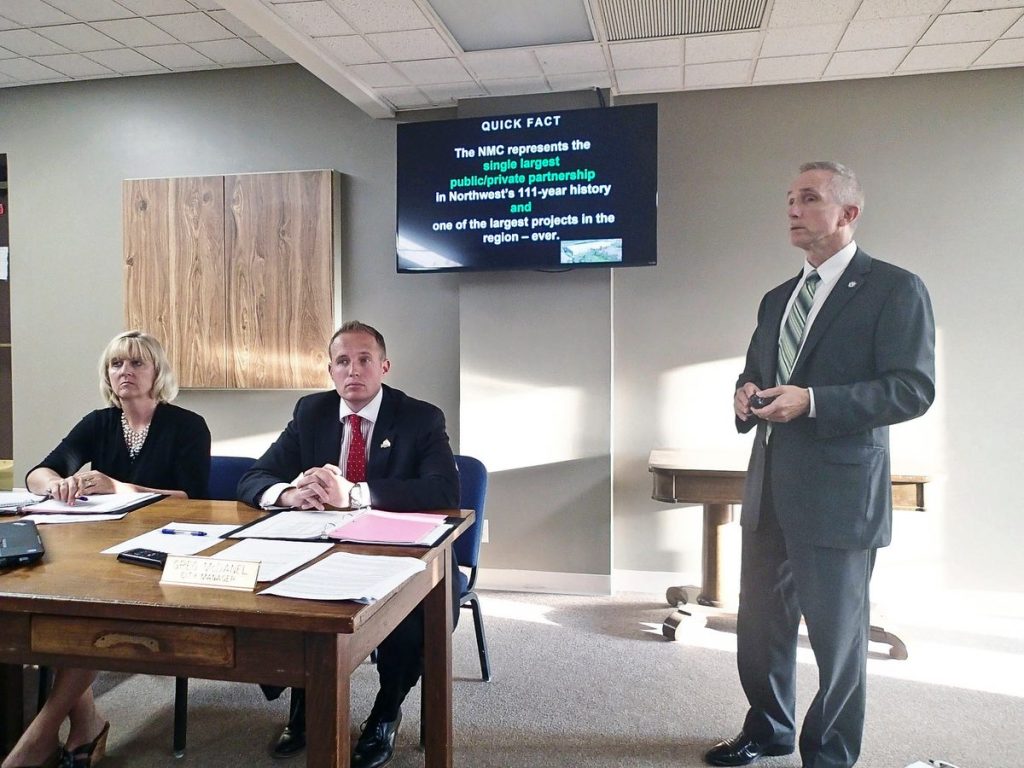
TONY BROWN/DAILY FORUM
Northwest Missouri State University President John Jasinski, right, speaks Monday to the Maryville City Council about a city/university proposal to jointly fund a $20 million, 137,250 square-foot multipurpose complex. Jasinski described the project as “the single largest public/private partnership in Northwest’s 111-year history, and one of the largest projects in the region ever.” Also pictured are Maryville City Manager Greg McDanel and City Clerk Sheila Smail.
There were plenty of fireworks at this week’s Maryville City Council meeting, what with the opening pitch by municipal officials and Northwest Missouri State University administrators for a cooperative effort that would help fund the proposed $20 million Northwest Multipurpose Center.
“It’s a big deal,” Northwest President John Jasinski told the council, adding that the NMC — which is what the project is being called for now — “represents the single largest public/private partnership in Northwest’s 111-year history, and one of the largest projects in the region ever.”
As reported earlier, the basics of the deal are this: Maryville voters will be asked to approve a 5-percent transient visitor tax on hotel bills during the Nov. 8 general election. That tax, if it passes, will generate — based on today’s numbers — about $215,000 a year.
Of that amount $3.45 million, or $150,000 a year, will be handed over to Northwest to help pay for the NMC. The remaining $65,000 will be used to fund various tourism and marketing efforts proposed and executed by a tourism committee whose membership will include university and municipal staff, community members, and Maryville Parks & Recreation personnel.
City Manager Greg McDanel said the panel would be the first such group to address tourism and marketing challenges and opportunities as they affect the entire Maryville community.
In the past, he said, such efforts have been divided among several entities, including City Hall, the Greater Maryville Chamber of Commerce, Nodaway County Economic Development, Northwest, and Maryville Parks & Recreation, each of which has its own budget and agenda.
While estimates show that the tourism committee will have at least a $65,000 budget, McDanel noted that figures used to arrive at that number do not include anticipated increases in the volume of gatherings, events, and hotel stays associated with completion of a new conference center and 40-unit lodge currently under construction at Mozingo Lake Recreation Park.
Since the obligation to the university would remain unchanged, McDanel said he is hopeful the actual amount of funds available for tourism and economic development will significantly exceed the existing calculation.
As for the appropriateness of using city funds to build what will largely be a campus facility, McDanel said the local economic impact of anticipated events, including trade shows, concerts, fundraisers, exhibitions, and athletic competitions, more than justifies the use of local tax dollars.
“There is such a thing as athletic tourism,” McDanel said, citing one example.
In announcing the proposal publicly only three months before the Nov. 8 election, McDanel said the decision to move forward with the NMC effort is being driven by state law, which limits bed tax proposals to 5 percent and requires such questions to go on either the primary or general election ballot during an even numbered year.
Failing to act now, therefore, would delay voter approval or rejection of a bed tax until at least 2018.
Assuming the tax passes, the resulting revenue will cover only 17.25 percent of the NMC’s total cost. Northwest officials hope to come up with the remaining $16.5 million through private donations and other funding streams associated with its “Forever Green” capital campaign.
Asked by Councilman Jerry Riggs if the bed tax will fill the fiscal gap Northwest needs close before moving forward with the complex, Jasinski responded with a qualified yes, explaining that while most of the money appears to be in place, fundraising efforts associated with the NMC are still underway.
Jasinski said the university plans to advertise for contractor bids on the facility in January and open the resulting offers in March.
Now that the proposal has been made public, the bed tax question will go back before the City Council on Monday, August 22, for a vote on whether to place the issue on the November ballot.
If that happens, McDanel and Jasinski said, both city and campus representatives can be expected to start reaching out to service clubs and other civic organizations in what McDanel characterized as a “voter education” campaign.
By state law, government entities are prohibited from urging citizens to vote yes or no on such proposals, and must restrict all statements, including those appearing in the media, to information that excludes any call to action other than marking a ballot one way or the other.
“We simply want to bring this to the voters and let them decide if this is a valid partnership,” McDanel said.




