Soldiers from the local guard reach prestigious rank
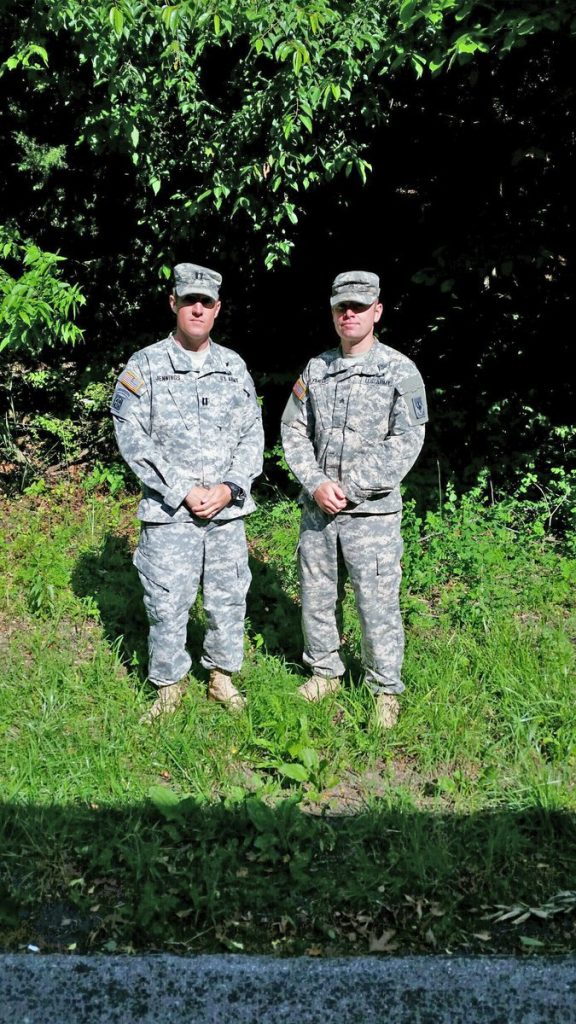
Captain Ryan Jennings and Sergeant Justin Plymell of the 1-129th FA recently earned the status of Pathfinder. Less than one percent of the entire United States Army holds that status.
Two members of the Missouri National Guard’s 1-129th Field Artillary unit based in Maryville have earned one of the military’s most challenging certifications — that of Pathfinder.
Capt. Ryan Jennings and Sgt. Justin Plymell completed their proficiency training in air mobility operations to become Pathfinders during a two-week training program conducted May 1-14 at Camp Crowder, Missouri, by the Army National Guard Warrior Training Center, headquartered at Fort Benning, Georgia.
Open only to soldiers who have completed the prerequisite Air Assault Training Course, the Pathfinder course is not as physically demanding as Air Assault, but is a grueling academic gauntlet.
During the course, candidate Pathfinders learn how to establish and operate a day and night helicopter landing zone, establish and operate day and night parachute drop zones that included Computed Air Release System drop zones, Ground Marked Release System drop zones, and Army Verbally Initiated release system drop zones.
“You had guys from all walks of life including the Army, Special Forces, as well as Rangers,” Plymell said. “You had elite members of different military branches, yet only half of the class graduated. That should tell you right there how intense it was.”
Also during the course, candidates conduct sling load operations, provide air traffic control, and navigational assistance to rotary wing and fixed wing airborne operations. Students are dropped from the course by failing any of the four written exams or hands-on rigging test.
The rigorous training culminates with a three-day field training exercise prior to graduation. It is important to note that in addition to all the requirements for completing the course, there is an additional requirement before being awarded the Pathfinder Badge: the candidate Pathfinder must view “a suspended object falling from the sky.”
The Camp Crowder Pathfinder course began with 47 students and graduated 24, including Je3nnings and Plymell, who were awarded the Pathfinder’s distinctive winged torch at graduation.
Fewer than 1 percent of the entire United States Army has earned the status of Pathfinder.
The Pathfinder’s winged torch badge symbolizes runners from ancient Greece opening up the Olympic Games, bearing the Olympic torch.
The Pathfinder torch signifies the pathfinder’s function to “Light the Way” for forces following behind.
“This just broadens the scope of what we in the 1-129th are capable of,” Jennings said. “The more you can provide as a unit, the more successful you are for your community.”
The skills they mastered will prove crucial in enhancing the 1-129th FA mission training in air resupply and air assault artillery raids.
Over the past year, the Army has implemented several new key training courses which battalions and batteries/companies are dictated to complete as part of their Mission Essential Task List.
Some of the key tasks for the 1-129th include conducting an air assault artillery raid, receiving resupply by airdrop, and receiving external sling load resupply.
To perform these tasks, the battalion must select the best amongst its ranks to become qualified in Air Assault and as Pathfinders. Both courses are considered some of the most challenging training in the Army.
The Missouri National Guard and WTC conducted the Air Assault Training course at Camp Crowder May 1-12. More than 270 soldiers began the grueling course. Six of the 149 students earned the coveted Air Assault wings were from the 1-129th, including SPC Steven Sporleder, SPC Jordan Miller, CDT Nicholas Chesley, SPC Chad Ness , SPC Kristopher Paschel from the 1128th FSC, and SPC Robert Saunders from 1128th FSC.
The Air Assault course qualifies soldiers to conduct air mobility and air assault rotary wing operations. The school trains soldiers on helicopter insertion techniques, pathfinder operations, sling-load operations as well as rappelling from buildings, cliffs and helicopters.
“While this training was set up for combat situations, this also helps us back here in the states in the case of an emergency,” Jennings said. “We now have the capabilities to set up and secure a drop zone within our own unit if we ever need food, water, sandbags, or anything else dropped off by an aircraft.”
Plymell added that he could also use his new training as a local EMT, securing a safe site for Life Flight.
“So much of this training as civilian soldiers in the National Guard doubles as training for our civilians lives,” Plymell said. “This training was no different.”
Each day begins with rigorous physical training that includes unit runs from two to five miles. The course ensures soldiers constantly maintain attention to detail. Failing any task from any phase could cause the student to be dropped from the course immediately.
The Air Assault Course, often referred to as “the toughest 10 days in the Army” begins on “Zero Day” before sunrise, with a timed two-mile run. Following the run is a nine-station obstacle course that tests the students’ endurance.
If students weren’t double timing between obstacles, they were crab-crawling, high stepping, completing push-ups or even flutter kicks. This kept the students at a constant challenge between obstacles. The students who made it through “Zero Day” attended several days of Phase I classroom instruction on aircraft orientation, air assault, pathfinder and Air MEDEVAC operations.
If soldiers passed all Phase I exams, they progressed to Phase II, sling load operations.
Phase II is considered by some to be the toughest phase of the course, which mainly consists of rigging procedures. The phase II exam is a hands-on test in which individual soldiers must identify several faults on multiple pieces of rigged equipment. During phase III, soldiers focus on repelling from walls and helicopters with safety as the single most important factor. Fatal hook-ups are the most dangerous safety violation a student can make and one violation will get them dropped from the course. Phase III ends with a 12-mile road march with three hours on the clock and a 35-pound rucksack strapped to their back.
Every student completed the road march, but were still not cleared for graduation. Air Assault instructors inspected student’s packs for deficiencies. A missing item, no matter how small, ensures the soldier is dropped due to lack of attention to detail. The six Redlegs who completed the difficult course enrolls them into a proud Army tradition. The sling load skills the soldiers learned will enable the battalion’s training to prepare for State Emergency Duty missions and overseas deployments.