Vice presidents: White House hopes and 5-cent cigars
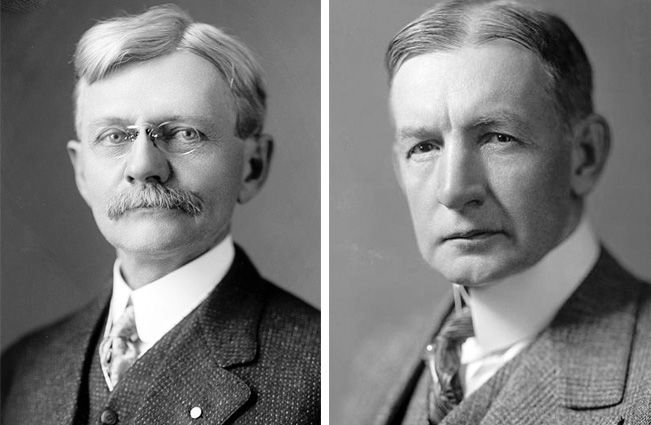
Thomas Marshall, left, and Charles Dawes
Throughout American history, vice presidents have been a mixed lot. Many have used the position as a springboard to the presidency, and a few, like Theodore Roosevelt and Thomas Jefferson, achieved greatness. Others were wholly unprepared for either office.
In many campaigns, the vice presidential candidate is selected to balance a ticket politically and geographically but is not always the most qualified candidate.
While vice presidents in recent administrations have been more visible, “veeps” holding office earlier in the nation’s history were often kept at a distance by the chief executive. In some cases, VPs weren’t even invited to cabinet meetings.
Fourteen presidents held the vice presidency earlier in their careers. Eight of those took over after the death of a sitting president, while a ninth, Gerald Ford, became president following the only presidential resignation in American history, that of Richard Nixon in 1974.
By comparison, seven vice presidents have died in office. In such cases, prior to passages of the 25th Amendment in 1967, the vice presidency remained vacant until the next election, altering the course of presidential succession.
President James Madison suffered the misfortune of having both his vice presidents — one in each term — die in office. A century later, James Sherman, VP in the Taft administration, died just weeks before the end of his term.
Thomas Hendricks, the first vice president under President Grover Cleveland, died eight months into his term in November 1885, leaving a void of more than three years.
Hendricks is one of five Vice-Presidents from Indiana, the second-highest total of any state. The leader is New York with 11.
Two vice presidents have resigned, including Nixon vice president Spiro Agnew, who left amid charges of corruption and tax evasion in October 1973. The other, John Calhoun, resigned in 1832 to become a U.S. senator about two months before the end of President Andrew Jackson’s first term.
Agnew’s replacement, Ford, is the only person to serve as both vice president and president without winning election to either office.
Three VPs went on to failed presidential bids, most recently Walter Mondale, the victim of the 1984 Ronald Reagan landslide.
In 1860, John Breckenridge, the sitting vice president, ran as one of two Democratic presidential candidates after the party fractured over slavery. The main Democrat was Stephen A. Douglas.
Breckenridge finished second in a four-man field in the Electoral College and third in the popular vote behind winner Abraham Lincoln, the first Republican president.
A distant cousin of Lincoln’s wife, Mary Todd Lincoln, Breckenridge served as a Confederate general and secretary of war during the Civil War.
Another ex-vice president who ran for president as a third-party candidate was Henry Wallace, who served during Franklin Roosevelt’s second term and tallied a million votes on the Progressive ticket in 1948. Democrat Harry Truman was elected president over both Wallace and Republican Thomas Dewey in one of the biggest political upsets in U.S. history.
Two former vice presidents tried for the office again, but with no success.
Adlai Stevenson Sr., the number-two man during Grover Cleveland’s second term, was on the ticket for the second of William Jennings Bryan’s three defeats for the presidency in 1900. Charles Fairbanks, the vice during Theodore Roosevelt’s second term from 1905-’09, also lost in a return bid in 1916. The city of Fairbanks, Alaska, is named in his honor.
Other vice presidents had unique personal stories. Charles Dawes of Illinois, the vice president during Calvin Coolidge’s full term from 1925-29, was the son of Wisconsin Civil War hero Rufus Dawes and a great-great-grandson of William Dawes, who, like Paul Revere, rode to warn Boston colonists of a British offensive in April 1775.
A self-taught musician and composer, Dawes wrote the music that was later turned into the hit song “It’s All in the Game,” which spent six weeks at No. 1 on the Billboard charts in 1958.
Dawes also shared the Nobel Peace Prize in 1925 for his “Dawes Plan” to rebuild the German economy after World War I.
When it comes to a quick wit, few veeps have ever topped Thomas Marshall of Indiana, who served during Woodrow Wilson’s presidency, 1913-21.
While listening to a long-winded senator deliver a speech titled “What This Country Needs,” a bored Marshall quipped, “What this country needs is a really good 5-cent cigar.”
Like many vice presidents, Marshall was largely ignored by the president, but his sense of humor remained intact. He once remarked that “once there were two brothers. One ran away to sea, the other was elected vice president, and nothing was ever heard of either of them again.”
EDITOR’S NOTE: Right now the political spotlight is on Donald Trump, Hillary Clinton, and Bernie Sanders, but soon the media will turn its attention to whoever takes the No. 2 spots on the Republican and Democratic tickets. The history of U.S. vice presidents is fascinating — if sometimes a little obscure. Here, freelance writer and occasional Daily Forum contributor Tom Emery tells a few stories about politicians who spent part of their careers “a heartbeat away” from the White House.