Veteran salutes those who fought ‘forgotten war’
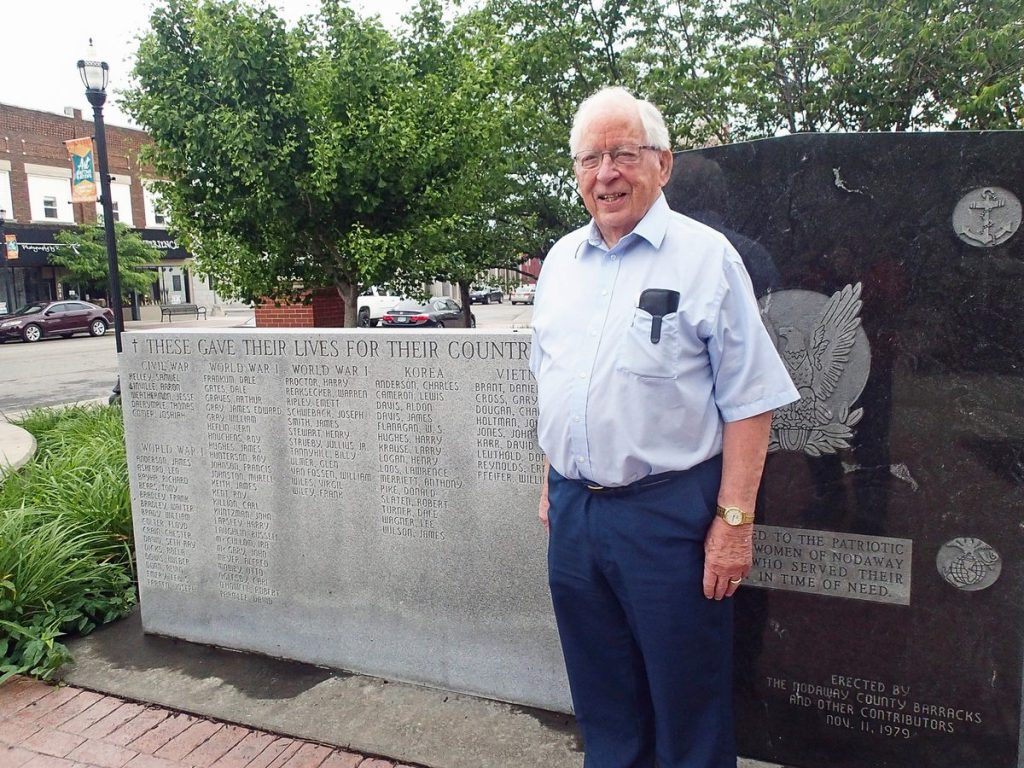
TONY BROWN/DAILY FORUM
Veteran and retired university professor Mahlon Fairchild stands beside a monument on the west lawn of the Nodaway County Courthouse that lists the names of soldiers, sailors, and airmen killed during the Civil War, World War I, World War II, the Korean War, and the Vietnam War. Fairchild, who served stateside during the Korean era, said he doesn’t believe lifelong civilians can really understand how veterans think or feel, but that the nation as a whole can do a better job of providing medical care and other services to those who have worn their country’s uniform.
As Memorial Day approaches — and Nodaway Countians break out their barbecue grills, coolers, and fishing poles for the first long weekend of the summer vacation season — one local man is hoping that folks spend at least a little time reflecting on the holiday’s true significance.
Mahlon Fairchild, 85, is a veteran who, like thousands of other men around his age, was drafted into the Army during the Korean War, an undeclared three-year “police action” lasting from 1950 until 1953 during which the U.S. and other United Nations member states opposed the invasion of South Korea by the communist north.
Fairchild, who grew up on a farm near Storm Lake, Iowa, had just completed a master’s degree in entomology —the study of insects — at Iowa State University when he was called up.
He is quick to say of his two years in uniform that he never got anywhere close to a combat zone, never fired a shot in anger, and in fact spent the tail end of the war teaching enlisted men at Fort Sam Houston in Texas how to avoid insect-borne diseases.
Fairchild left the Army as a corporal then went back to Iowa State to earn a Ph.D. before beginning a 33-year career as a professor and administrator at the University of Missouri-Columbia.
Still, his two-year hitch in uniform left a lasting impression, as did growing up the son of Elmer Fairchild, who, in his early 30s, served as a private during World War I in France, where he was taken prisoner and held in a German POW camp.
“My dad had what these days would be called post-traumatic stress disorder,” Fairchild said during an interview with the Daily Forum this week. “Back then you either had ‘shell shock,’ or you were a coward, and my father was no coward.”
Fairchild’s experience as the son of a war veteran called to the colors himself wasn’t unusual in the 1950s. But in today’s United States, which relies on a relatively small, all-volunteer military, it’s fairly rare. And he has mixed emotions about that.
“It’s something that most young people miss,” said Fairchild, who supports the idea of a universal draft, which he believes would help prepare young adults for the future while encouraging the nation’s leaders to think twice about sending their sons and daughters, and the son’s and daughters of their friends, neighbors, and colleagues, off to fight.
Fairchild noted that many members of the current crop of congressmen and senators were born in the 1960s and ’70s, and that relatively few are veterans.
“Everybody should have the opportunity to serve,” he said, adding that politicians who have spent time in the military might be more apt to weigh every possible option before calling for armed conflict.
As for his own service, Fairchild said he recalls having no idea what was in store while waving goodbye to his parents and younger brother in Storm Lake as he left for basic training. There was, after all, a war on.
“I remember wondering if I would ever get to see them again,” he said.
Before he left for the Army, Fairchild said his father approached him one day and said, “Let’s go check the cows.”
When the two men were alone, the older man said something that left an indelible mark on his son’s view of war and the people who fight in them.
“Remember,” Elmer Fairchild said, “that the man in the other trench doesn’t want to be there any more than you do, and that he has a mother and father and probably a brother and sister, too.”
Mahlon Fairchild says he frequently thought of those words while teaching young soldiers in Texas — perhaps headed for harm’s way — about the dangers posed by mosquitoes, ticks, and lice.
“My father almost never talked about the war,” he said. “I think he believed he could not be forgiven for the things he had done in the service.”
As for the men and women of his own Korean War generation, Fairchild said the youngest of them are now in their very late 70s, and that he fears a conflict that cost more than 36,000 American lives has been largely forgotten.
He told of a recent conversation in which someone was talking about the “Honor Flights” program that transports elderly veterans of the 1940s to see the World War II memorial on the National Mall in Washington D.C.
“We’re running out of World War II veterans,” he remembered a woman saying. “We need to start working with the veterans from Vietnam.”
A Vietnam veteran she was talking to quickly responded, “What about Korea?”
Fairchild said he is pleased that more Vietnam vets are being honored for their service these days, as opposed to the hostile welcome many received more than 40 years ago after returning home from an unpopular and deeply divisive war.
But he adds that the Korean War — sometimes called the “forgotten war” — was also controversial, and that many of the men and women who made it back were deeply scarred emotionally and physically then largely ignored by a nation eager for peace and prosperity in the rock ’n’ roll ’50s.
“As veterans, I think they’re kind of forgotten,” Fairchild said. “The history has gotten lost, and I understand that. … I can’t be critical of people who were born 50 years after World War II or Korea and don’t know much about it. How soon we forget.”
But there are things that can be done, he said, like funneling more resources at the “caregiver” level into veterans hospitals and “getting the politics out” of a Department of Veterans Affairs that has been plagued in recent years by scandal and controversy.
“We can serve our veterans better,” Fairchild said. “There should never be a waiting period for getting a veteran into a VA hospital.”
He would also like to see the movies and television, along with teachers of history and government, spend more time emphasizing the true cost of armed human conflict along with its unfathomable violence and horror.
“Teachers could perhaps do a better job of educating people about the losses we have incurred,” Fairchild said. “There’s too much Hollywood and not enough attention paid to the ravages of war.”