
Early planning starts on proposed jail conversion
TONY BROWN/DAILY FORUM
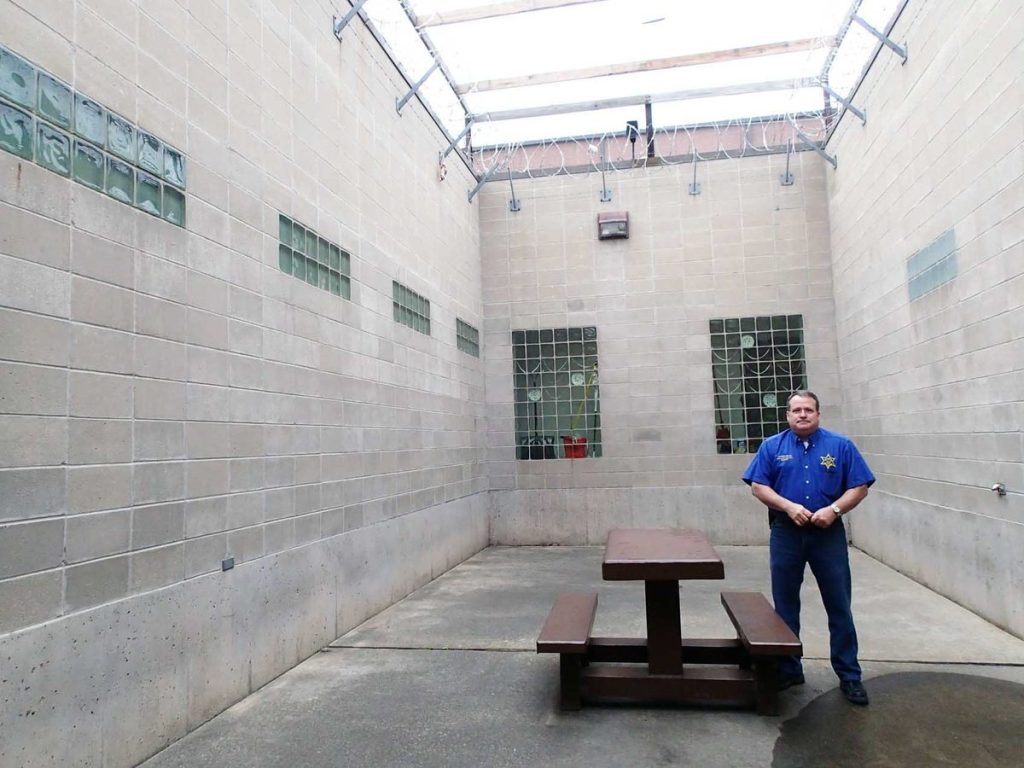
Sheriff Darren White stands Tuesday in the usually empty exercise yard at the Nodaway County jail. White has invited several architectural firms to look at the open-air yard with an eye toward converting it into additional cell space. The sheriff said the yard is infrequently used for its intended purposed, since it’s too cold during the winter and, due to the oven-like effect of thick concrete walls, too hot in the summer.
Though construction won’t begin until at least next year, Sheriff Darren White is moving forward with preliminary planning for converting the Nodaway County jail’s 40-foot by 20-foot exercise yard into additional cell space.
The Nodaway County Commission has set aside design funds for the project in this year’s budget, and White said Tuesday he has been in contact with several architectural firms who specialize in jail construction.
He said one of those firms has already been on site, but that few details about how the conversion might be carried out have been proposed. The county has yet to issue a formal request-for-proposals.
“We’re just putting it out there to people in the business to see what they think,” White said.
The sheriff discussed roofing and remodeling the open-air yard, which is enclosed by high concrete walls and topped with razor wire, with the County Commission earlier this year. The hope is that converting the area to cell space will help relieve periodic overcrowding that often has more to do with jail demographics than total numbers.
When the jail was built back in 1985, it was designed to accommodate two or three female prisoners at most. But these days, housing a dozen or more women in the county lockup is not uncommon.
White said it is a “pretty rare” day when the jail’s women’s area is not at or above capacity.
He added that enclosing the exercise yard would give jail personnel the flexibility to handle an overall inmate population that can change significantly from day to day.
Besides housing more women, White said, jail staffers face other challenges as well, such as the need to segregate convicted prisoners who are serving time from suspects in custody who have yet to be formally charged or convicted.
He said converting the exercise yard would also free up space for work-release inmates who return to custody after spending the day — and sometimes the night — at their jobs.
Currently, White said, work-release prisoners are integrated with the general inmate population, which he believes creates security concerns as prisoners exit then re-enter the facility.
Beyond the need to juggle various jail populations, White said outright overcrowding is sometimes a problem as well, though not particularly at the moment.
As of Tuesday, the 21-cell facility, which also contains a “drunk tank,” held 27 prisoners, five of whom were women. That total is down slightly from late February, when the jail population stood at around 30 people, including a half-dozen female inmates.
Sometimes, however, the county has 50 or more people behind bars, a situation that White said can cause unrest among prisoners and problems for the staff.
It might seem that creating more space by removing the prisoners’ sole access to outdoor exercise is not the best of solutions. But the sheriff said the yard’s design renders the space more or less unusable anyway.
In the winter, he said, the unheated yard is often too cold. And in the summer, thick concrete walls turn the area “into just this huge oven.”
White said he believes prisoners who want to do so get enough exercise walking circuits around the dayroom and doing calisthenics like pushups and pull-ups — lifting themselves off the ground using cell bars.
While such indoor exercise denies prisoners much fresh air and sunshine, White said the climate constraints affecting the exercise yard mean they seldom go outside anyway.




