Author recalls Missouri’s border state tensions
By JENNIFER DITLEVSON HAGLUND Staff writer
By contrasting the lives of infamous outlaw Jesse James and Confederate Gen. Joseph O. Shelby, journalist and author Aaron Barnhart explained how living in the tensions of Missouri affected their development as men and legendary figures.
Stories of legendary outlaws like Jesse James live in song and Hollywood films. Family mythologies throughout the Midwest even claim to have ties to the man who grew up in Kearney, Missouri. Generations pass down stories that James went to grade school with someone’s great-grandmother or stole a great-uncle’s horse.
According to author and journalist Aaron Barnhart, behind the veneer of family-friendly singalongs and old Westerns lies a complex and troubling tale of those raised in the Antebellum and Civil War Era in the western border states.
The violence at the time was unprecedented, he said.
“It was the cracking of the social fabric in a very violent way,” Barnhart said.
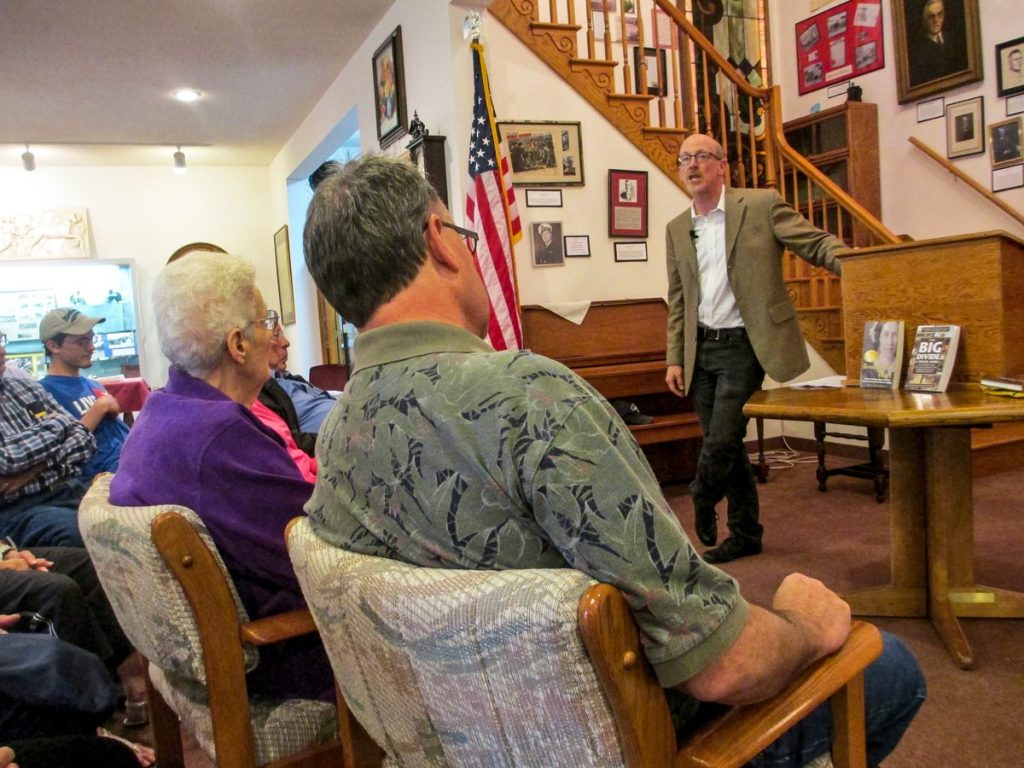
Most of Barnhart’s Saturday afternoon talk at the Nodaway County Historical Society Museum detailed the life of Confederate Gen. Joseph O. Shelby because Barnhart said he has studied Shelby more intensively and finds him a more interesting character.
As a successful slave-owning hemp farmer in Waverly, Missouri, Shelby organized the “Blue Lodge” group that terrorized abolitionists and people who were pro-Union during the Bleeding Kansas struggle that lasted from 1854 to 1861.
Barnhart labeled Shelby as an agitator who sought to preserve a way of life that he valued. Over time, however, Barnhart said Shelby shifted his way of thinking, which is what interested him in preserving and promoting Shelby’s reputation.
“Plus, I don’t think I would want to spend too much time in Jesse James’ head,” Barnhart said.
Barnhart traced James’ early entry into murder and robbery to having watched Union soldiers torture his stepfather for information.
“Jesse was scarred at a formative age, and it flipped a switch,” Barnhart said.
Having been raised with a pro-Southern mentality in a border state, Barnhart said, created lifelong problems for James. During the Civil War, James joined “Bloody Bill” Anderson’s gang of guerilla fighters in 1864. Casting James as more of a psychopath than a Robin Hood, Barnhart reminded audiences of the young man’s participation in the massacre that took place in Centralia where guerillas scalped and mutilated their enemies.
After the war, James never quit fighting. By 1870, Kansas City Times journalist John Newman Edwards reached out to James to form a correspondence that would eventually contribute to James’ celebrity status. Barnhart said it created a Robin Hood figure out of James and gave people with pro-Southern sentiments who felt disenfranchised during the Reconstruction Era a public voice.
Edwards, Barnhart said, was looking for another character to spread his own political agenda. After having served as Shelby’s adjutant during the Civil War, Newman needed a winner. Edwards chronicled Shelby’s military career in what Barnhart called a romantic and dramatic version of actual events.
When Shelby tried to reclaim his civilian life after the Civil War, however, he wasn’t as useful to Edwards because he began to mitigate the differences of principle in Missouri.
After failing with several business ventures and losing his early fortune from hemp farming, Shelby sought success in politics.
“There was a lot of cachet in being a storied Confederate General at the time,” Barnhart said.
In 1872, Shelby even supported the reelection of Ulysses S. Grant. Despite being a moderating democrat at the time, Shelby remained close to his affiliations with the Jameses.
When Frank James, Jesse James’ older brother, was tried in 1883 for the robbery of the Rock Island Line train in Winston, Missouri, Shelby was called for the defense. James was acquitted of all charges.
By the time he was appointed U.S. Marshal for the Western District of Missouri in 1893, Shelby had made friends with Union Army officials.
“He was the kind of aggressor to live long enough to regret what he did,” Barnhart said.
To Barnhart, these historical figures shared much in the viewpoints of their upbringing and the violence of their exploits, but they diverged in how they managed life in a Balkanized state.