A Day in the Life: The Rev. Joe Ledbetter
TONY BROWN/DAILY FORUM
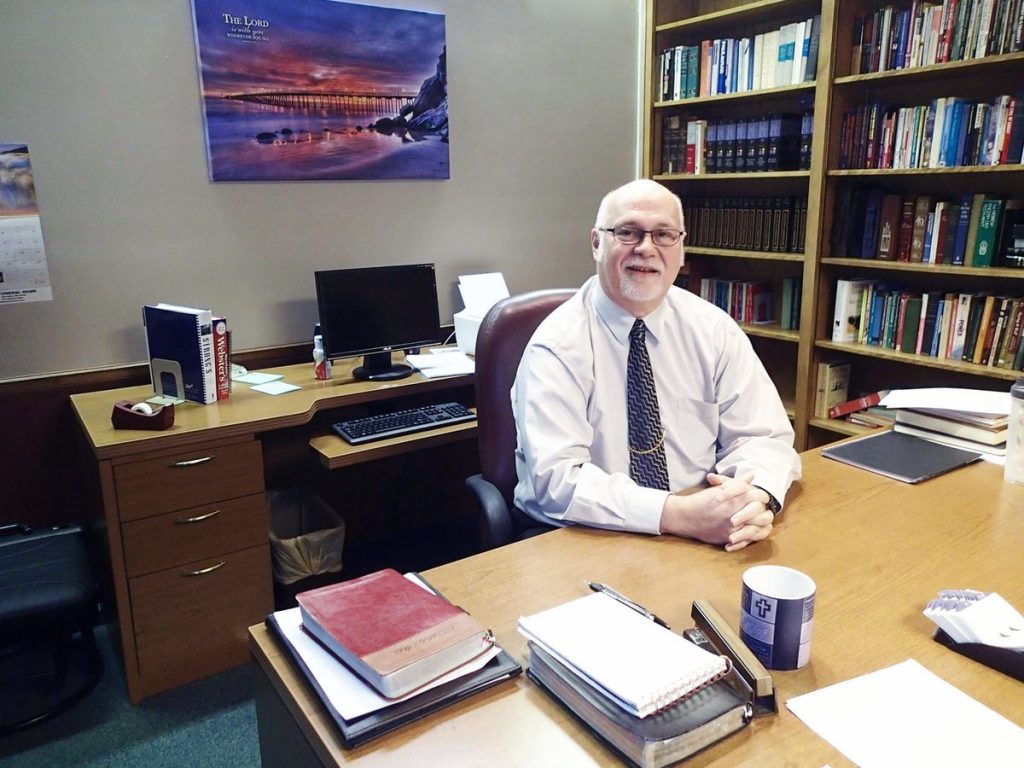
The Rev. Joe Ledbetter, who entered the ministry after a long career with the Missouri Department of Corrections, is shown in his study at the First Baptist Church of Maryville. “I love people, and this allows me to love people,” Ledbetter said. “If I didn’t get paid anything I’d still be doing this.”
Perhaps more than people in any other profession, pastors’ lives are defined by their work. And almost all men and women of the cloth will tell you that leading a group of believers along the sometimes rugged path of faith is truly a calling, not just a job.
Certainly that appears to be the case for the Rev. Joe Ledbetter, pastor of the First Baptist Church of Maryville, located at 121 East Jenkins St.
Tall, broad, and smiling, Ledbetter is a man who obviously relishes his role as shepherd, guide, spiritual partner, and friend to a growing faith community of about 100 people.
Serving as a pastor is a second act for Ledbetter, who spent more than 30 years as a corrections professional. During much of that time he was associated with the Maryville Treatment Center, where he worked from the mid-1990s when the state prison was established until his retirement in 2010 after eight years as MTC warden.
Though he is proud of his corrections career, stepping into the pulpit at Faith Baptist Church in Bedford, Iowa, shortly after leaving the state Department of Corrections, gave Ledbetter the chance to answer a call to ministry he first felt as a young man raised within the traditions of the Church of the Nazarene.
That early spiritual yearning led to MidAmerica Nazarene University, where Ledbetter earned a bachelor’s degree in religion.
But after graduation, he found that the doors to pastoral life “just weren’t opening up,” and corrections became his career of second choice.
And that may have been just as well, since Ledbetter soon found that prisoners need faith, hope, and love just as much as families, Sunday school teachers, and deacons.
“I discovered that corrections is one of the biggest ministries that is needed now,” he said.
Still, as his prison career drew to a close, Ledbetter found that the call to minister in a church setting remained, and that God was leading him to use his well-honed leadership and administrative skills in a new way.
So, after three and a half years in Bedford, the invitation came to return home and lead First Baptist.
So what are his days like?
Well, it may come as a surprise to folks who fill a pew only a couple of times a year — or not at all — but there’s a lot more to being a preacher than preaching.
First of all, there is no normal. The phone can, and sometimes does, ring at 3 a.m. when a church member or someone from a member’s family is sick or injured or going through a personal crisis.
Technically semi-retired, Ledbetter supposedly works part time at First Baptist, but when people are hurting, either physically or emotionally, that goes out the window.
“For a pastor to have an established day of rest is difficult,” Ledbetter says, describing a “typical” weekday as one that includes hospital visits, sermon preparation, and enough office hours to ensure that he remains accessible to his congregation.
This last is important, he said, because not infrequently a minister’s main job is just to be there with a pair of open and sympathetic ears.
“Sometimes people will come by and say they just want to visit,” he said, “but then you find there’s something that they really need help with.”
He adds: “A lot of being a pastor is listening, and that is one thing I learned having worked in the prison system for a lot of years. There are things people talk about, but that’s not the bigger issue. You have to listen to what they are really saying.”
In addition to individual counsel and comfort, which he said can embrace everything from prayer and shared tears to the occasional dose of “tough love,” Ledbetter also spends as many as 20 hours a week preparing his Sunday morning sermon, a process he describes as requiring “a lot of time reading and a lot of time studying” in his book-lined office.
“It’s almost like a lawyer preparing a case to present to the jury,” he said, explaining that he tries to build his messages around a series of key points designed to leave his listeners “with a decision to make” about their relationship with God.
“The main thing is that I always want to point to Jesus and the cross …” Ledbetter said. “I want to show them that there is a God in heaven.”
Another concept Ledbetter tries to get across from the pulpit, he said, is the need for believers to “develop a Christian world view that applies to every area of our lives — how we think, how we live, and how we behave.”
Besides writing and delivering his weekly sermon, Ledbetter also helps teach a Sunday school class for young married couples. In addition, there is a Sunday evening Bible study session and, on Wednesday night, a prayer group, an adult Christian life class, and the Awana program for children and teenagers.
It’s a busy life and one often lived in full view of those he pastors. Indeed, one of the biggest challenges many ministers face is dealing with the stress of a fishbowl existence in which expectations for perfection are high and all eyes are watching.
But Ledbetter says that, so far at least, his job is one that gives him unalloyed happiness — except that, at 62, he might like to have more time to go fishing.
“Sometimes God just lays something on your heart, and you just have to do what he’s telling you to do,” Ledbetter said of his life as a pastor. “I find fulfillment and joy and peace in doing it, by following God’s will.
“I love people, and this allows me to love people. If I didn’t get paid anything I’d still be doing this.”