Maryville schools provide safe space for children with autism
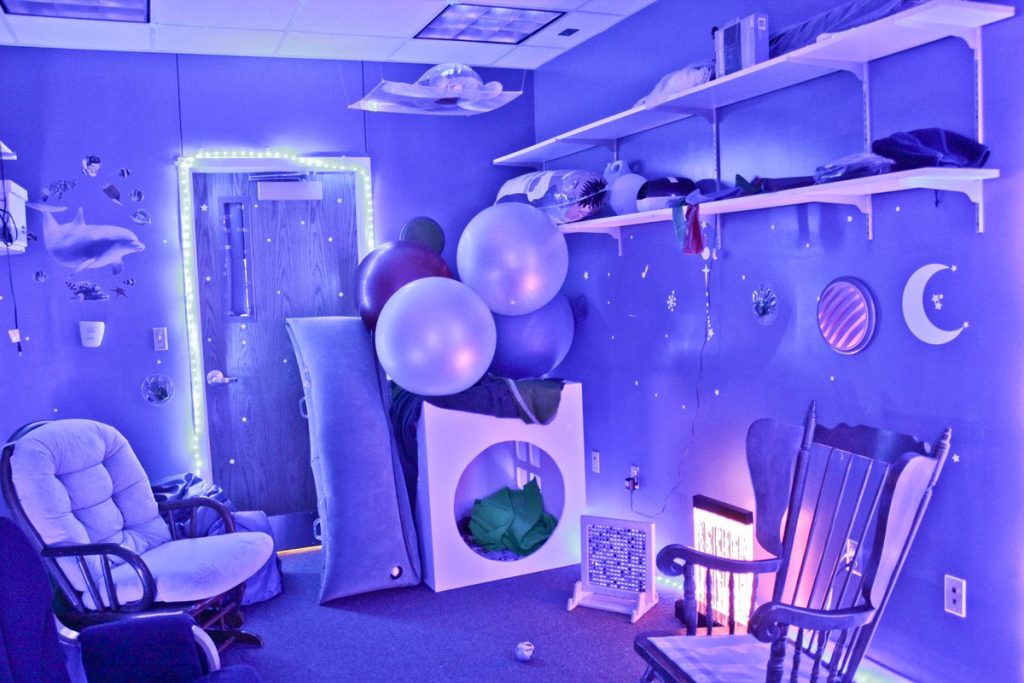
JENNIFER DITLEVSON HAGLUND/DAILY FORUM
Maryville Middle School added this sensory room within the last year to provide a place for children with sensory processing issues to regroup. Eugene Field Elementary School and Maryville High School have them as well. Students who use this resource spend an average of 10 minutes in the room, doing activities that help them with sensory overload or a need to expend energy.
Autism awareness ribbons and signage often incorporate multicolored puzzle pieces to reflect the diverse situations of people living with autism spectrum disorder.
It’s a complex condition that the Centers for Disease Control and Prevention estimates affects one in 68 children in the United States.
For someone without any personal connections to those with ASD, it could be hard to identify and understand behaviors. Although many people with autism require special services throughout their schooling, ASD is not a learning disability or mental health issue.
According to Student Services Director in the Maryville R-II School District Katie Neubauer, students confirmed with educational autism have sensory, language, or social impairments. The child may have one or all of these.
“The spectrum is just huge,” Neubauer said.
Living with autism often means having to learn social expectations that many people learn by observation. For example, people with ASD may not understand facial expressions or tone of voice. They may also avoid eye contact and react strongly to scents, textures, lights, and tastes.
Autism is five times more prevalent in males than females, but research has yet to pinpoint why.
“There are a lot of correlations but not a lot of cause and effect,” Neubauer said.
Scientists aren’t sure if genetics or environment — or a combination of the two — contributes to the likelihood and severity of a person having the condition.
In recent years, the number has continued to climb.
Neubauer said the figure might not reflect an increase in cases as much as it signifies how perspective on the condition has changed and how gradations are classified according to the Diagnostic and Statistical Manual of Mental Disorders.
Susan Law, who is the autism specialist for the Maryville R-II School District, said she works with seven students with ASD at Maryville Middle School.
“All of the kids are completely different individuals,” Law said.
For the past seven years, Law has worked with students with ASD, and she said there isn’t a lot of overlap when it comes to preparing curriculum or teaching the students life skills.
Neubauer said teachers try to keep students with ASD in the classroom as much as possible, but sometimes they need to work in small groups or individually with a special needs teacher.
This year, MMS added a room for Law to work with children with autism.
Law modeled the sensory room after the one at Eugene Field Elementary School and used ideas from resource magazines. Noise machines with ocean sounds, soft blue lights, a bed, pillows, and some toys give children the opportunity to calm down or burn some energy.
Law said students spend an average of 10 minutes there, doing whatever helps them to focus and resume previous activities. Sometimes, Law sends students in there, but they also can request it.
When interacting with a person who has autism, Law said, it’s important to wait for responses.
Also, Law said she discovered that she is most successful communicating with her students when she uses few and direct words.
“As a teacher, of course you like to talk, but because of how they process, they’ve already quit listening by the time you finish what you’re saying,” she said.
The R-II district evaluates students to determine the level of assistance they might need in and outside the classroom. However, pediatricians, neurologists, and psychiatrists provide the medical diagnoses for ASD.
Neubauer said children who come with medical diagnoses still undergo testing at the school for placement and for progress assessment.
“The prevailing theory is that there’s not a cure, but there is intervention, and you can see how successful that is.”
Interventions can take place before children get to school. Recent research in the field indicates that infants can be red-flagged for delayed social development. Infants and toddlers who don’t cuddle, reach to be picked up, return smiles, or make eye contact could be at risk for having ASD.
Because development is so individual, however, caretakers can be unnecessarily alarmed about children not hitting milestones at a certain time and figuring out the difference between a curiosity and a fixation.
“A hallmark is that the fixation looks different from curiosity,” Neubauer said. “If a young child is interested in a new sensation or object, they eventually incorporate the new thing into their lives. A child who is fixated cannot move on.”
Neubauer said that it’s not always easy for caregivers to address a child’s special needs because it takes a lot of adjustment. Often, many conversations begin because of deficits that students have in development or comprehension.
For parents, family, and friends of people with ASD, Neubauer said it’s important to find ways to relate by taking interest in what they do.
More information about ASD is available at autismspeaks.org.
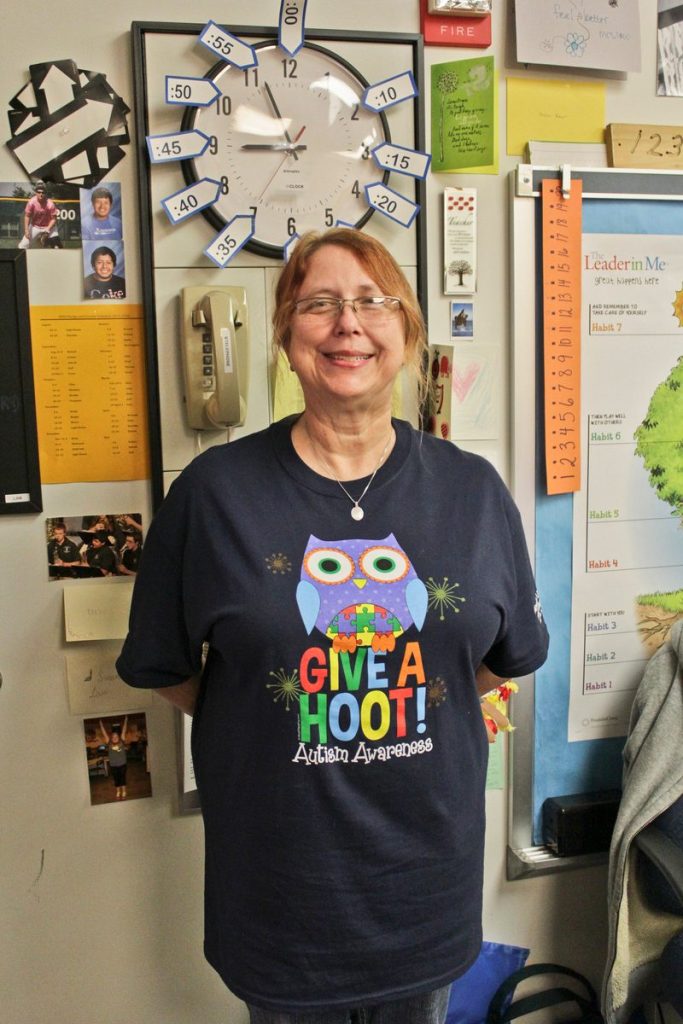
JENNIFER DITLEVSON HAGLUND/DAILY FORUM
Susan Law, who is the autism specialist for Maryville R-II School District and a special needs teacher at Maryville Middle School, said she changed careers from working in human resources to teaching because she wanted to help children with unique situations.