Meeting raises opposing views on Jefferson gym
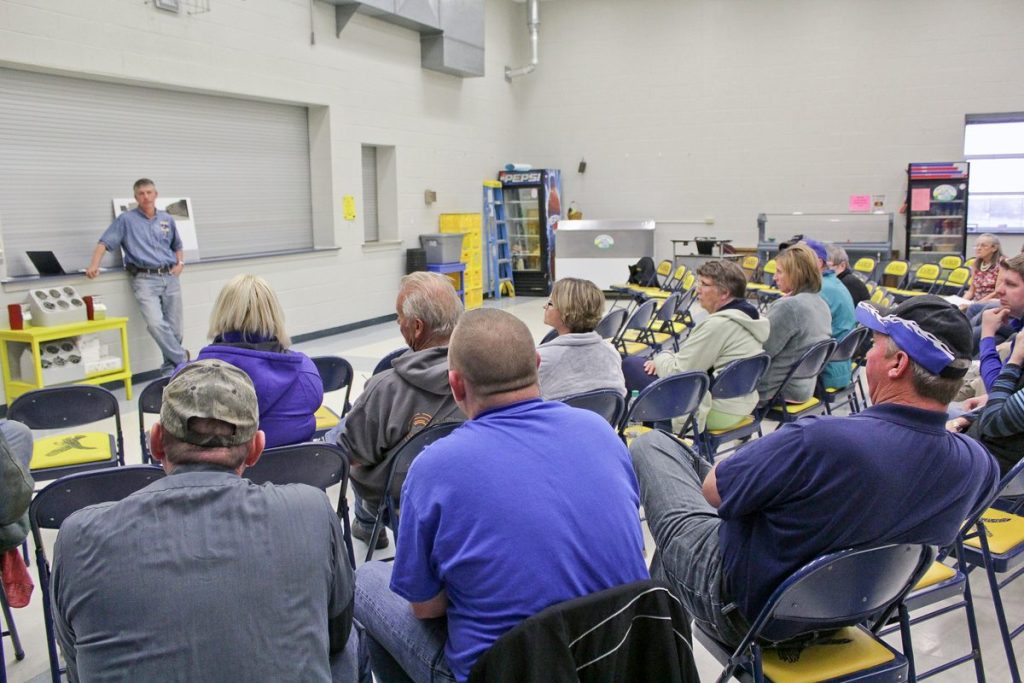
JENNIFER DITLEVSON HAGLUND/DAILY FORUM
Jefferson C-123 District Board of Education President Ray Meyer took questions about the $1.5 million general obligation bond to construct a new gymnasium. The issue is on the April 5 ballot for the seventh time in eight years.
For the seventh attempt to win a super majority for the $1.5 million general obligation bond issue in eight years, the Jefferson C-123 District Board of Education and administrators want to know what keeps plans for an auxiliary gymnasium on hold.
At an informational meeting at the school Thursday night, opponents and supporters of the issue shared their concerns about keeping their community intact. Board President Ray Meyer and Superintendent Tim Jermain said they wanted to know if people are against building the gym, the tax, or both.
Because the levy would increase property taxes, opponents expressed hesitation to vote for an issue that would take more money from their budgets.
“If we could do it besides property taxes, we would do it,” Meyer said.
Gary Lager of Clyde referenced 2013 statistics when he said Nodaway County is one of the poorest in the state. In 2014, Nodaway County’s poverty rate was 20.8 percent.
“I don’t know how you could justify adding another tax to us,” Lager said.
Meyer said that people pay taxes for everything, so they might as well pay taxes on something they know will benefit their community.
“And not only are you paying tax, but the windmills are going to pay half of it,” said Meyer.
Not knowing how long the windfarm would remain in the area caused some attendees to worry about whether or not they would be stuck with the bill. Although Meyer said he couldn’t promise that they would stick around, he reminded the audience that the Conception Wind Farm would have to break the contract that obligates them to stay another 17 years.
Meyer said that continuing to vote against the new gym risks losing support from the revenue generated from the windmills in the area. According to the informational brochure about the bond, the 2014-2015 audit indicated that 49 percent of the school’s revenue comes from local sources. Of the local sources, local taxes generate 70 percent of that revenue. The wind farm paid about 41 percent of the local tax money.
“We’ve already lost seven years,” Meyer said.
Tax revenues brought in by the wind farm has paid for a new roof and a heating system, but Jermain said there isn’t enough money for a gym.
Those in favor of passing the tax increase raised points about how the gym would serve several purposes.
Having a co-op with South Nodaway R-IV School District for sports, Jermain said, does not mean that the school will use its gym less. Joining South Nodaway for multiple sports means that practices can’t take place during the school day. After school practices will fill the gym for more hours per day.
Faculty and staff from Jefferson in support of the bond issue said they view the gym as vital for teaching.
“I think of this as a classroom,” said Stacey Mattson, a paraprofessional at Jefferson. “I don’t think of it as using it for basketball, softball, or whatever. I think of it as a needed classroom for our whole school.”
Tyler Pedersen, who is a health and physical education teacher at Jefferson, said he knows that times have changed. Even though the school’s students live in a rural area, that doesn’t mean they’re doing farm work to get their bodies moving and teach them about work.
“Playing on a team can teach them a strong work ethic,” Pedersen said.
For the proponents of the levy, getting a new gym has greater ramifications than bettering academics and sports. It could potentially keep the community from losing more population and secure its future.
“The community is going to die if you don’t have a school,” said Raymond Jermain of Conception Junction.
People on both sides of the issue raised the possibility of consolidation. Neither side wanted to see students spending more than an hour every school day to get to and from school.
Jermain also clarified a rumor that the Board would build the gym regardless of the vote.
“That’s not the truth,” he said. “We can’t do that. We wouldn’t have the money to do that.”
The board, however, did discuss running a lease purchase that would only require a simple majority. The lease purchase would allow the school to acquire the gym without paying the full cost at once, whereas the obligation bond would set aside the total amount. The board decided against the lease purchase, Jermain said, because pursuing an obligation bond was a more stable route to acquiring the funds to construct the gym.