Fellowship and ministry go hand in hand
JESSICA ALLEN/DAILY FORUM
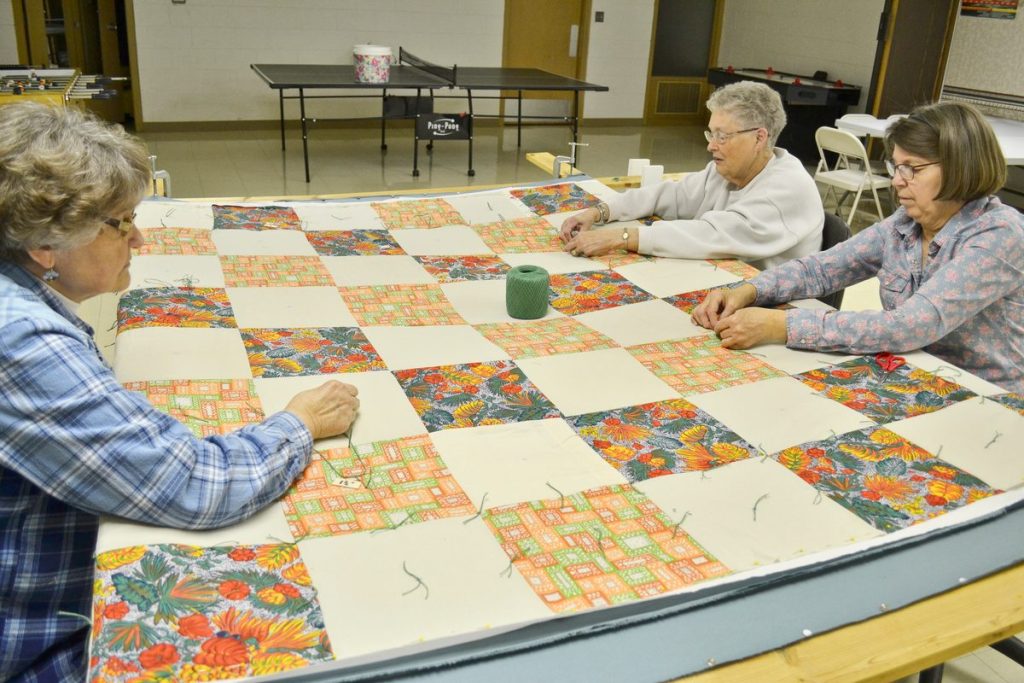
Marcia Droegemueller, Phyllis Abbott, and Pam Myers, from left to right, work together to tie a quilt in the basement of Hope Lutheran Church in Maryville. The women are part of the Lutheran Women’s Missionary League ministry that produces around 20 quilts each year to be sent overseas or to areas in the U.S. that have experienced a disaster.
Fellowship and ministry go hand in hand for the women of the Lutheran Women’s Missionary League at Hope Lutheran Church in Maryville.
Each Thursday afternoon from just after Christmas to just before Easter, the group of about six women gathers in the church basement to tie quilts.
The ministry is a tradition for Marcia Droegemueller.
“It started because my mother had tied quilts in her church basement,” said Droegemueller, who began organizing the ministry a few years after she joined Hope Lutheran in 2002.
The women tied just five quilts when they began the ministry about 10 years ago. This year, their goal was 28, one for each pew in the church sanctuary.
Last Thursday, the women worked on quilts 27 and 28 after keeping up a steady pace of about two to three quilts a week.
“This year we’ve been coming in at different times so we can get them finished,” said Marilyn Bettis.
Quilt tying involves using thread to tie together the three layers of a quilt—the squares that make up the top layer, the batting, and the backing.
Droegemueller begins a quilt by cutting 80 10-inch squares of cloth and sewing them together to create the top layer of the quilt before bringing it to the church to be tied.
Material for the quilts is donated by people in the church and some community members who are aware of the ministry.
“So far we have not bought material,” said Phyllis Abbott. “It’s all donated. Every year you wonder, ‘Will we have enough fabric?’ and every year we seem to have enough.”
The donated material can consist of anything from large pieces of fabric to sheets, scraps, and even clothing.
Part of the challenge, and the fun, for Droegemueller is taking the eclectic supply of materials and creating coordinating patterns for the quilts.
“It’s all scraps but it’s amazing how different colors come together as you’re working,” she said. “You can make a whole kid’s quilt out of fabric given by six or seven different people.”
This year, for example, the women put together a Christmas-themed quilt.
The group emphasized that what they do is not actually quilting, which involves sewing tiny, intricate stiches.
“We laugh because in the church bulletin it says ‘quilting’,” said Droegemueller. “We’ve tried to change it to say ‘tying quilts’ but it always comes back to ‘quilting’.”
“I hope people don’t think we sit down here and make 28 hand-stitched quilts,” she added.
Quilt tying allows more women to participate in the ministry because it is a simpler process that does not require knowledge of sewing.
Once the quilts are tied, however, Droegemueller finishes by sewing the edges together.
While all the women agreed that Droegemueller is the driving force behind the effort, Droegemueller emphasized that they could not complete as many quilts as they do without everyone pitching in.
The ministry is also an opportunity for camaraderie and building relationships.
“It’s really good fellowship,” said Bettis. “We get together and we can talk while we work.”
Perhaps an appropriate theme song for the women would be the old hymn “Blessed Be the Tie That Binds.”
“A couple years ago we had a Sunday school class come and we had teenagers tying and we talked about that hymn and different concepts of tying,” said Droegemueller. “We’re hoping to do something for people in need, but there’s also that tying of friendship.”
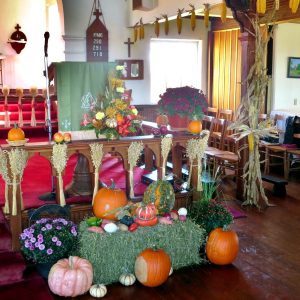
Once all 28 quilts have been tied and finished, they will be laid across the sanctuary pews and dedicated during a church service before being sent to either World Relief in Minneapolis or Orphan Grain Train in Norfolk, Neb.
The quilts are then sent overseas or to areas in the U.S. that have experienced some kind of disaster.
In countries with hotter climates, the quilts may be used for privacy as room dividers.
One of the women at Hope Lutheran, Pam Myers, has a special connection to Orphan Grain Train. Her father and uncle helped open a warehouse for the organization in Ida Grove, Iowa.
The warehouse is used to store quilts, clothing, and other donated items, which are then shipped overseas.
“Women from our church sometimes take trips and go to some of these countries and they see a quilt here and a quilt there,” said Droegemueller. “It’s just so exciting to see these quilts helping and being used.”
“It’s really good fellowship,” said Bettis. “We get together and we can talk while we work.”
JESSICA ALLEN/DAILY FORUM
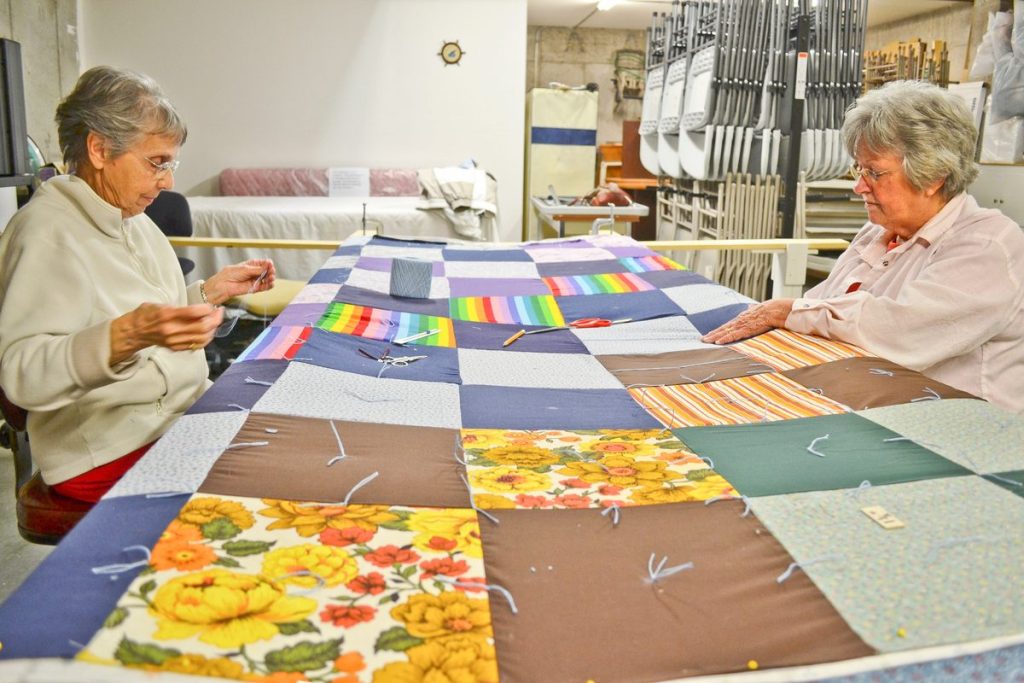
Marilyn Bettis, left, enjoys the friendship that arises from tying quilts with Pat Bobzien and other women at Hope Lutheran Church. The women meet each Thursday afternoon to tie quilts that are then donated to organizations such as World Relief and Orphan Grain Train.