Police dispatcher makes the tough calls
TONY BROWN/DAILY FORUM
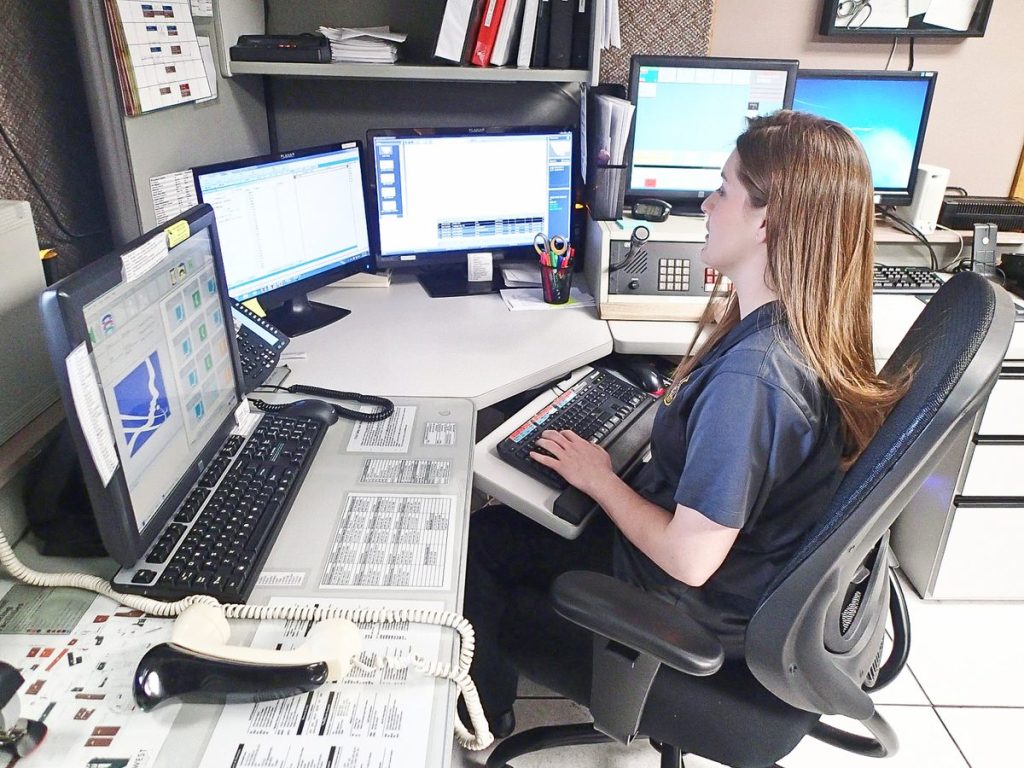
Jessica Sigman, dispatch supervisor for the City of Maryville Department of Public Safety, is shown at work near the close of a recent weekday shift. “I like the feeling of helping people in our community,” she said. “You’re either helping someone have a better day or being there for them on a bad day.”
When Jessica Sigman, the 23-year-old dispatch supervisor for Maryville’s Department of Public Safety, starts her regular dayside shift at 7 a.m. she’s likely to face anything from a house fire, to a high-speed chase, to an armed robbery, to a medical emergency, to basic record keeping and routine communication with police officers in the field.
“There is no normal,” said Sigman, the daughter of Missouri State Highway Patrol Trooper Darren Sigman and a graduate of Northwest Missouri State University’s Emergency Disaster Management program.
Sigman started working for MPS as a part-time dispatcher before going full time in 2012. She became the dispatch supervisor, assuming responsibility for two full-time dispatchers and six part-time staff, two years later.
While her days, and sometimes nights, are unpredictable, dispatch shifts, which last from 7 a.m. until 3 p.m., 3 p.m. until 11 p.m., and 11 p.m. until 7 a.m., do have a certain rhythm.
Usually Sigman gets to work in the morning in the cramped, screen-filled MPS communications room about 10 minutes before 7 o’clock. She receives a quick rundown from the nightside dispatcher about any ongoing situations, which can cover the gamut from medical emergencies to fires to arrests. Then she determines what kind of follow-up needs to occur.
For example, if someone has been injured overnight or involved in some other calamity, and authorities have been unable to reach the family — people often keep their phones turned off at night, Sigman said — she has to make those calls.
It’s not a cheerful task with which to start the day.
Usually however, as with most law enforcement work, the morning begins with routine.
Sigman establishes what officers are on duty, what vehicles they are driving, and then records the mileage those vehicles have racked up.
She also takes radio and telephone calls from officers requesting her to “run” license plate or driver’s license information through the Missouri Unified Law Enforcement System (MULES) and then enters that data into a Computer Aided Dispatch database so that it can be quickly accessed as needed.
It’s painstaking, detail-oriented work, and the information recorded often ends up being used as evidence in court.
In Maryville, during the daytime, there are usually between two and four officers on patrol plus a detective, a lieutenant, and Maryville Public Safety Director Keith Wood on duty at the station.
In addition, School Resource Officer Josh McMillen is working at one of the Maryville R-II School District’s three campuses, and Sgt. Rick Smail is either patrolling Mozingo Lake Recreation Park or teaching D.A.R.E. classes.
Sigman’s job, besides supervising her staff, is to make sure all these people have access to the information and communications resources they need at the moment they need them regardless of whether it’s a slow day or one of those not-infrequent shifts when very bad things happen extremely fast.
Aside from officer communication, Sigman also fields calls from citizens, everybody from homeowners upset about their driveway being blocked during a football game to newspaper reporters — often this one — demanding to talk to Director Wood as soon as possible. She always responds, as the writer of this story can confirm through experience, with flawless courtesy.
But the real test for any dispatcher is when a 911 message or other emergency call comes in.
Whenever there’s a genuine emergency, and in Maryville that happens more often than one might think, Sigman says she tries to act like “a duck on the water,” gliding serenely across the surface while paddling like mad underneath.
Moments after a bad wreck, a violent crime, or a fire, she often finds herself talking on the radio with a landline receiver clapped over one ear and a smartphone jammed against the other while coordinating the whereabouts and actions of police officers, ambulance crews, and firefighters, each of whom need all the information there is to be had no later than 15 seconds ago.
“That happens all the time,” she said.
It is not a job for the faint-hearted or the emotionally fragile — and absolutely not for the untrained.
And that may be Sigman’s biggest challenge. In addition to acting as the lead weekday dayside dispatcher she is also responsible for keeping the entire dispatch staff up to snuff.
New dispatchers require seven to 10 weeks of training and must master a policies and procedures manual about 6 inches thick.
The learning curve is so daunting that Sigman said she divided what used to be a single gargantuan notebook into three two-inch binders so all that paper wouldn’t look so intimidating.
Trainees have to learn both the immense, jargon-stuffed protocol of law enforcement radio communications plus the nuances of working with the public, such as knowing that older Maryville residents are likely to call the Laura Street Baptist Church youth center the “Cardinal Inn,” a long-closed restaurant.
“I tell them (dispatch trainees) that 100 percent of the job is to help the community,” Sigman said, “and 100 percent of the job is to help the officers.”
That’s right, a 200 percent job. Forget about all those coaches who urge athletes to give “110 percent.”
It is an all-but-impossible assignment, and Sigman admits that neither she nor any member of her staff ever has a perfect day or night.
“A win in our book,” she said, “is when everybody comes home safe.”
But that doesn’t always happen, and in the aftermath of violent crime, destruction, loss, and death there is the inevitable emotional backlash. And when that happens, Sigman’s job assumes a deeply human dimension.
A dispatcher can do everything by the book with blazing speed and textbook efficiency, and “sometimes things still end badly,” she said.
When that happens, Sigman simply tries to make sure her staff has the emotional support they need to move on.
After especially rough calls, she said, she makes a point of giving her dispatchers “an opportunity to talk it out.”
Sometimes, she said, dispatchers just have to come to grips with the fact that a tragic situation was handled with speed, efficiency, and courtesy and “that there’s nothing else you could have done, so it’s not like you dropped the ball.”
As one might expect, Sigman said most dispatchers are “a little ‘type A,’” perfectionists who like to have a plan and get things done right. But the job also demands considerable flexibility and a talent for “bending where you need to.”
Asked why she likes her job — which she obviously does — Sigman said it’s hard sometimes to be exposed to “things you wish you didn’t know,” but that the rewards are worth the trauma.
“I like the feeling of helping people in our community,” she said. “You’re either helping someone have a better day or being there for them on a bad day.”