County, city discuss Depot Street gap
TONY BROWN/DAILY FORUM
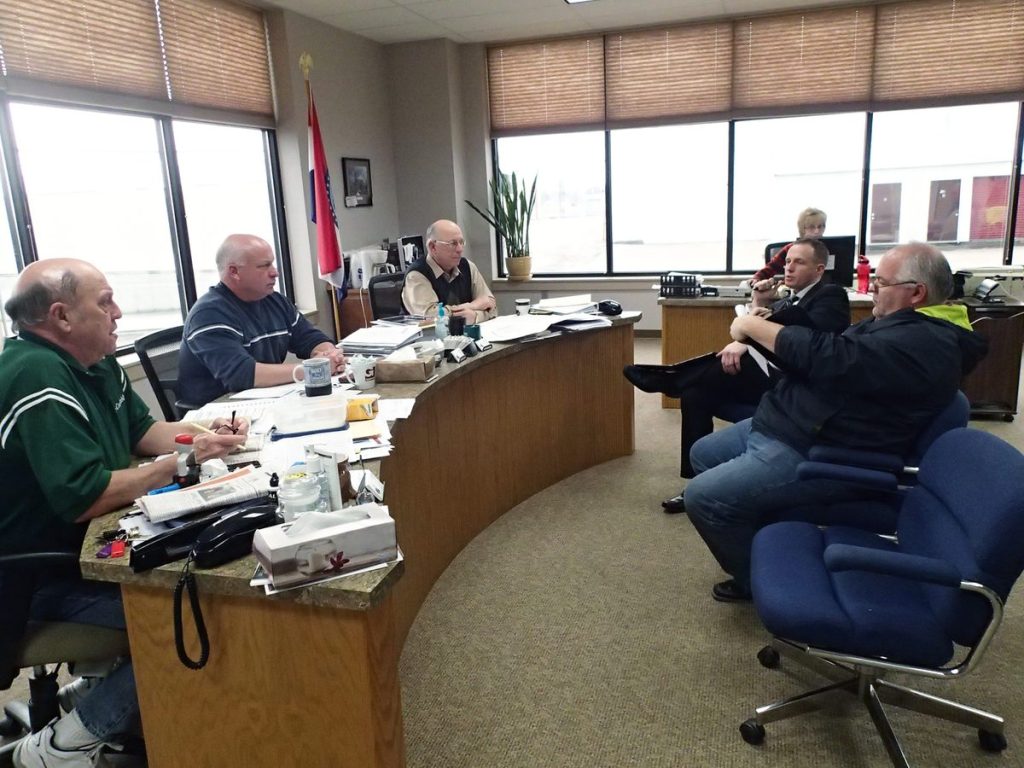
City Manager Greg McDanel (in suit) and municipal Public Works Director C.E. Goodall are shown discussing transportation issues last week with the Nodaway County Commission. Pictured behind the commission chambers desk from left are North District Commissioner Robert Westfall, Presiding Commissioner Bill Walker, and South District Commissioner Robert Stiens.
The City of Maryville’s top administrator and Nodaway County’s three-member board met Friday to discuss pending transportation projects and other issues pertaining to both governments.
Top on the list was the unpaved 200-yard gap on South Depot Street between East Halsey Street and the city limits, which end just south of the New Nodaway Humane Society animal shelter.
Presiding County Commissioner Bill Walker said he has been getting phone calls from constituents about the dilapidated strip of roadway, which was not included in the city’s 2013 reconstruction of Depot between East First Street and East Halsey.
At about the same time most of the city’s portion of the street was rebuilt, the section of Depot running south from the gap to South Avenue, which lies beyond the city limits, was paved by Polk Township.
Because the two sections of pavement fail to meet in the middle, motorists get a rough ride along what would otherwise be a fully improved north-south corridor on the east side of town.
Just how the gap came to be has been a subject of debate between township, county, and municipal officials. Public Works Director C.E. Goodall, who joined City Manager Greg McDanel in meeting with the County Commission last week, said the city was unaware of Polk Township’s plan to pave its portion of the roadway until after the municipal project was halted at Halsey Street due to fiscal considerations.
As originally engineered, the city’s South Depot reconstruction project stretched to the Polk Township line. However, the scope of work was reduced in order to free up funds for a similar street rebuild of South Munn Avenue, which provides access to Maryville High School.
In the meantime, the township decided to proceed with repaving its portion of Depot with funds from the Pave it for Pennies sales tax levy, which is no longer on the books.
The township project involved expense for both the city, which had to reroute some underground infrastructure, and the county, which replaced a large drainage tube.
During the summer of 2013, the Maryville City Council discussed possibly overlaying the unpaved gap with asphalt, but ultimately decided that anything less than a permanent concrete street would be inadequate since Depot carries a significant amount of truck traffic.
McDanel told the County Commission on Friday that while Maryville plans on eventually extending South Depot reconstruction to the city limits, work will not begin for at least a year or two.
That’s because remaining revenue from Maryville’s half-cent capital improvements sales tax, which expires in 2018, will be used to pay off debt incurred for already completed projects, including Depot Street, Munn Avenue, West Fourth Street, Sixteenth Street, and a portion of Main Street.
McDanel said the city will likely ask voters to renew the sales tax for another 10 years in the April 2017 municipal election. If the measure passes, he said, Maryville would be in a position to issue bonds to finance extension of Depot Street paving so that it links up with the township section.
On other fronts, McDanel, Goodall, and the commissioners talked about proposed installation of a permanent household hazardous waste collection and storage facility to be located near the county maintenance garage.
The facility itself is to be fashioned from a metal storage container or similar structure and paid for largely through a grant from the Missouri Department of Natural Resources. The grant would also cover transport of collected waste to an approved disposal site and training for collection site staff.
However, the grant will not include wages for staff who would have to be on hand whenever household waste, such as solvents, cleaners, oil-based paint, and fluorescent bulbs, is deposited.
The commissioners asked McDanel if the city would be interested in having one or more of its employees trained as household hazardous waste handlers and in sharing the personnel cost involved in operating the facility.
McDanel said he was open to the idea and would take the proposal under advisement.
Also discussed was Maryville’s plan to overlay North Main Street with fresh asphalt this summer from the 71/136 bypass south toward the main part of town.
The two-mile-long highway-like stretch is badly deteriorated in places, and McDanel said the city will spend approximately a quarter-million dollars this year resurfacing about half that distance.
Other proposed transportation projects contemplated, but still mostly unplanned and unfunded, include paving the gravel portion of 285th Street where it runs by the Kawasaki Motors manufacturing plant. The effort is to include a merge lane that would allow large trucks and other traffic to access Highway 71 without having to turn onto South Main.
Finally, McDanel and the commissioners briefly discussed paving now-graveled Hawk Road, which is maintained by Polk Township and provides access to the Northwest Missouri Regional Airport.
While desirable, McDanel said paving the road is impractical this year due to the number of large trucks that will rumble over it during this summer’s multi-million-dollar runway rehabilitation project.
TONY BROWN/DAILY FORUM
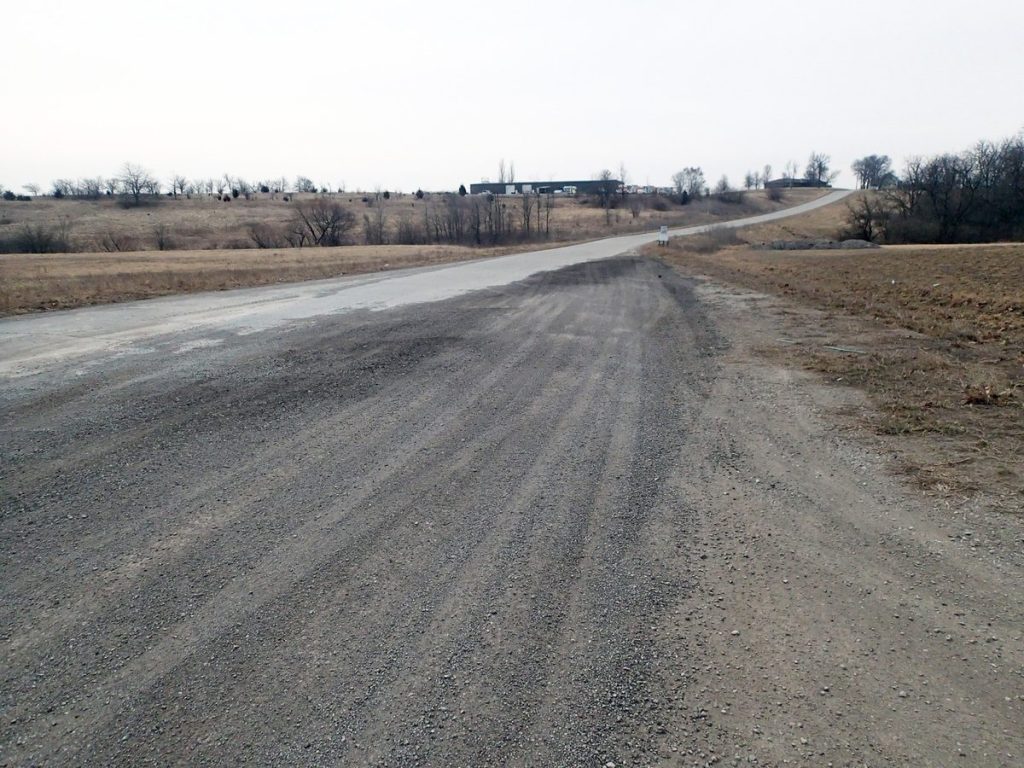
Engineering plans exist to pave South Depot Street between the city limits and East Halsey Street, but money to move forward with the project will depend on voter approval next year of a half-cent sales tax renewal. Shown here is the paved Polk Township portion of Depot where it meets with a short unpaved section owned by the City of Maryville.