Pearl Harbor hero had roots in Maryville
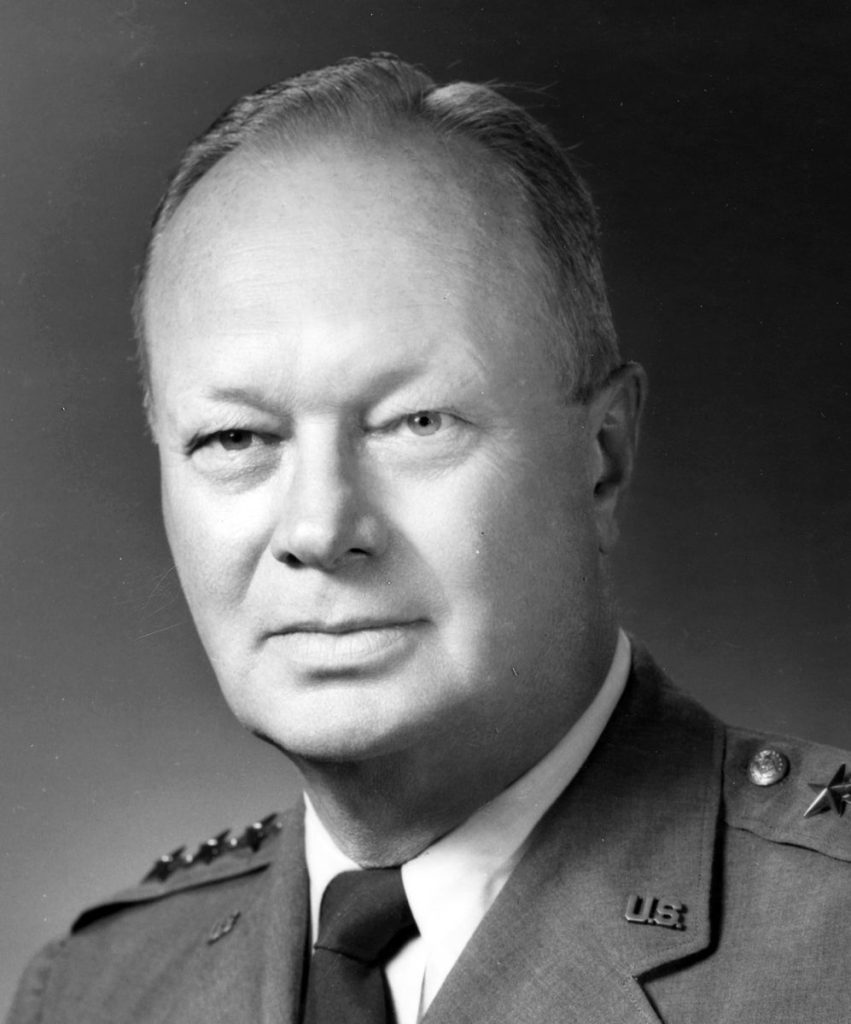
Gen. Truman H. Landon
Born in Maryville on Feb. 11, 1905, U.S. Air Force Gen. Truman Hempel Landon left an important imprint on the history of military aviation in the 20th century.
Among his many other distinctions, Landon received the Silver Star for gallantry for actions taken during the Japanese air raid on Pearl Harbor, and was briefly depicted in the 1970 movie “Tora! Tora! Tora!,” which dramatized the devastating attack that precipitated America’s entry into World War II.
Landon subsequently held key commands in the South Pacific and then in Europe during the Cold War.
The future general’s stay in Nodaway County was brief, and his family soon relocated to Carlinville, Illinois, where Landon was a high school track star.
He went on to spend two years at Blackburn College in Carlinville before entering the U.S. Military Academy at West Point. There, he was a halfback on the Army football team and a hurdler on the track team.
Landon graduated from the Academy in 1928 and, during his career, ascended from second lieutenant to full general.
The young officer received his pilot and observer ratings at Kelly Field in Texas in 1930 and subsequently spent two years with the 3rd Attack Group at Fort Crockett, Tex.
Landon then served as a flying instructor at Randolph Field from 1932-36 and with the Sixth Bomb Group at France Field in the Panama Canal Zone from 1937-39. From 1939-42, he commanded the 38th Reconnaissance Squadron.
On May 13, 1941, he was in the first mass flight of B-17s from Hamilton Field in California to Hickam Field in Hawaii.
On Dec. 7 of that year, Landon was heading for the Philippines as commander of the 38th Squadron when he arrived at Hickam Field to find the Japanese attack in progress.
The flight of 12 B-17s had originated from Hamilton Field, a 14-hour trip, and was nearing the end of its fuel load as it approached Oahu at 8 a.m., local time, and saw the smoke rising from Pearl Harbor.
Despite being completely unprepared for battle, Landon calmly engineered the safe landing of his flight amid intense anti-aircraft fire.
Landon received the Silver Star “for gallantry in action, conspicuous bravery, and coolness in handling of his airplane, and in leading his echelon.”
It was one of many decorations for Landon during his career, including the Distinguished Service Medal, the Legion of Merit, the Distinguished Flying Cross with oak leaf cluster, and Air Medal with two oak leaf clusters.
As for Pearl Harbor, Landon is said to have later remarked, “Hell of a way to fly into war! Unarmed and out of fuel!”
Later in World War II, Landon commanded the Seventh Bomber Command in the Central Pacific, during which time he also commanded a Joint Task Group under the legendary Admiral Chester Nimitz.
He was promoted to brigadier general in 1943, major general in 1948, and lieutenant general in 1954.
A younger brother, Kurt Landon, was also a brigadier general. Also born in Maryville, in 1908, Kurt Landon also attended Blackburn College and graduated from West Point in 1930. He died in 1961.
Beginning in December 1944, the elder Landon spent ample time in Germany, including a stint from March 1951 to August 1953 as deputy commander-in-chief for the United States Air Forces in Europe at Wiesbaden. On July 1, 1961, Landon was nominated by President John F. Kennedy as commander in chief of American Air Forces in Europe.
Following his retirement, Landon was presented with the highest German decoration ever given to an American military officer, the Grand Cross of the Order of Merit with Star and Shoulder Scarf. Some credit Landon with the rebirth of the German air forces.
In other theaters, Landon headed the Caribbean Air Command at Albrook Air Force Base in the Panama Canal Zone from June 1956 to August 1959.
Landon’s time in Latin America reflected in his personal interests, and he was considered an authority on military and political affairs in the region. He also owned a large collection of Latin American folk records. Fluent in Spanish and German, he delivered speeches and lectures in both languages.
In Washington, Landon was successively the senior air commander and commandant of the Army and Navy Staff College. At Headquarters U.S. Air Force, he was assistant deputy chief of staff for operations, inspector general, and deputy chief of staff for personnel. He retired on July 1, 1963.
An avid golfer who also loved electronics, Landon was a devout Baptist who believed Sundays should be spent with family.
He died in San Antonio, Texas, on Jan. 27, 1986 — the day before the Challenger space shuttle explosion.
EDITOR’S NOTE: Tom Emery is a freelance writer and researcher from Carlinville, Illinois, who occasionally contributes articles of historical interest to the Daily Forum. He can be reached at [email protected].