LEDs brighten outlook at City Hall
TONY BROWN/DAILY FORUM
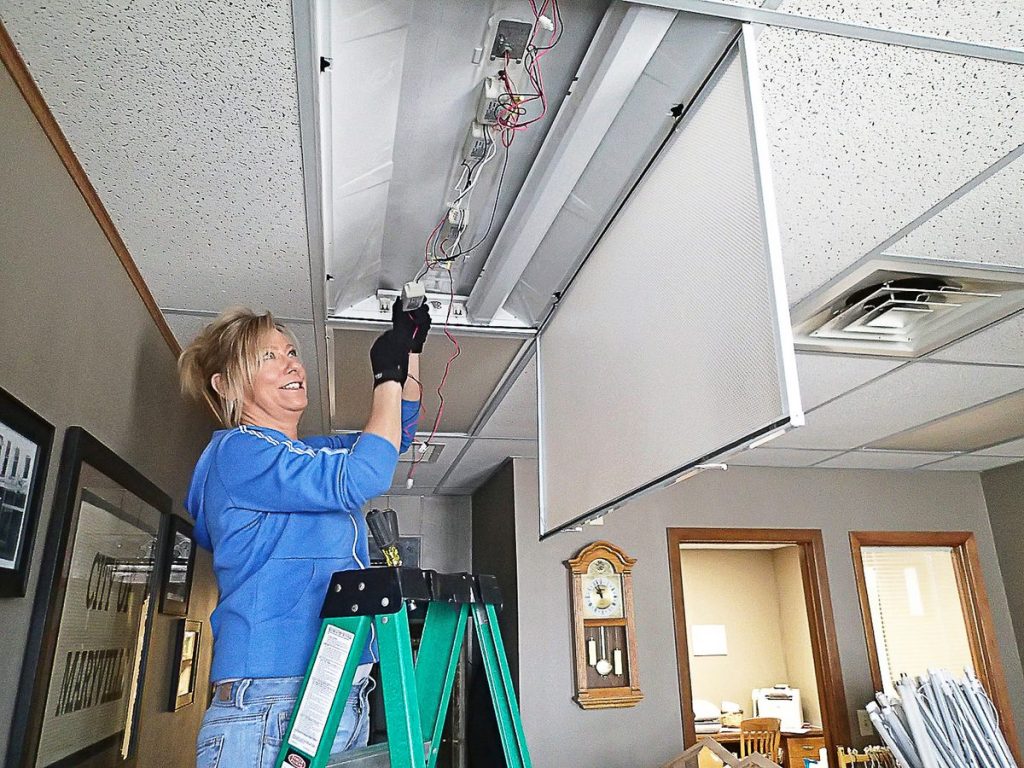
Electrical technician Karol Wilson connects LED drivers in what used to be a fluorescent lighting fixture outside the municipal clerk’s office at City Hall. The drivers replace voltage-regulating “ballasts” used in fluorescent systems and transform standard 120-volt AC current into the 48 volts of DC current required to illuminate each LED tube.
Municipal government in Maryville has seen the light — or at least will very shortly after Clinton-based American Eagle Electrical finishes replacing fluorescent and incandescent tubes and bulbs with highly efficient LEDs in approximately 600 fixtures at City Hall, Maryville Public Safety headquarters, and the street maintenance garage.
Installation by American Eagle owner David Stadter and subcontractor Karol Wilson began Monday and should be complete in two weeks or less.
In addition to the city buildings listed above, the upgrade to LEDs will also include 29 vintage-style streetlights on the courthouse square and all fixtures at the New Nodaway Humane Society animal shelter on South Depot.
The shelter is not a city-owned facility but does provide Maryville with animal control services in exchange for a municipal operating subsidy, which this year totals $60,000.
City Manager Greg McDanel said earlier that LED lighting represents an additional $12,000 worth of public investment in the shelter and will result in an estimated energy savings there of $2,800 a year. Energy costs are a major expense for the facility, which must be either heated or cooled 24 hours a day, seven days a week.
The switch to LEDs — short for light emitting diode — was approved by the city council last October through a lease agreement with Kansas City-based Brightergy, a company that specializes in lighting upgrades for both public and private sector operations.
As it did in a similar project involving three Nodaway County buildings, the Administration Center, jail, and road maintenance garage, Brightergy performed an energy audit for the city that compared before and after utility expenses and included an energy-efficiency rebate from Kansas City Power & Light that significantly lowered installation costs.
According to city documents, total cost for the LED upgrade is $108,000, nearly $53,000 of which will be covered by KCP&L. The improvements are expected to generate $187,000 in energy savings over the next 10 years plus another $55,000 in reduced spending associated with maintenance and bulb replacement.
The highly efficient lights are expected to cut the number of kilowatt-hours billed to the city by 58 percent.
According to its lease, the City of Maryville will make four annual payments to Brightergy of $13,900 each, for a total of $55,600. The energy audit indicated that the city should save $14,500 in energy costs during each of those years.
By way of illustrating the efficiency of the new lighting system, Stadter said Wednesday that each of the 34-watt fluorescent tubes used to illuminate much of City Hall will be replaced with an 18-watt LED lamp capable of producing between 40 and 50 percent more light.
In addition to removing the old fluorescents, Stadter and Wilson are also replacing the voltage-regulating “ballasts” in each fixture with LED drivers, devices that transform standard 120-volt AC current into the 48 volts of DC current required to illuminate each LED tube.
Screw-in incandescent bulbs are being replaced with similarly shaped LEDS of the sort commonly available these days in hardware stores. The units, each of which contains a small DC driver in the base, consume 9.5 watts of electricity while producing the same amount of light as a 60-watt incandescent bulb.
In moving to LEDs, the city is continuing a transition that began with an earlier Brightergy installation late in 2014 at the municipal water treatment plant east of town.
McDanel said at the time that new lighting at the plant “created a much safer work environment, literally a night and day difference.”
Installing LEDs at the water plant required a $4,650 investment by the city with an anticipated payback period of 2.6 years and a 10-year savings of $15,000. Half of the project’s $9,300 total cost was covered through the KCP&L rebate program.