City to lease transfer station to hauler co-op
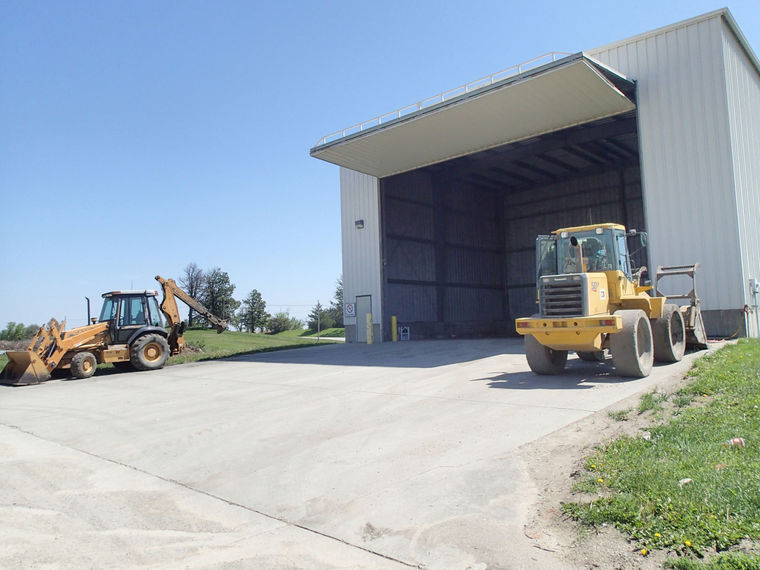
FILE PHOTO
Maryville’s municipal solid waste transfer station will soon have a new operator. Instead of being run by the city, the station is to be leased this summer to the Maryville Trash Cooperative, which will run the facility as a private business.
The City of Maryville will soon be officially out of the solid waste business, sort of.
On Monday night in a rare 3-2 split vote, the five-member council accepted a bid submitted by the Maryville Trash Cooperative, which beginning late this summer will begin operating the municipal solid waste transfer station east of town.
Mayor Renee Riedel and Council Member Rachael Martin voted against accepting the bid. “Yes” votes included council members Tim Shipley, Jason McDowell, and Jerry Riggs.
The co-op consists of three local haulers serving residential and commercial customers: Klosek’s Trash Service, Mozingo Sanitation, and Gaskill & Son Trash Service.
The only other bidder was American Recycling & Sanitation Inc. of Rock Port.
Once under contract, the co-op will run the station as a private business, paying the city $100 a month in rent. It will also dispose at no charge of up to 360 tons a year of municipal street sweepings, “clean fill,” and other debris generated by the city.
Tipping fees for private haulers using the station — that is the cost of depositing refuse there — will be $45 a ton, $12 for loads under 500 pounds, and $33 per ton of wood and brush.
A competing station operated by Porter Trash Service east of town charges $48 per ton, the same price currently charged by the city.
The opening of the Porter facility in late 2012 initiated a series of deficits for the city-owned transfer station, which as an “enterprise” operation was supposed to sustain itself without a municipal subsidy.
A solid waste transfer station is a facility where garbage is compacted and loaded onto trucks for shipment to approved landfills.
General Fund subsidies to keep the transfer station operating under city management have cost Maryville taxpayers in the neighborhood of $100,000 a year, including state-mandated testing at the municipal landfill, which closed in 2001. The cost of those tests is currently $30,000 a year and will remain a line item in the municipal budget for years to come.
Based on current transfer station volume, acceptance of the co-op bid means the city will still lose an estimated $1,050 a year on transfer station operation, since the Campus Town Redevelopment Program, which waives demolition and construction fees for eligible developers, may drive the city’s total waste volume above the 360-ton limit.
The bid from American Recycling & Sanitation would have generated an estimated $9,600 in additional transfer station revenue.
City Manager Greg McDanel presented the council with two other options Monday night. The first was to continue operating the station and subsidizing it if necessary. The second was closing the station altogether, which would have effectively handed local transfer station business to Porter Trash.
Porter had earlier proposed locking in rates for city street sweepings at $5 above cost and holding rates for debris disposal related to municipal demolitions at $10 above cost until 2020.
The business also offered to freeze tipping costs for private haulers at $48 per ton over the same time period.
Defending her “no” vote, Riedel said leasing the station rather than closing it means the city will likely have to install fences and cameras to adequately monitor and protect a privately run operation that is nevertheless publicly owned.
She also said there would be personnel expenses for monitoring the facility and making sure it was properly run, along with increased municipal liability for workers and equipment not paid or owned by the city but operating on city property.
Martin also expressed concerns that leasing the station to a private concern raised liability questions.
Riggs, however, said that the City Maryville had an obligation to citizens to ensure there was a place where they could dump their trash. He said he was especially concerned about the availability of a facility that would accept tree limbs and other debris following storms.
“I think that’s an option we need to have available,” he said.