Retiring pastor reflects on career in ministry
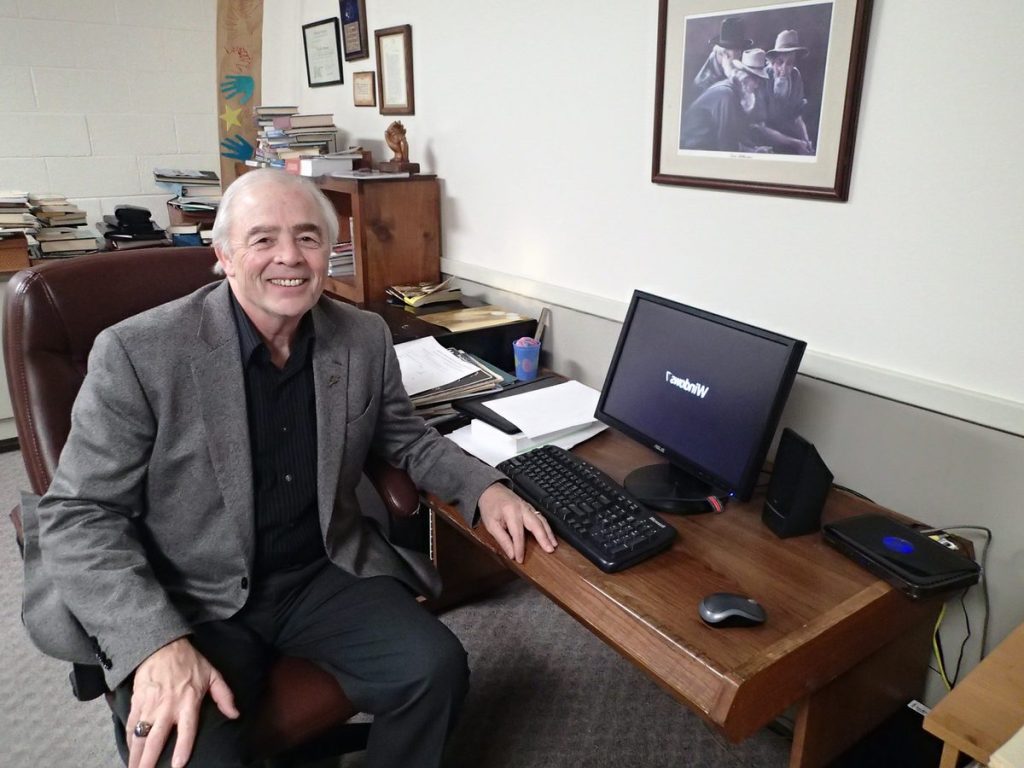
TONY BROWN/DAILY FORUM
The Rev. W. Dale Stewart, who has led the First Christian Church of Maryville, 201 W. Third St., as its senior minister since 2007, will preach his final sermon this Sunday prior to officially retiring on Jan. 15. A former police officer, Stewart said he decided to become a pastor in the late 1970s after finding himself “more and more drawn to ministry.” Finally, he said, “I couldn’t talk myself out of it anymore. Why do your second-favorite thing when you can do your first?”
One of Maryville’s veteran spiritual leaders will close the book on more than three decades of professional ministry this month.
The Rev. W. Dale Stewart, pastor of the First Christian Church of Maryville (Disciples of Christ) since 2007, will deliver his final sermon this Sunday before officially retiring on Jan. 15.
In addition to his pastoral duties, Stewart is well known locally for taking an active role in civic life through such affiliations as the Maryville Optimist Club. He is also a writer, and in 2013 published “Where Life Meets Love … Nudges Toward God,” a collection of essays that includes reminiscences of his rural Kansas youth and early career as a peace officer.
After serving on the Overland Park, Kan., police force from 1972 to 1978, and earning a promotion from patrol officer to detective, Stewart felt the call to full-time religious life within the denomination to which he has belonged since boyhood.
“I found myself more and more drawn to ministry,” he said. “Finally I couldn’t talk myself out of it anymore. Why do your second-favorite thing when you can do your first?”
After completing a master’s degree in divinity in 1981 at Texas Christian University’s Brite Divinity School, Stewart became a minister at Central Christian Church in Coshocton, Ohio, and later the Raymore Christian Church in suburban Kansas City, where he served until 1994.
He then stepped out from behind the pulpit for a few years to work as a consultant, mediator, and seminar leader, a profession in which he was sometimes called upon to work with church congregations in the midst of division and turmoil.
“Believe it or not, occasionally a church will have conflict,” Stewart said.
During this period, Stewart drew on his law enforcement background, working as a court mediator who helped people find common ground and healing while going through divorces, custody fights, and domestic crises.
One of his more intriguing tasks, he said, involved seeking “restorative justice” for juvenile offenders by bringing them face to face with their victims in an effort to negotiate solutions that offered opportunities for redemption, remorse, and reparation as an alternative to trying the case in court.
Stewart returned to church pastorship — and first got to know his local congregation — in 2000 when he came to First Christian in Maryville as an interim minister, filling that role for nearly two years.
He returned for good in 2007 after filling a series of pulpits in Kansas City; Nevada, Missouri; and Auburn, Alabama.
Looking back on his career in an interview this week, Stewart said he has learned that the biggest constant in the life of the church in the 21st century is change, while one of the biggest challenges is to seek out opportunities for ministry that are both “effective and compatible with what we say we believe.”
He added that many churches are striving these days to balance “the message against the method” with changing styles of worship and music on the one hand and the enduring biblical charge to serve as “the body of Christ” on the other.
“We may need to be less centered within a building, a structure, as being the church and more centered on the outside world,” Stewart said, “not as caught up in doing things a particular way because that’s how we’ve always done it.”
Asked what he’ll miss about leading First Christian and the ministry as a whole, Stewart said he considered the same question along with another pastor a while back, and that both agreed it would be the “knee hugs” from small children expressing joy and simple affection.
He also said he expects to feel a bit of a void when it comes to interactions between pastor and parishioner, which be described as a “special kind of relationship.”
And then there’s standing behind that pulpit on Sunday morning and attempting to share with people who have become your friends and neighbors a palpable sense of the divine.
“I love preaching,” Stewart said simply, adding with a smile. “I’ll probably also miss all the brownies people bring me because they know I love chocolate.”
As a mainline Protestant pastor, Stewart, like colleagues in similar denominations, has witnessed a continuing decline over the decades with regard to his particular brand of Christianity.
According to the Association of Religion Data Archives, membership in the Christian Church (Disciples of Christ) has shrunk significantly since the late 1950s when numbers peaked at just under 2 million. By 2009 that total was less than 700,000.
Stewart said such trends might be worrisome if the church were merely a human agency, a notion he firmly rejects.
“Fundamentally it’s up to a power that is much greater than us,” he said. “It’s God’s message.”
And so the future of the church, Stewart believes, lies in the determination of believers to follow Christ’s example of love, forgiveness, sharing, service, and compassion.
“That’s what life is supposed to be,” he said.
In retirement, Stewart, 65, said he and his wife, Terri, intend to remain in Maryville. However, as required by church policy, he will disassociate himself from First Christian during the pastoral search and transition, a process that could take up to a year.
Asked what advice he might offer his successor, Stewart said, “Change gently, with both words being of equal importance.”
Otherwise, Stewart said, he plans to write and pursue various hobbies, which include riding his Harley-Davidson motorcycle. He’s also looking forward to visiting other churches and enjoying the novel sensation of filling a pew instead of a pulpit.
And one other little thing.
“I’m going to play golf on Sunday morning and meet the other half of my congregation,” he said.