
City moves toward lift station solutions
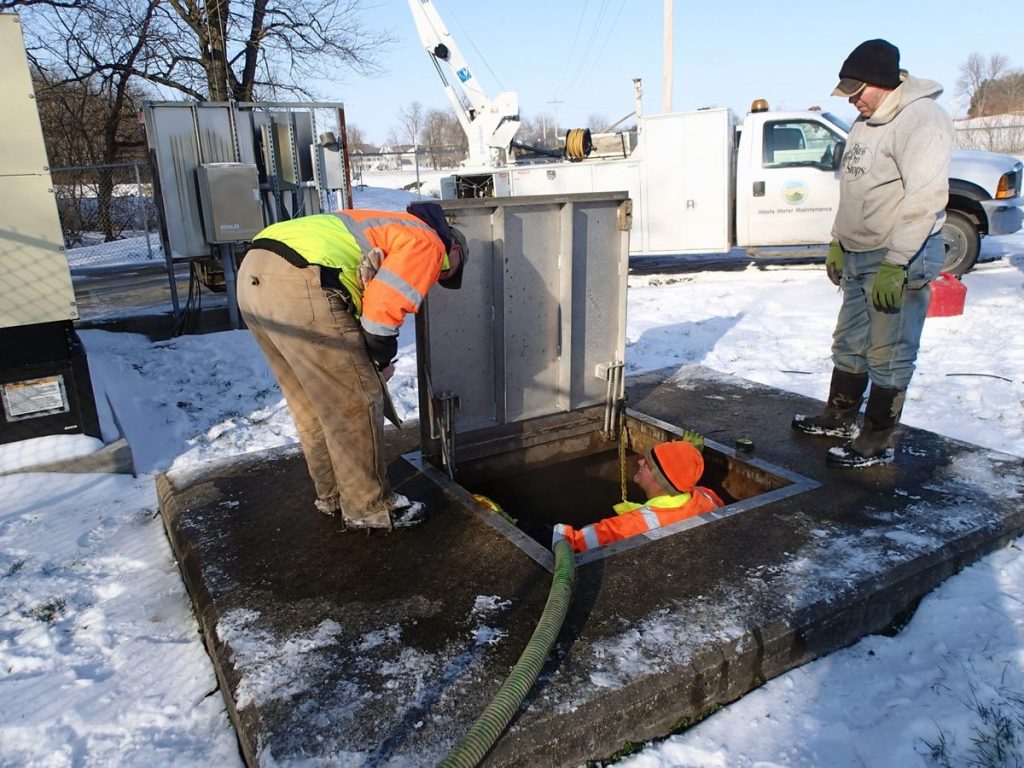
TONY BROWN/DAILY FORUM
Water and Sewer Maintenance Superintendent Eric Lance, center, along with maintenance crew members Bryan Williams, left, and Buck Selles, check out the city’s southwest sanitary sewer lift station last week in preparation for the installation of a new pump. A number of emergency repairs have taken place at the station over the past year due to a combination of high effluent volume, lightning strikes, and mechanical failures.
The City of Maryville’s Department of Public Works is starting off the new year with efforts designed to solve continuing issues at the southwest sanitary sewer lift station.
Located on the south side of Route V across from Maryville Middle School, the station consists of a couple of pumps that mechanically force sewage into gravity mains, which ultimately carry effluent to the city’s wastewater treatment plant east of town.
Public Works Director C.E. Goodall said the southwest station handles more than 50 percent of the city’s sewage flow and serves as a crucial component of Maryville’s sanitary sewer system.
It is probably because of that high volume, plus a little bad luck, that the station has experienced a series of pump and electronic failures since last spring, the most recent of which occurred in early December when a 30-horsepower pump broke down, probably due to a lightning strike.
Previous efforts at the station in 2015 included work on a 21.5-horsepower pump, which has since been declared unfixable; emergency replacement of a faulty electrical panel; and a series of repairs to the station’s primary 70-horsepower pump, one of which was also related to lightning damage.
As for the 30-horsepower pump currently out of commission, Goodall said the estimated cost of repairs turned out to be nearly as expensive as buying a new unit. Also, it was decided merely replacing the pump was not a good option, since predicted sewage volume means both pumps would continue to run for long periods without shutting down.
During its final December session, the City Council, on Goodall’s recommendation, approved purchasing a new 50-horsepower pump for $24,762 from Allied Systems Inc. In doing so, the governing board bypassed a slightly cheaper option calling for a 40-horsepower pump that would have cost about $2,000 less.
While a 40-horsepower unit might be big enough for the time being, Goodall said, it would have been inadequate for a planned lift station upgrade included as part of $500,000 in sanitary sewer system improvements scheduled for the current budget year.
In other words, by spending a little more now, the city hopes to save some money later by incorporating the new pump into the new station.
Since the pump is considered an emergency purchase, the competitive bidding requirement was waived.
City Manager Greg McDanel said last week that because the 30-horsepower pump was apparently struck by lightning, at least part of the cost of purchasing its 50-horsepower replacement should be covered by insurance.
On another front, McDanel said the city plans to conduct a feasibility study as a first step toward applying for a Community Development Block Grant through the Missouri Department of Economic Development that would be used to help pay for the lift station upgrade.
In a related effort to better manage volume at the southwest station, the city has also embarked on a joint project with Northwest Missouri State University that calls for installation of a new gravity line designed to reroute approximately 70,000 gallons of sewage daily from the high-rise residence halls and other campus facilities.
When completed, the new line will carry that flow to another lift station located north of campus.
Under the agreement with the university, Northwest will cover labor and installation, while the city is to provide $14,470 in budgeted funds for materials. Total project cost is $65,000.
McDanel said a third initiative that should help relieve pressure on the southwest station involves continuing efforts to reduce infiltration and inflow — so-called I&I — into the sanitary sewer system during times of peak rainfall.
In going with a new, larger pump, the city has elected to spend all but about $2,000 of its existing pump-repair budget for the entire fiscal year. However, McDanel said that if additional repairs or replacements are required, funds could be transferred from the half-million dollars set aside for sanitary sewer upgrades.




