Animal shelter makes plea for more county dollars
TONY BROWN/DAILY FORUM
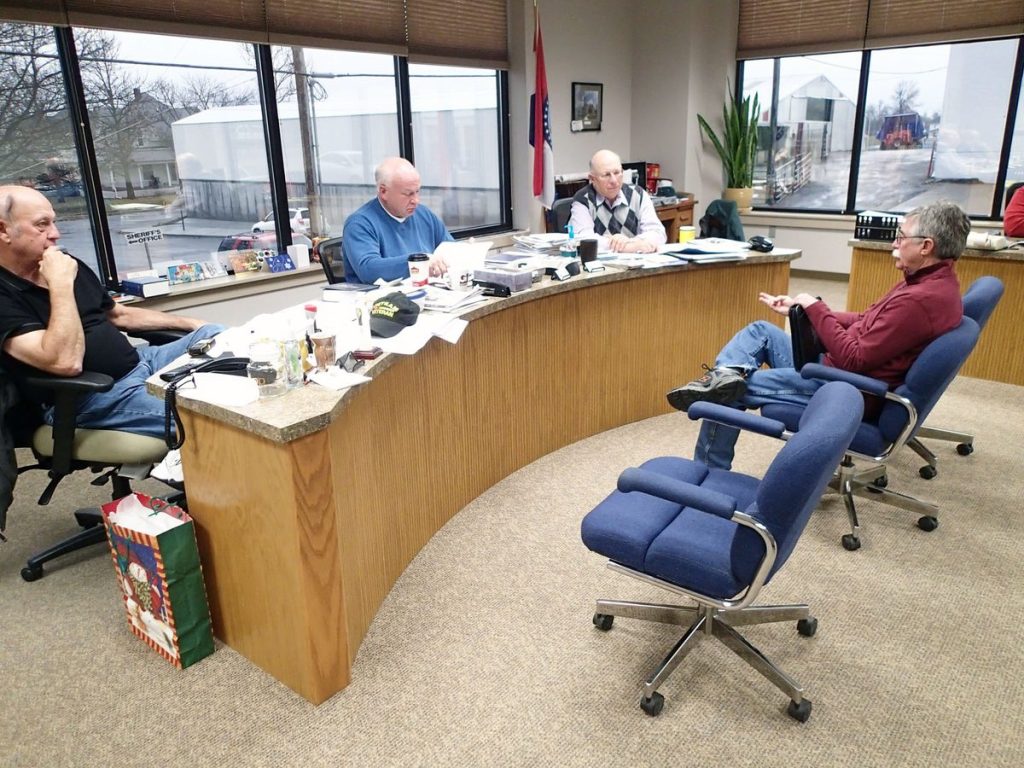
Nodaway County commissioners Robert Westfall, Bill Walker, and Robert Stiens, seated at desk from left, listen as New Nodaway Humane Society President Doug Sutton makes his annual request for financial aid in support of operations at the society’s no-kill animal shelter. The county’s new budget year begins Jan. 1.
Members of the New Nodaway Humane Society Board of Directors met with the Nodaway County Commission Wednesday to make their annual request for funds in support of the society’s no-kill animal shelter.
Society President Doug Sutton asked the three-member commission to appropriate $30,000 for the shelter, which he said would allow the Maryville-based operation to extend animal control services to unincorporated parts of the county.
In its 2015 budget, the commission set aside $1,500 as a shelter donation, and Presiding Commission Bill Walker said he anticipates some support for the facility on South Depot Street will be forthcoming next year as well.
“I’m sure we’ll give them some money,” Walker said. “We’re not going to give them $30,000.”
Traditionally, the commission approves a number of budget requests from charitable, humanitarian, and economic development agencies, usually for $2,500 or less. In addition to the Humane Society, these organizations have included Children’s Mercy Hospital, various family welfare and advocacy agencies, Big Brothers Big Sisters of Nodaway County, Northwest Missouri Enterprise Facilitation, and the Nodaway County Ministry Center food pantry.
While the City of Maryville budgeted $60,000 during its current fiscal year for operations at the shelter, which has an annual budget of $216,000, the county has traditionally considered its appropriation more in the nature of a donation than essential funding for a public service like road maintenance or law enforcement.
But there has been an exception. South District Commissioner Robert Stiens said the county provided the shelter with $12,000 in 2005, the highest total ever. However, since 2008, the first year of government belt-tightening linked to the Great Recession, commission support has withered to about a tenth of that.
Rather than provide significant funding directly to the shelter, Stiens said, the commission is more apt to encourage more Nodaway County communities to contract with the society for animal control services.
A few towns, such as Hopkins and Burlington Junction, already have such agreements in place, Sutton said.
Looking at the society’s overall scope of service, Sutton said a total of 622 animals were taken in by the shelter during its 2014-’15 fiscal year, and that 531 of those came from Maryville and other parts of Nodaway County covered by contracts. Ninety-one animals, he said, came from parts of the county not covered by such agreements.
Non-contract animals, Sutton said, accounted for 17 percent of those cared for by the shelter, whereas the county’s $1,500 contribution in 2015 makes up only .6 percent of the facility’s budget.
During his pitch for more funding, Sutton also tried something of a new tack, presenting figures he claimed illustrate the shelter’s importance to the local economy.
According to the American Society for the Prevention of Cruelty to Animals, he said, the average pet owner spends $580 a year on his or her animal. Also, during its last full fiscal year, the Maryville shelter released 352 spayed or neutered dogs and cats back into the county as adopted pets.
Multiplying $580 times 352, Sutton said, yields a total of $220,000 in local consumer spending directly related to shelter services.
In addition, Sutton said the shelter is proving its value as an entity worthy of public support through increased efficiency and programs that have resulted in a higher adoption rate.
In past years, he said, the shelter’s 55 dog cages were often at full capacity with two animals per cage. However, monthly adoption events at the Orschelen Farm and Home store in Maryville and Petco and PetSmart stores in St. Joseph have cut those numbers significantly.
Other successful initiatives include Puppies for Parole, a program that sends three dogs every eight weeks to the Maryville Treatment Center where they are trained by state Department of Corrections inmates. So far, Sutton said, animals completing the program have a 100 percent adoption rate.
As of Wednesday, he said, the shelter was caring for only 26 dogs.
Sutton said bringing a clinic technician on board at the shelter has also improved the adoption rate due to improved animal healthcare and appearance.
Humane Society Board Member Ray Courter said PetSmart staff members have told him that the condition of animals put up for adoption by the shelter exceeds expectations.
“They have told me that the quality of the animals is the best that they could expect for their operation,” Courter said. “It’s gratifying to see that our efforts have meaning.”