Haulers offer to lease waste transfer station
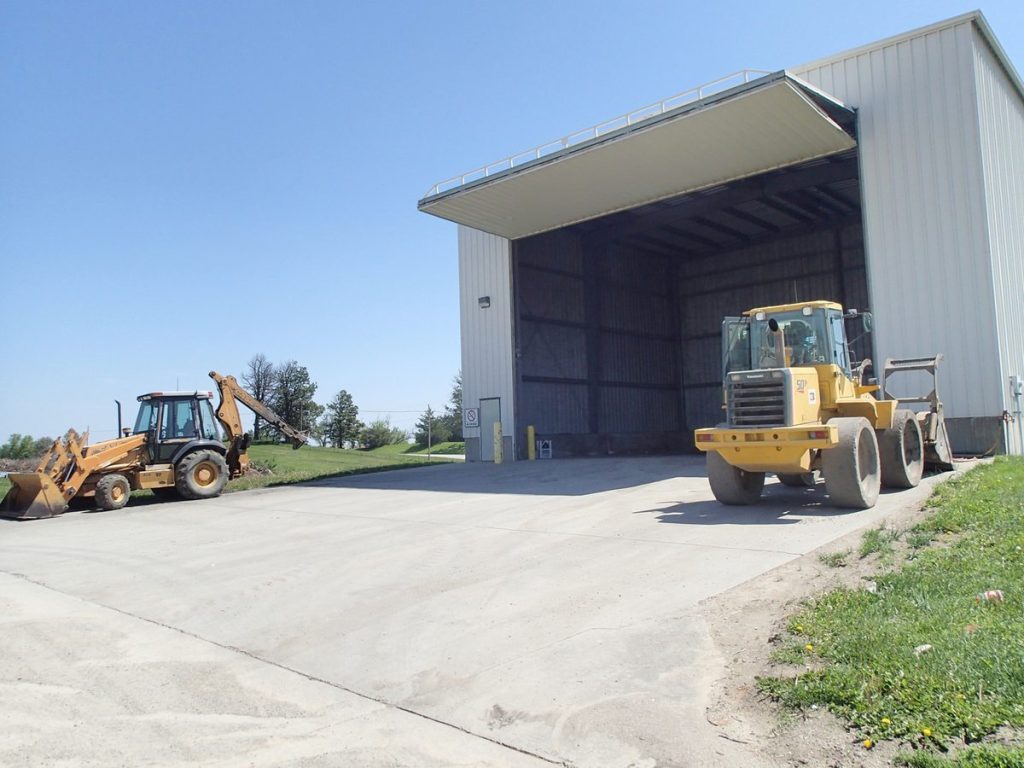
FILE PHOTO
Discussion regarding the fiscally problematic municipal solid waste transfer station, pictured, will continue among members of the Maryville City Council on Monday when the governing board considers proposals from area haulers offering to lease the facility and run it as a private business.
The Maryville City Council plans to revisit the nettlesome issue of solid waste disposal during its first regular December session Monday night.
At issue are a couple of offers submitted in response to a request-for-proposals issued in September seeking a vendor that would take over operation of the city’s solid waste transfer station on the north end of town.
The transfer station, where trash and garbage is delivered by private haulers and loaded onto trucks for shipment to landfills, was established after the city’s landfill was closed in 2001 under orders from the state Department of Natural Resources.
For a decade after the closure, according to City Manager Greg McDanel, the station, which is supposed to support itself through hauler-paid “tipping fees,” generated a positive cash flow, a state of affairs that came to an end in late 2012 when Porter Trash Service opened the privately operated Highway 136 Transfer Station.
Since then, the city’s station, which costs about $350,000 a year to operate, has generated an annual deficit of around $100,000.
In fiscal 2015, McDanel told the council earlier this year, the transfer station required a $109,000 subsidy from the General Fund, money that could otherwise be used for everything from paving streets to economic development.
During several meetings on the issue over the summer, the council debated a number of options designed to stem the flow of red ink, including municipalization, in which the city would either carry out trash collection itself, excluding private haulers, or, more likely, contract with a single hauler following the submission of competitive bids.
The proposal proved controversial since it would likely drive several of the city’s half-dozen or so private garbage collectors out of business and, according to McDanel, very possibly result in legal action against the city.
A second option calls for closing the station altogether and accepting an offer from Dennis Porter of Porter Trash, who has said he would work with both the city and other haulers in order to keep tipping fees reasonable at his transfer operation located a few miles east of Maryville.
Should the Highway 136 facility become Nodaway County’s only transfer station, Porter pledged to offer contracts freezing tipping fees at their current level through 2020. After that, he said, prices would likely increase about 3 percent due to anticipated higher costs for hauling compacted refuse to distant landfills.
In addition, Porter said he would accept the city’s street sweepings at a discounted cost of $5 per ton over cost.
Porter’s offer was viewed with suspicion by competing firms, most of them small, family-owned companies, who fear that he would eventually raise tipping fees to unaffordable levels.
Then, in August, Mike Klosek Jr. of Klosek’s Trash Service, which provides garbage hauling services to customers in Maryville, Tarkio, and Mound City, told the council that several garbage companies operating here were interested in forming a co-op and making an offer to lease the city’s transfer station, which they would operate as a private enterprise.
The resulting RFP issued on Sept. 2 attracted two offers: one from the newly formed Maryville Trash Cooperative consisting of Klosek’s, Mozingo Sanitation, and Gaskill & Son Trash Service, and one from American Recycling & Sanitation Inc. of Rock Port.
Maryville Trash Cooperative has offered to pay the city $100 a month in rent in addition to providing free disposal of city-generated clean fill, street sweepings, and other refuse up to 360 tons a year. Proposed tipping fees under the co-op would be $45 a ton or $12 for each load under 500 pounds and $33 per ton for wood and brush.
American Recycling & Sanitation’s bid proposes $500 a month in rent or free dumping of 12.5 tons of municipally generated solid waste. In addition the city would receive $4 for each ton of waste deposited. Proposed tipping fees are $60 per ton or $18.75 for loads under 500 pounds and $33 per ton for wood and brush.
While the council is expected to consider both offers, McDanel’s written summary of the issue states that other options are still on the table. These include closing the transfer station altogether and accepting Porter’s offer; municipalizing trash collection and disposal using either city crews and equipment or a third-party-vendor; and passage of a “flow control” ordinance that would require all local haulers to use the city transfer station.
Other business before the council this evening includes:
• An ordinance proposing a 20 percent increase in sewer rates effective Jan. 1. The increase is part of a plan put together in 2013 to cover debt service on $13.7 million in voter-approved bonds used to build a new wastewater treatment plant.
The measure means that a family whose current water bill totals $45 a month will pay about $50 after the first of the year.
• An ordinance for sanitary sewer improvements to be made in conjunction with Northwest Missouri State University that would decrease sewage volume at the city’s Southwest Lift Station, which has a history of problems during times of peak rainfall.
The proposal calls for installation of a new gravity line that would carry sewage from the high-rise residence halls and other campus facilities to the municipal Northwest Lift Station.
Estimated cost of the project is $65,000. Under a proposed agreement with the university, Northwest would cover labor and installation, while the city would provide $14,470 in budgeted funds for materials.