Voters to decide Mozingo sales tax proposals
TONY BROWN/DAILY FORUM
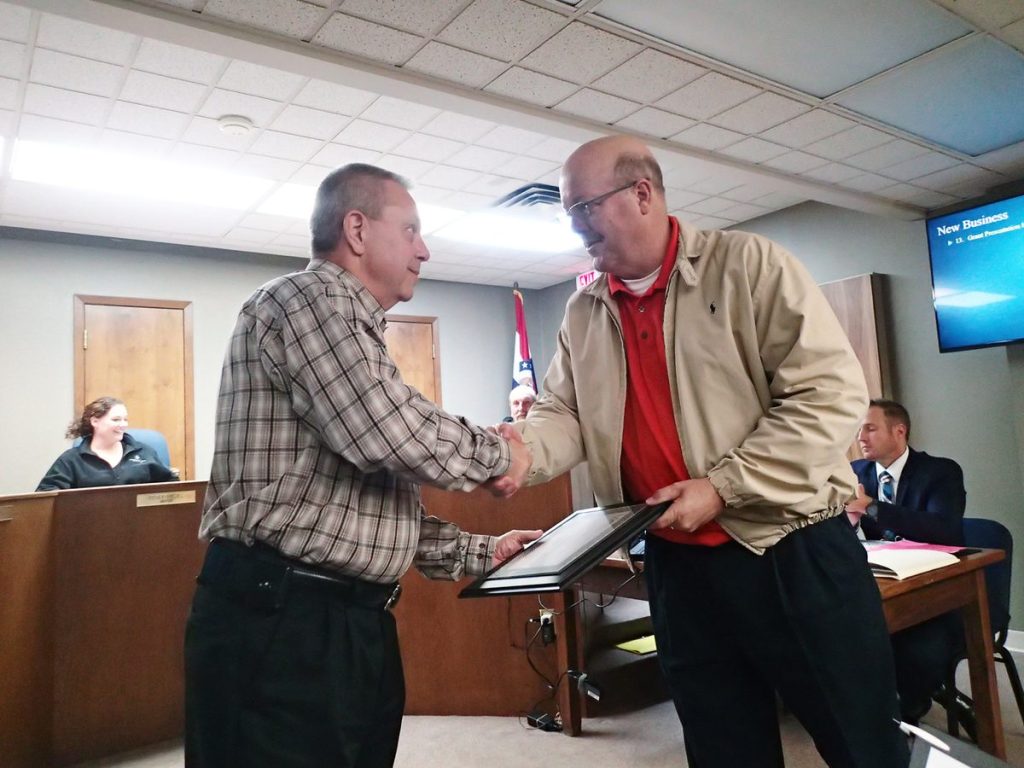
Maryville Public Safety Director Keith Wood, left, accepts a plaque from Jeff Arp, a loss control specialist with the Missouri Intergovernmental Risk Management Association, the city’s insurance provider, symbolizing a $3,150 MIRMA grant that will be used to help purchase a new patrol car dash camera. The presentation took place at this week’s City Council meeting.
Now it’s up to the people.
The Maryville City Council this week directed municipal staff to proceed with preparing language for two ballot questions set for the April 5, 2016, election, each of which will have a significant effect on the future of Mozingo Lake Recreation Park.
Citizens living inside the city limits who go to the polls that day will be asked to renew an existing half-cent sales tax that provides approximately half of the park’s $1.9 million annual budget. They will also vote yes or no on a new eighth-of-a-cent sales tax proposed for constructing a $4 million lakeside conference center.
If approved, both levies would stay on the books for 20 years.
The half-cent tax has been on the books for nearly two decades and has been renewed by voters twice for a term of 10 years, first in the mid-1990s when the lake first opened and again in 2006. If voters reject the tax, it will cease being collected in July 2017.
City Manager Greg McDanel has called the tax crucial to continued operation of the park at its current level of services and facilities.
Built to serve as the city’s primary water supply, the 3,000-acre recreation compound, which surrounds a 1,000-acre reservoir, has been the site of numerous improvements over the years and now functions as a regional recreation hub offering RV camping, rental cabins, a youth camp, two golf courses, and other amenities.
McDanel told the council during its regular session Monday that city staff recommended increasing the life of the tax from 10 to 20 years in order to match the revenue stream with the period of proposed development set forth in the park’s recently completed master plan.
He said the idea of making the tax permanent was considered, then abandoned, since “long-term community needs or Mozingo’s financial position could change significantly in the future.”
On the other hand, he argued, a third 10-year renewal was seen to carry risks as well, since existing and proposed facilities at the lake, and as described in the plan, will likely require maintenance and investment over an extended period.
A win at the polls for the second proposed ballot measure green-lighted by the council this week — the eighth-of-a-cent sales tax — would create a fiscal basis for the proposed conference center with construction to begin in spring 2016.
Voter rejection, on the other hand, could mean that plans for the facility would be placed on a back burner, perhaps indefinitely.
The center is envisioned as a companion facility to a proposed $3 million hotel that is to be developed and operated by Boulders Inn & Suites of Denison, Iowa, which has partnered with a group of local investors.
McDanel said the center would be designed to host events attended by up to 500 people and would contain a golf course pro shop, a golf cart storage area, meeting rooms, offices, and a restaurant operated by a private vendor.
Development of the center-hotel complex, he said, has been adopted by the council as a top priority and is also listed as a priority in master plans developed for both the park and the city.
If approved at the polls, the levy would increase the combined local sales tax to 8.6 cents on the dollar compared to the current rate of 8.475.
However, a separate eighth-of-a-cent sales tax levied to service debt incurred to build the Maryville Community Center sunsets in 2021, meaning that the combined rate would revert to its current level at that time.
City officials estimate the conference center tax will generate approximately $240,000 a year, which is only 23 percent of the annual $312,000 that would be required to pay off $4 million in certificates-of-participation debt over the life of the levy.
COPs are a form of financing used by municipalities and other government entities that, unlike most bond issues, do not have to be approved by voters.
While a 23 percent revenue deficit would normally be unacceptable, McDanel has proposed filling the gap with funds currently earmarked for paying off existing concrete cart path debt at Mozingo’s Sechrest 18 golf course, an obligation totaling just over $100,000 a year that ends in 2017.
Revenue used to service cart path debt comes from the existing half-cent Mozingo tax as well as user-fees paid by park patrons.
Depending on how things work out, McDanel said, the city — and local taxpayers — might not be on the hook for the entire $4 million the conference center is expected to cost. If the new sales tax is approved at the polls, McDanel said the city will apply for a Rural Economic Development Loan and Grant, known as a REDLG, through the U.S. Department of Agriculture.
If approved, the loan would provide $1 million toward conference center construction to be paid back by the city over 10 years at zero-percent interest, thus reducing the principle and interest owed on projected COP debt.
In other business this week, the council:
• Accepted a $3,150 grant from its insurer, the Missouri Intergovernmental Risk Management Association, that will be used to partially pay for a replacement police car dash camera. Maryville Public Safety Director Keith Wood said all six of the city’s marked police vehicles are now equipped with such cameras, which cost about $5,000 each.
• Approved a request from the Greater Maryville Chamber of Commerce to hold a Christmas Parade beginning at 6 p.m. on Friday, Dec. 4. The procession is to begin at Second and Main streets and proceed north on Main through the square to Franklin Park, the site of this year’s Winter Wonderland and Santa Claus display hosted by local Girl Scouts.
• Approved an ordinance to execute an agreement with United Services Inc. for equipment and installation of a Voice Over Internet Protocol (VoIP) telephone system in an amount not-to-exceed $22,788.
According to a staff report, the city’s average landline telephone phone bill totals just over $5,100 a month. Switching to VoIP will reduce that amount to approximately $700 for a savings of about $4,400, or approximately $53,000 a year.
• Approved an ordinance to execute a contract with Snyder & Associates Engineers for work associated with a Maryville Eastside Development traffic study in the vicinity of East First Street and the Highway 71 bypass, an area experiencing ongoing commercial development.
The $12,000 study, required by the Missouri Department of Transportation, is being funded with an $8,000 Traffic Engineering Assistance Program grant plus a $4,000 local match.