‘Roadsides’ a treasure of small-town sights
TONY BROWN/DAILY FORUM
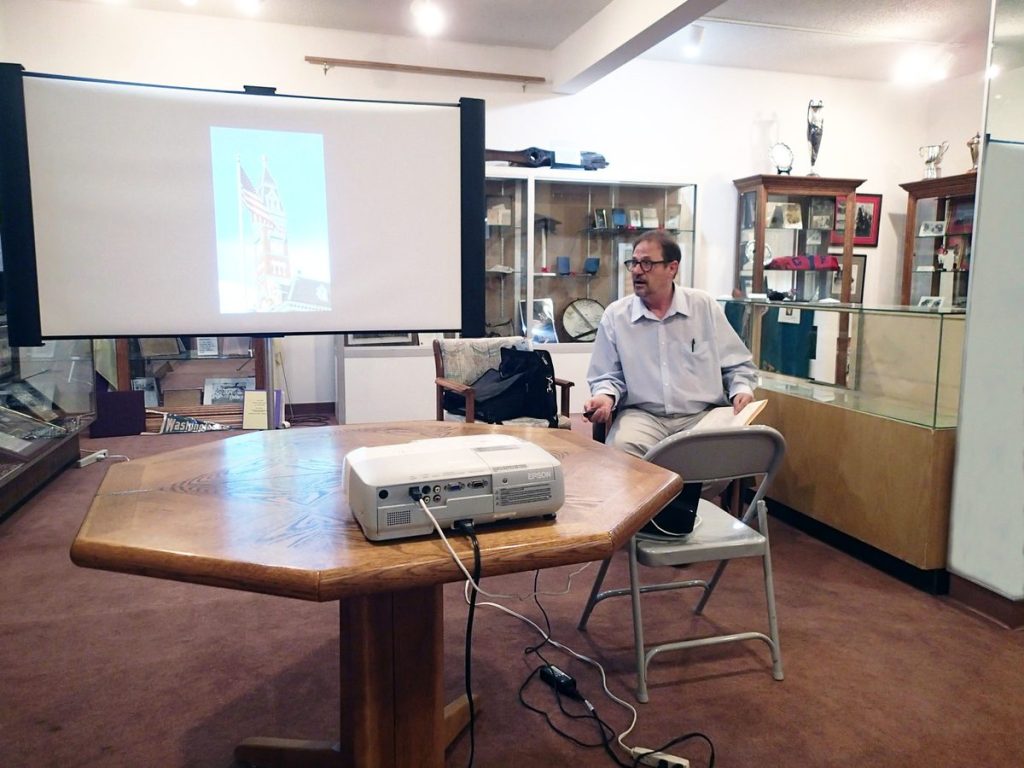
Historic preservationist Bill Hart, author of “Historic Missouri Roadsides,” spoke Friday to members of the Nodaway County Historical Society. The book’s six suggested highway tours highlight architectural gems found in numerous small towns in the state, along with locally owned and operated restaurants, hotels, bed-and-breakfasts, and shops. Maryville is featured in the book along with other communities located in the six counties associated with the Platte Purchase of 1836.
You have to be a certain age to remember, but there was a time in Missouri when, especially as autumn approached and the trees began to turn, the open road beckoned.
In the first three decades or so after World War II, nothing in the world was so common on a Saturday or Sunday afternoon as for a father to lay down his newspaper, turn off the huge, clunky console television, and say to his wife and children, “Let’s go for a drive.”
In those not-so-long-ago days, giant oaks and elms arched over winding country blacktops, and every little town offered travelers small instances of charm and adventure: an old drug store with a tiled soda fountain that served milkshakes to die for, or an art deco gas station with glass-topped pumps and cooler-style soda machines filled with slushy ice.
Such gems were set along bustling Victorian-style Main Streets, where the sidewalks were jammed with people and lined with stores and shops offering everything from dress shoes and fedoras to fishing tackle and yo-yos.
Today, the family drive is largely a thing of the past.
But bits and pieces of the world through which those now-classic Fords and Chevrolets rolled remain. And historic preservationist Bill Hart is dedicated to searching them out, writing about them, and, when possible, saving them for future generations.
Hart, who lives in St. Louis, is the executive director of the Missouri Alliance for Historic Preservation, and he was in Maryville Friday to talk about his new book, “Historic Missouri Roadsides,” to members of the Nodaway County Historical Society.
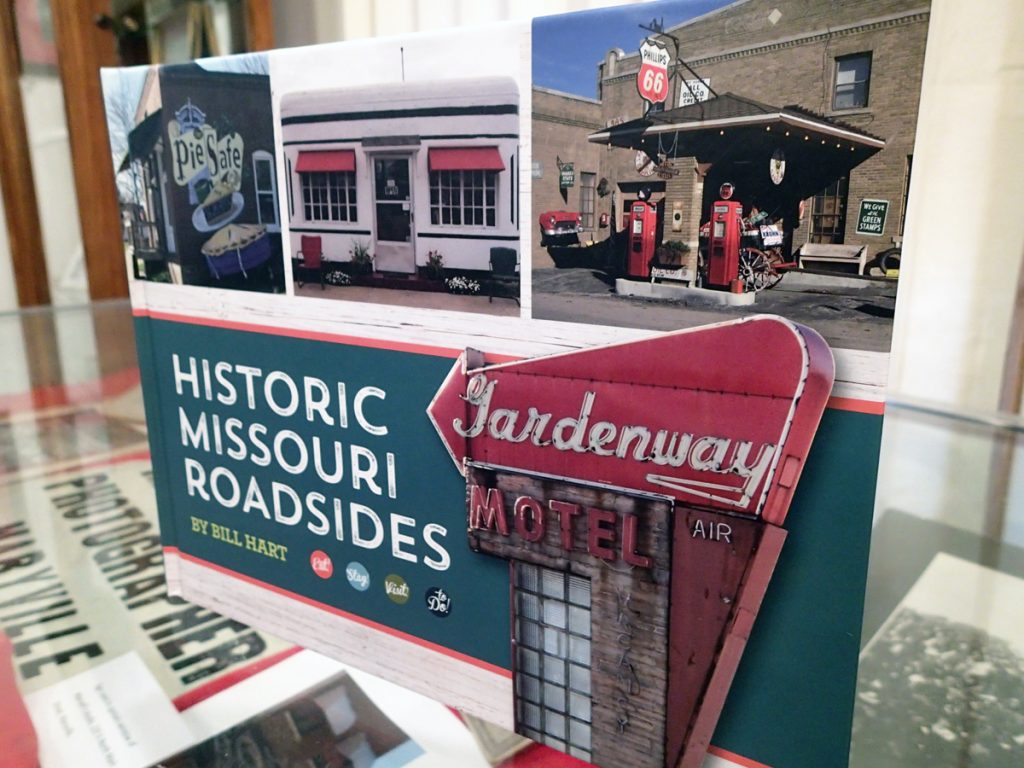
The lavishly illustrated, full-color travel guide offers readers a detailed outline of six motor tours across the state’s major regions.
Each section is replete with photos and descriptions of places to eat, stay, and shop with a heavy emphasis on family-owned small businesses that go heavy on individuality and even eccentricity. If you’re looking for a McDonald’s or a Holiday Inn or other examples of what Hart call “Generica,” you won’t find them listed in his book.
Instead, the author has sought out people like Scotty Walker of Walker’s Variety in downtown Holden, a small town in Johnson County. Crammed floor to ceiling with merchandise, the shop stocks an eclectic variety of goods ranging from art supplies and electronics to bicycles, housewares, and fabrics.
Of special interest to Nodaway Countians is the section of Hart’s book dedicated to the Platte Purchase, a large tract of Native American land acquired in 1836 that now includes Platte, Buchanan, Andrew, Holt, Atchison, and Nodaway counties.
Even those long familiar with the area will likely discover some new treasures, including several examples of the work of noted architect Edmond Jacques Eckel, who designed the Nodaway County Courthouse.
Hart notes that Eckel left a rich legacy across northwest Missouri, where his other surviving work includes the St. Joseph City Hall, the former St. Joseph police station on Messanie Street, the Gentry County Courthouse, the Carnegie Public Library in Albany, and the Hamilton House at 1228 W. Main St. in Bethany.
Other Platte Purchase landmarks pictured or described in Hart’s book include the Andrew County Courthouse in Savannah, with its original Seth Thomas clock and crowning statue of Liberty; a restored “painted lady” pressed metal storefront in Mound City; the former Tarkio College’s Elizabeth-style Rankin Hall, and the abandoned and deteriorating Burlington Junction depot.
Hart readily admits that many old buildings will inevitably pass away, but he also believes that much can be preserved if more people learn to recognize and appreciate the physically present past that still lingers in many small towns.
“We have a wealth of beautiful architecture, pretty landscapes, interesting places to visit, and much more right here in Missouri,” he said. “And we need to enjoy them and hold them up, not only as places to visit but also as places to live, eat, drink, and shop locally, purchasing from Missouri citizens rather than corporations.”
If history consists of “words written on the page,” Hart said, unique buildings and architectural sites serve as illustrations for the book of our shared past.
“My job,” he said, “is to help advocate — to help people save the places that are important to them.”
TONY BROWN/DAILY FORUM
“Historic Missouri Roadsides,” an illustrated travel guide written by Bill Hart and published by Reedy Press, offers a detailed look at scenic and architectural treasures found in virtually every region of the Show-Me State, including the Mississippi River Valley, the Ozarks, the Lewis and Clark Trail, and the northwest Missouri prairie.