Dog numbers spike; shelter seeks more funding
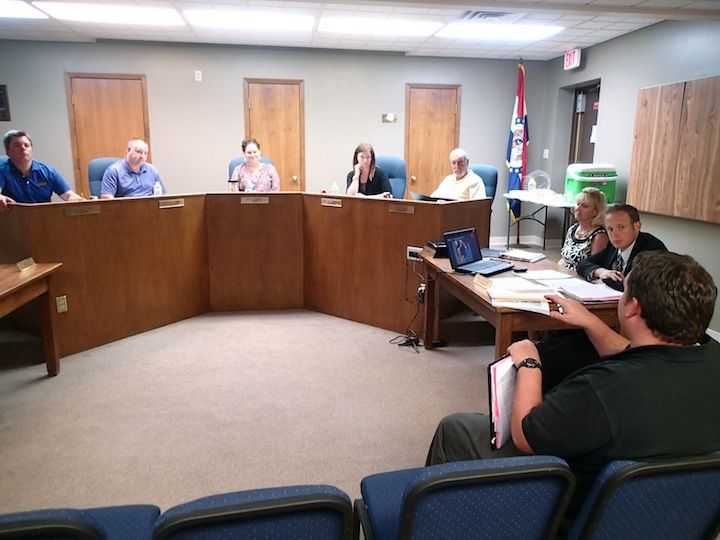
TONY BROWN/DAILY FORUM
The Maryville City Council spent nearly four hours this week digesting a staff summary of the proposed 2015-2016 municipal budget scheduled for adoption Sept. 21. City Manager Greg McDanel, seated behind table at right, said the spending blueprint is lean compared to recent years due to a lack of discretionary revenue derived from the city’s half-cent capital improvements tax, much of which will be used to service debt associated with completed projects.
After gathering for an early meeting to go over the proposed 2016 budget, the Maryville City Council this week convened in regular session and heard from local organizations requesting a piece of the municipal money pie as the council prepares to begin a new spending year on Oct. 1.
Those appearing before the governing board included a group from the New Nodaway Humane Society, which is seek to increase its city subsidy from $82,800 a year to $94,000 a year, or an additional $1,000 a month.
Doug Sutton, who chairs the society’s board, said the new funds are needed to cover higher costs associated with a 42 percent increase in the number of dogs handled by the society’s no-kill shelter, which serves as the city’s animal control facility.
Last year, the shelter handled slightly more than 400 dogs, a number that shot up in 2015 to about 620 animals.
Sutton said the society is requesting the increase for one year only to give the shelter time to come up with strategies for both improving efficiency and reducing the number of stray and abandoned animals in need of care.
Society board member Ray Courter said he is not sure why numbers at the shelter have spiked, but noted that of the 2,100 dogs estimated to live in Maryville, as few as 10 percent are properly licensed, meaning that a large number likely also remain unsterilized.
Assuming that half the dogs in town are female, Sutton said, only a fraction would have to bear litters in order to produce enough puppies “to overwhelm the shelter.”
While the council has proven willing to increase funding levels at the shelter in recent years, fiscal 2016 promises to usher in a period of tighter spending due to a lack of discretionary revenue from a nearly exhausted half-cent capital improvements sales tax.
After listening to Sutton’s remarks, Councilman Jerry Riggs said that while he understands the shelter’s plight, the city has other obligations as well.
“Nobody sitting up here is against the humane society,” Riggs said. “You guys do a great job.” But, he added, the council has a responsibility to approve a budget that best serves the city as a whole.
“Sometimes there isn’t enough money to go around,” said Riggs, who named such competing priorities as sewer improvements and adequate pay for city workers.
Also seeking city assistance Monday was Josh McKim, executive director of Nodaway County Economic Development, whose $60,000 request mirrored last year’s.
McKim noted that NCED has helped create an estimated 52 local jobs over the past year, helped stimulate about $4 million in business-related investment, and played a key role in lining up $800,000 in private equity for proposed development of a hotel at city-owned Mozingo Lake.
The following organizations are also seeking city appropriations for 2016: Northwest Missouri Enterprise Facilitation ($10,000 request), Community Foundation of Northwest Missouri ($2,000 request), the Maryville Downtown Improvement Organization ($10,000 request), and a new group seeking to promote a local farmers market ($610 request).
Other business before the council Monday included approval of a re-zoning request by Kelly Morrison and Cris Wilmes for a residential lot located at 531 W. Halsey.
The property was re-zoned from R-2 Single Family to R-2 Single Family Modified, which will allow Morrison and Wilmes to tear down an existing house on the property and construct a duplex.
According to a staff report, the neighborhood surrounding the house in question consists primarily of owner-occupied single-family homes with a mix of single-family rental properties to the north, south, and east. The Fox Cove apartment complex is located across the street immediately to the west.
Additionally, the council approved a refunding scheme for Tax Increment Financing bonds issued in 2005 to reimburse the developer for a portion of the costs related to improvements at Maryville Town Center, the retail complex anchored by Hy-Vee.
Under terms of the original TIF, 50 percent of all Town Center-derived sales taxes and 100 percent of real estate taxes assessed on new development were abated until bond maturation in 2026.
The new arrangement provides for a lower interest rate and early repayment of remaining debt in 2024, after which sales and property taxes will be collected at the full amount.