City renews bid for creek crossing funds
TONY BROWN/DAILY FORUM
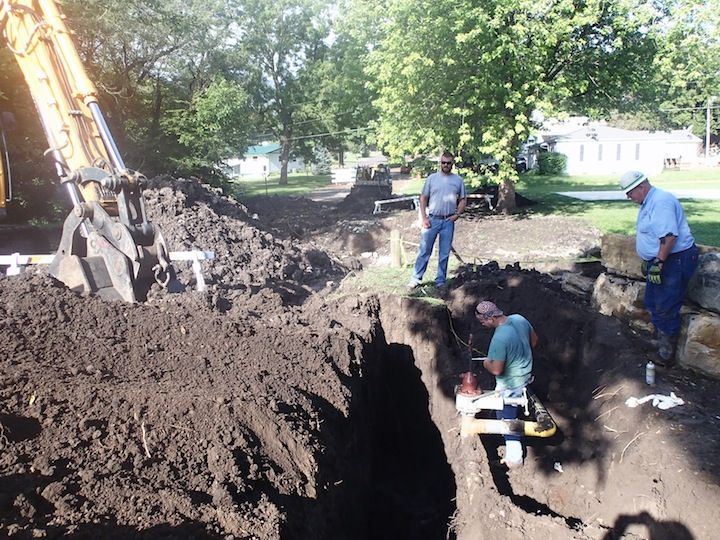
An Empire Gas crew works to move an exposed line over Peach Creek underground Wednesday as part of a project to repair and upgrade a tube crossing on West Cooper adjoining Judah Park. The City of Maryville is seeking more than $60,000 in federal disaster funds to pay for work at the crossing, which was damaged this summer by heavy rains and flooding.
Representatives from state and federal emergency management agencies were in Maryville on Wednesday for an “applicant briefing” with members of the Nodaway County Commission and representatives from several townships.
Both the county and the townships are seeking disaster funding for infrastructure damage caused by severe storms that pummeled northwest Missouri between mid-May and the last week of July.
Also attending a portion of the morning session at the County Administration Center was Maryville City Manger Greg McDanel, who along with Public Works Director C.E. Goodall, is working to obtain Federal Emergency Management Agency funds for repair of the Peach Creek drainage tube crossing in the 600 block of West Cooper at the southern edge of Judah Park.
The crossing has been a flood-prone trouble spot for years and was rendered impassable this summer when heavy rain undermined pavement laid over the top of two large drainage tubes.
The City Council budgeted $40,000 to repair and upgrade the crossing during the current budget year, but diverted $17,000 from that line item to help pay for widening and dredging Peach Creek further to the south.
This was done, McDanel said, because the city was hoping to receive a “hazard mitigation” grant from FEMA that would have paid for the crossing project. However, the application was denied.
A hazard mitigation grant differs from disaster funding in that such funds are allocated to upgrade infrastructure deemed likely to fail during a severe weather event. Disaster funding, on the other hand, is used to repair damage that has already happened.
When the effects of flooding rendered the crossing unsafe and the county was added Aug. 31 to Gov. Jay Nixon’s original 68-county disaster list, the city, as a political entity within the county’s borders, became eligible for assistance under the latter category.
McDanel said Wednesday that means FEMA could fund the entire cost of replacing the crossing, which is estimated at $63,500, a total that includes about $20,000 in labor and materials provided by the city and $43,000 in design and construction fees for contractor White Cloud Engineering and Construction of Maryville.
Because municipal staff classed the deteriorated crossing as an emergency repair, the normal requirement for competitive bids was waived and work begun.
Since the Peach Creek crossing is classed by FEMA as a relatively minor project, McDanel said his understanding is that, should funding be approved, no local match will be required.
After speaking with agency officials who inspected the crossing, he said he feels fairly confident the request will be approved, adding that the resulting elimination of several thousand dollars in spending from reserves is good news as the city nears the start of a “tight budget year” on Oct. 1.
Wednesday’s meeting was the third official phase in a complex, multi-stage process that must be completed before Nodaway County is approved for FEMA funding to repair an estimated $700,000 in severe weather damage to dozens of bridges and drainage tube crossings.
Initial funding steps included the completion of “Preliminary Damage Assessments” by local officials and federal acceptance of Nixon’s disaster list that enlarged the number of eligible counties from 68 to 76, the most since the “Great Flood” of 1993.
That $700,000 estimate does not include requests from most of Nodaway’s 15 townships for funds to replace gravel washed off portions of the county’s 2,000-mile network of gravel roads.
County officials say township funding, if approved at expected levels, could total at least $500,000.
Should county disaster funding be approved, FEMA would pay 75 percent of the repair costs for damaged bridges, crossings, and gravel roads, and the State Emergency Management Agency would pay 10 percent, leaving a 15 percent local match.
Many of the jobs will likely be classed a “small projects” costing less than $121,600, which can be funded earlier in the process and with less paperwork. In addition, unspent federal dollars from small projects completed for less than their estimated cost do not have to be returned.
Large projects costing more than $121,600 are not “obligated” — that is funded — until a full Project Summary Report is approved by FEMA. In addition, final payment by the agency is based solely on “documented, eligible cost as applied to the approved scope of work.”
TONY BROWN/DAILY FORUM
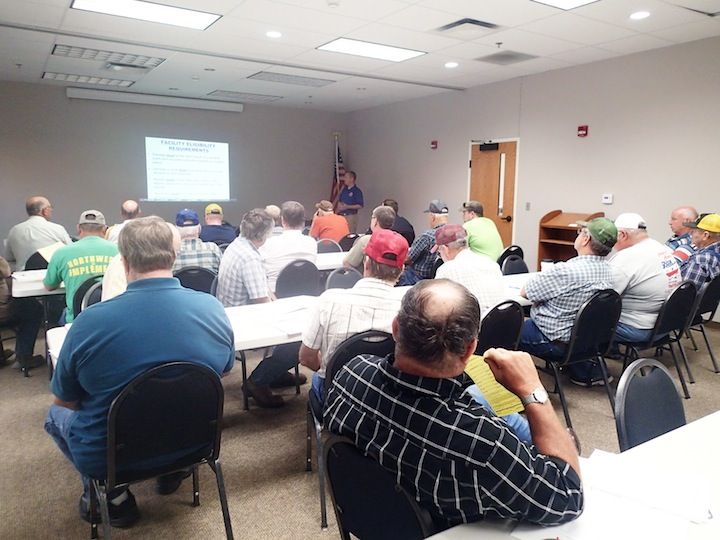
County and township representatives listen to Public Assistance Specialist Charles Highland of the State Emergency Management Agency summarize the lengthy application and review process required before local governments can receive federal disaster funds. Nodaway County was approved for Federal Emergency Management Agency assistance earlier this summer following a series of severe storms that damaged bridges and washed out dozens of tube crossing and gravel roads.