
UPDATE: Boil advisory tied to ‘disinfection issue’
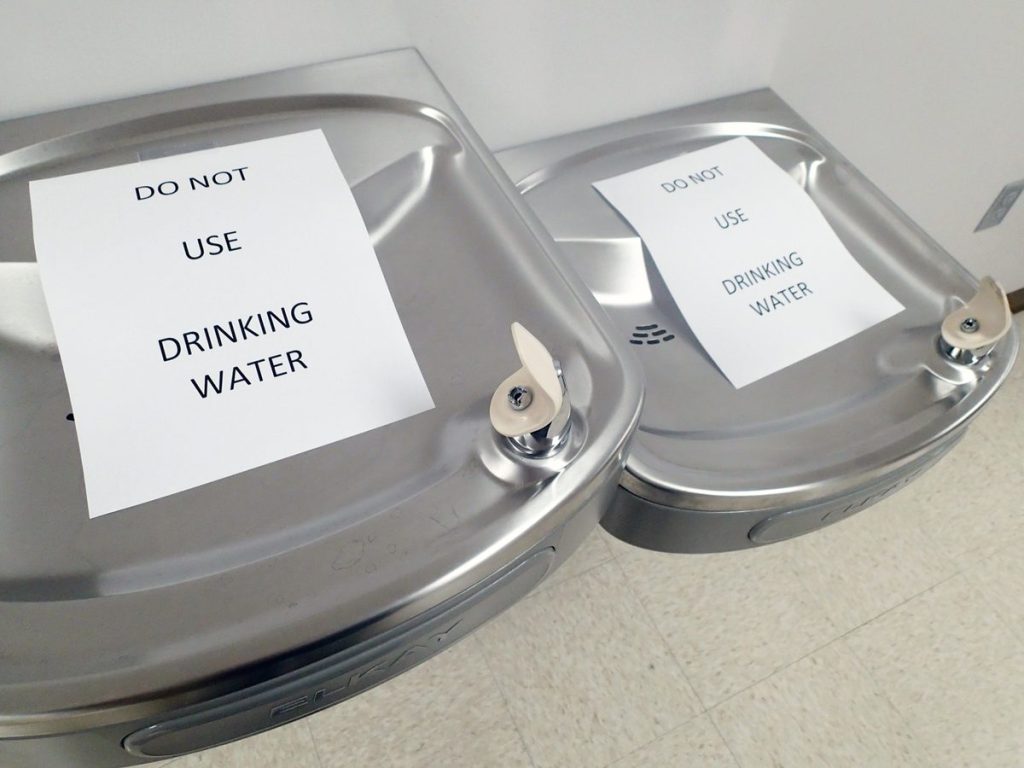
TONY BROWN/DAILY FORUM
Printed signs on the ground floor of the Nodaway County Administration Center on Wednesday warned people not to drink from the water fountains as the city of Maryville remained under a boil advisory related to elevated levels of manganese in Mozingo Lake. Boiling does not remove the naturally occurring metal from water, but excessive manganese content can be indicative of bacterial pollution.
Maryville Public Works Director C.E. Goodall said Wednesday that a boil advisory issued with regard to the city’s drinking water would remain in effect at least until Thursday morning.
The advisory was issued due to elevated manganese levels in samples taken from Mozingo Lake, the city’s primary water source. Goodall said technicians at the municipal water plant were varying the chemical process used to purify lake water, and that the manganese content level had dropped, but not quite enough.
Manganese is a chemical element classed as a metal often found in combination with iron and various minerals.
High concentrations of manganese have been linked to a syndrome affecting the nervous system and are considered especially hazardous to young children and pregnant women.
Goodall explained Wednesday that boiling will not remove manganese from water, and that the advisory was issued because the presence of the element, which can cause discoloration and turbidity, is indicative that other kinds of pollution may occur.
Turbidity is a measure of water clarity, and when manganese oxidizes, like iron rusting, it can make water turn reddish or gray.
But that’s not the most serious problem.
“That the manganese is there creates a disinfection issue,” Goodall said.
Chemically manganese combines with chlorine, also an element, which the city adds to water in order to kill bacteria. The reaction between the two elements lowers the amount of residual chlorine in drinking water, creating an enhanced opportunity for bacteria to grow.
The Missouri Department of Natural Resources urged the city to issue the boil advisory when manganese levels swelled to well over the recommended maximum of 0.3 parts per million. At one point, Goodall said, the ratio of manganese in water samples taken from the lake exceeded 1.0 ppm.
Adjusting the cocktail of chemicals used to treat Maryville’s drinking water brought the level down to .45 ppm as of Wednesday morning, said Goodall, adding that testing for manganese is occurring on site, meaning the city won’t have to wait for lab results before lifting the advisory.
He said that samples for testing are being taken directly from the lake as well as during various treatment stages at the water plant.
It is believed the elevated manganese levels were caused by runoff from recent heavy rains that washed soil and rock containing the element into the lake. According to Goodall, at least “two or three” other Missouri cities that rely on surface water are experiencing similar problems.
Goodall said that while the risk to Maryville residents for illness caused by waterborne bacteria is small, it does exist, and that the advisory was implemented on the strong recommendation of state DNR officials.
He added that urging water customers either to boil water or purchase bottled water was simply the right thing to do.
“This is all just to be safe,” he said. “I know it’s a pain, and I wish that we didn’t have to do it. But we’re always going to err on the side of safety.”




