Seniors enlisted in fight against elder crime
TONY BROWN/STAFF WRITER
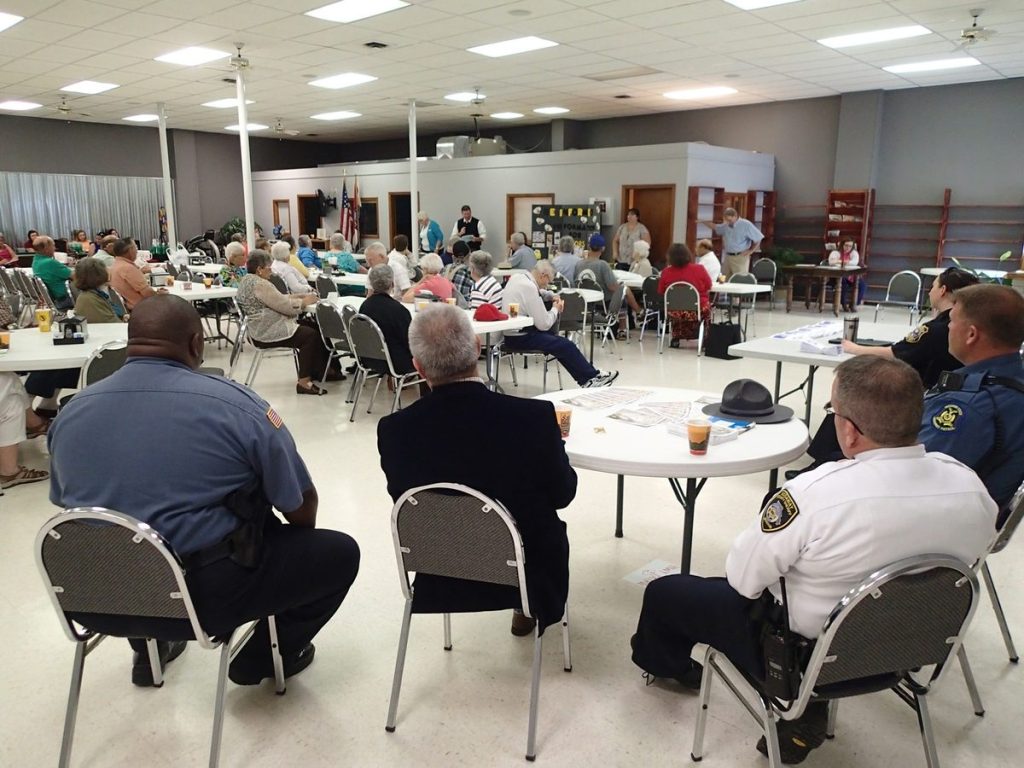
Some of the area’s top cops listen in on one of several presentations Friday during a workshop at the Nodaway County Senior Center organized to inform older citizens about ways they can avoid being victimized by fraudulent door-to-door salesmen and telecommunications con artists. Pictured in the foreground, from left are: Northwest Missouri State University Police Chief Clarence Green, Maryville Public Safety Director Keith Wood, Nodaway County Sheriff Darren White, Highway Patrol Trooper Dale Reuter and Maryville Public Safety Officer Sarah Kahmann.
Local law enforcement and social services professionals gathered at the Nodaway County Senior Center on Friday to deliver an encouraging message to a group of citizens in their seventh, eighth and ninth decades — you don’t have to be a victim.
The age of the Internet and the smartphone has ushered in a disturbing new wave of crimes against older folks, as scammers, frauds, thieves and — still today — old-fashioned strong-arm hoodlums use everything from computer savvy to physical intimidation in an effort to part innocent people from their money.
So, in an effort to help seniors protect themselves and stay safe in a dangerous world, Prosecuting Attorney Robert Rice organized the county’s first-ever crime prevention workshop aimed specifically at area residents old enough to remember black and white televisions, car window vents and fountain pens.
About 50 people turned out for the event, which included booths offering information on topics like real estate fraud and identity theft. The three-hour session also included presentations by law enforcement officers who offered real-life stories about how unscrupulous criminals prey on the elderly.
Citing statistics from MOSAFE, a program administered by the Missouri Department of Health and Senior Services, Rice said that in 2007 the agency received 4,319 reports alleging financial exploitation of seniors — more than twice the number of incidents recorded two years earlier when the program was established.
Those who suspect that an elderly or disabled Missourian is being exploited financially can call MOSAFE’s adult abuse and neglect hotline at 800.392.0210. Another number to have handy is the Missouri attorney general’s consumer protection line at 800.392.8222, which can be used to report scams and cons of any type, including those associated with telemarketing, the Internet, email, financing and home and car repairs.
During separate presentations by Rice, Maryville Public Safety Officer Sarah Kahmann, and Sheriff Darren White, common threads emerged with regard to techniques seniors can use to protect themselves. First, if a sales pitch sounds too good to be true assume that it is. Second, never let yourself be intimidated.
A third theme was that the current generation of thieves and con artists has become quite sophisticated when it comes to robbing the elderly, so victims should strive not to give in to embarrassment or a feeling of shame after getting ripped off. Call the authorities, the officers urged. They are on your side.
White recalled one recent incident in which an elderly woman was intimidated into “writing a check for $700 that she didn’t have” to door-to-door meat salesmen.
The woman told an acquaintance about the incident who was able to stop payment on the check, but the victim herself was hesitant to take action, White said, “because she was embarrassed.”
The meat scam, common in rural areas, has cropped up with some frequency in Nodaway County this summer, White said. The “salesmen,” he added, are often people with lengthy criminal records and a penchant for physical intimidation.
He said the meat, often stolen, is sometimes transported in unpowered freezers in violation of state health regulations, a transgression law officers have used to shut down the fly-by-night operations, since the county, unlike the city of Maryville, does not require solicitors to acquire a peddler’s license.
“This is their career,” White said, “to scam money out of people, to victimize people. They’re good at it. So please call somebody if this happens to you. You don’t have to be embarrassed or ashamed. It could happen to anyone.”
Another popular rip-off, according to White and his fellow officers, is the roof or driveway repair offer, in which someone comes to your door and offers to pave your driveway or roof your house at a bargain price.
What usually happens, White said, is that some men show up and spread gravel on the driveway or sprinkle oil on the roof, come back to the homeowner and say, “Oh, it cost a lot more than we thought. You need to pay us $20,000.”
When the homeowner refuses, several large, strong-looking men materialize and imply or directly state that it would in the victim’s best interest to open his or her checkbook.
While such strong-arm tactics have been around for years, computers have given criminals a vast new arsenal of tools with which to defraud the elderly. And unlike door-to-door thugs, which White said are arrested with some frequency, con artists who rely on telecommunications are far more elusive.
White said the local arrest rate for telephone and Internet fraud is “about zero.”
“I don’t like to say that, because it makes us look bad. But that’s what it is,” he said, adding that computers both mask the identities of scammers and help them keep the money they steal.
“The first thing they do is get the money out of the country.”
Which means that the intended victim’s response to electronic criminals is crucial.
“When the IRS calls and says pay us immediately or we’ll arrest you and put you in prison, that would scare anybody,” White said. “But they’re not the IRS. The IRS doesn’t call anybody. You can’t even call them and get a human being on the phone.”
Maryville Public Safety Director Keith Wood offered two words of advice as to how seniors should respond when someone asks them for money or personal information over the phone.
“Hang up,” he said.
The IRS dodge and similar scams invoking government agencies have been around for years. More recent rip-offs, the Senior Center group was told, include schemes in which criminals make offers to people trying to sell stuff on Craigslist and other Internet market sites.
It works this way. You’re trying to sell an old car online. Someone make an offer and sends you a check for way more than the selling price, asking you to return the difference. Their check is bad, yours isn’t.
It shouldn’t work, White said, but it does, because Internet and telephone criminals are polished, skillful and practiced at their nefarious art.
“Please call us if any of these things happen to you,” Kahmann said. “You do not have to be embarrassed or ashamed. It could happen to anyone. These guys are that good.”