Northeast Nodaway teacher has lift off
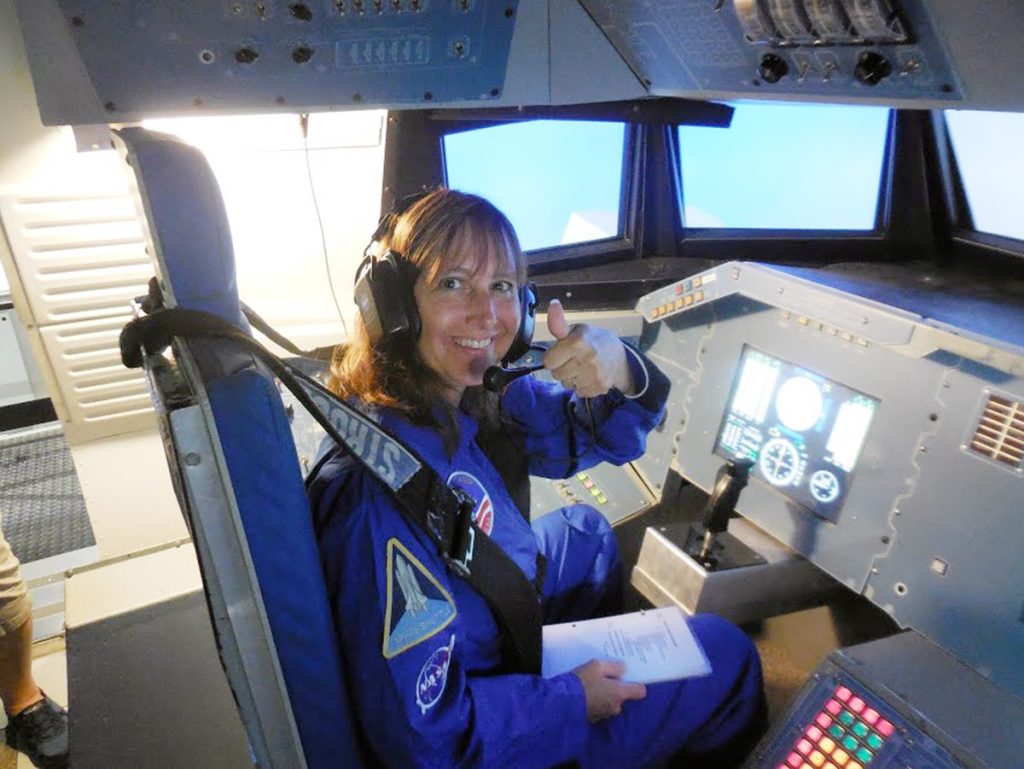
SUBMITTED PHOTO
Northeast Nodaway fourth grade teacher Denise Henggeler recently took part in the Space Academy for Educators Program at NASA’s Marshall Space Flight Center in Huntsville, Ala. Henggeler served as commander for a simulated virtual mission to save the International Space Station and received NASAS content and knowledge to pass on to her students during the four-day camp.
“This is space shuttle Endeavor, we’re a go.”
Denise Henggeler, a fourth-grade teacher at Northeast Nodaway R-V, has taken part in several NASA-sponsored events in her time in education, but none of them have compared to the experience Henggeler had last month, serving as commander of a space shuttle on a virtual mission to save the International Space Station.
Northeast Nodaway is a NASA explorer school, and Henggeler has been to Marshall Space Flight Center in Huntsville, Alabama twice, Glenn Research Center in Ohio and met several astronauts, including Barbara Morgan — the first teacher in space — among other things through NASA’s educational programs.
“We’re a NASA explorer school, so I’ve done a lot of things with NASA, but every time I go to something I learn even more,” she said.
“I can’t remember all the astronauts I’ve met. … I’ve been very lucky to get to do some things like that.”
So when Henggeler received an email earlier this year from the program saying they were willing to pay for teachers from Iowa and Missouri to go, she thought “Why not, I’ll give it a shot and see if I get picked to go.”
Henggeler received an invitation to attend the four-day camp, which ran from June 4-7, and NASA picked up the class cost (around $900) and some of the travel expenses to travel to Marshall Space Flight Center to attend. Northeast Nodaway picked up the remainder of the tab, since Henggeler was partaking in professional development.
The educational program promotes science, technology, engineering and math (STEM), while training students and adults with hands-on activities and missions based on teamwork, leadership and decision-making. The program Henggeler took part in, the Space Academy for Educators Program, is designed for teachers who want to advance education in the STEM fields.
Henggeler said the best part of the camp, which started at 7 a.m. each day and oftentimes went until 8 p.m., was the virtual shuttle mission.
Space Camp crew members watched the teachers throughout the week and Henggler said they had to fill out questionnaires to help the crew pick their roles for the mission.
“I put down that I would like to be the pilot who does not fly the plane, but is second in command because I didn’t know if I was ready to be in charge of everybody,” she said. “…They’re saying this is a go, and I got to say, ‘This is space shuttle Endeavor, we’re a go.’ I got to say all the stuff that I’ve seen on TV, so it was pretty cool.”
However, Henggeler was selected to lead a four-person team on space shuttle Endeavor up to the International Space Station to do repairs. In addition to Henggeler in the pilot’s chair, she had a co-pilot and two mission specialists, who were put into suits to allow them to float while they left the shuttle to repair the space station.
“They got to float around like they were superman and try and fix something. Then they came back on and we headed back,” she said.
The trip back, though, didn’t quite go as planned.
NASA’s flight controller, CAPCOM, came across the radio to tell Henggeler she was landing at Kennedy Space Center in Orlando, but didn’t tell her which station to land at.
“I looked at my book and it said refer to landing booklet now,” Henggeler said. “I’m looking, and there’s no landing booklet. ‘Uh, Houston, this is Endeavor. We have no landing booklet.’”
So Henggeler and her team had to land the shuttle blind.
“I landed it without the booklet,” she said. “I’m sure they fixed it so I wouldn’t crash, per se, but I landed it with no landing book. I was pretty proud of that.
“They said somebody one time landed it upside down in the swamp.”
Henggeler said the biggest things she would bring back to her students are teamwork and not giving up. She said while recently teaching summer school at Horace Mann Laboratory School on the campus of Northwest Missouri State University she talked with her class about the unmanned SpaceX rocket that blew up June 28 and used it as a lesson in not giving up.
“They can’t just say, ‘Oh well,’ they have to figure out how to get supplies to people up on the space station,” she said. “… A lot of what I’m going to take to my kids is not giving up and the teamwork aspect of it. I was flying blind and had to rely on CAPCOM to tell me where I was going and what I was doing.”
She also said she is still communicating with other teachers from the camp and they are planning to use Skype to allow the kids to communicate among other projects.
Henggeler also said she would like to return to Space Camp to take part in the simulated helicopter crash that also involves zip-lining and swimming. She also said she would like to look into the program that allows students to design microgravity experiments for the teachers to then fly.
“I want to look into that. I know it’s a lot of paperwork and a lot of time, but I’d like to do that someday,” she said.
Space Camp operates year-round and uses astronaut training techniques to engage trainees in real-world applications of STEM subjects. Trainees sleep in quarters designed to resemble the ISS and train in simulators like those used by NASA.
Nearly 700,000 trainees have graduated from Space Camp since its opening in Huntsville in 1982. Last year, children and teachers from all 50 states and 64 international locations attended Space Camp.
“The reason I do this stuff is because I want to let kids know this stuff is out there,” Henggeler said. “So many times, they think an engineer is a person who drives a train. They don’t know engineers are problem solvers and they don’t know that they can do these kids of things. … There’s all kinds of things going on and we’re not limited to northwest Missouri. It’s a great place to live, but there’s a lot out there.”