Steiner reflects on 10 years as Historical Society president
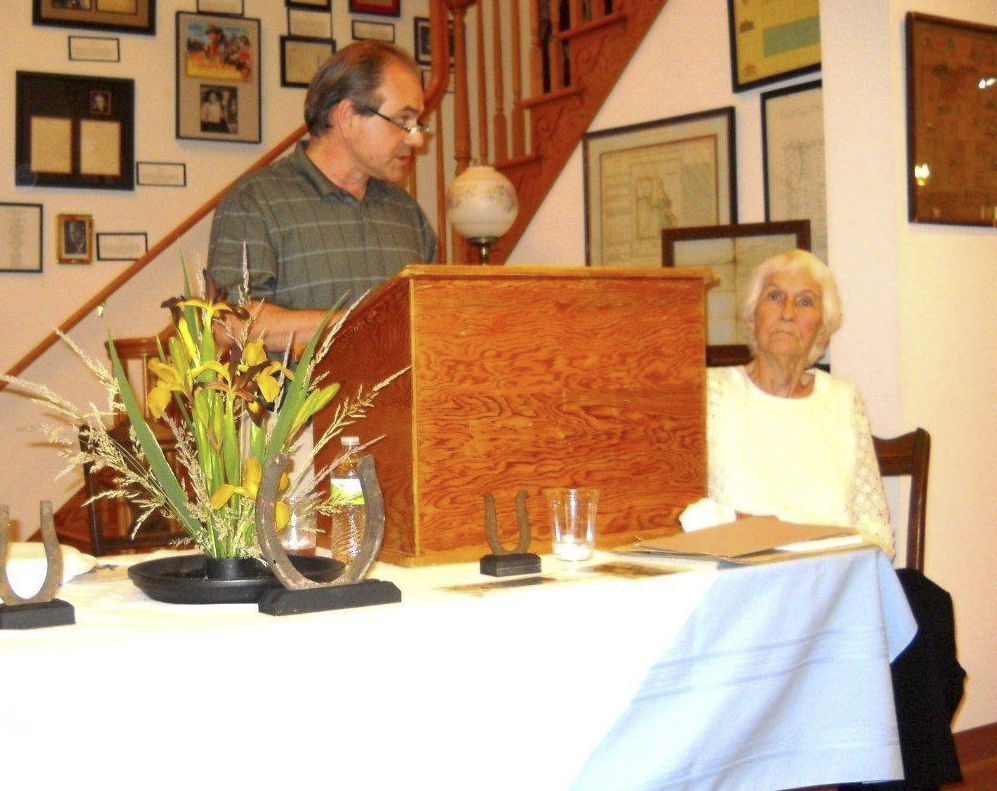
SUBMITTED PHOTO
Current Nodaway County Historical Society President Dr. Michael Steiner speaks during the 2015 banquet. Steiner has been the president for 10 years, but has decided to step down due to obligations at his job as the Dean of the College of Arts and Sciences at Northwest Missouri State University. Also pictured is board member Jo Ann Outs, of Arkoe, who delivered a speech about Leo Baumli at the banquet.
It is said that history is bound to repeat itself, if people don’t learn from it. It’s also said that if people don’t know their history, they can’t move forward.
The Nodaway County Historical Society was founded in 1944 and was later reorganized in 1964. But the society is an active organization dedicated to the study, collection and preservation of the historical data of the county.
“For me, it’s been my primary community service,” Former Historical Society President Dr. Michael Steiner said. “I think the primary focus of the Historical Society is that, it’s not a government organization, it’s a non-profit. Its goal is to serve the community through historic preservation and programming. It’s just been an excellent opportunity to be engaged in the community in area that I enjoy.”
Steiner has been the president of the Historical Society for the past 10 years and recently stepped down from the presidency due to time restraints. Along with being the president of the organization, Steiner is the Dean of the College of Arts and Sciences at Northwest Missouri State University.
While he has been president for 10 years, Steiner had been involved with the organization several years prior to his presidential tenure.
“I was familiar with the Historical Society when I came to Maryville because I was a Historian and I taught history,” Steiner said. “My department chair at the time, Tom Carneal, was instrumental in establishing the Historical Society and creating the museum. So Carneal was the one that got me involved with the organization. I felt a connection to it because I was a history teacher.”
The organization serves the community in several different ways including hosting several programs a year and having a three-story museum located on the corner of First Street and Walnut Street in Maryville. Steiner said that the community having a Historical Society is important because it not only preserves the history, but it also teaches people about their past.
“If you want to know where you’re going as a community, you need to know where you’ve been,” Steiner said. “I think it’s valuable for people who live in a community to really have an understanding of the community’s identity. People are more comfortable with themselves when they know who they are, where they’ve been and what has shaped them. It’s important to understand that and historical societies are communities that help residence understand what the community is about.”
Steiner said that one of the main functions of the Historical Society is to give people an idea of what kind of community they are living in. He said that there are three ways that the organization reaches the community.
The first is the actual pieces of history from the community, which could include a book, a couch or any other historical item. The second way is the publications and displays that the Historical Society has. He said it’s important to have the history written and down and kept on record. The third and final way, according to Steiner, is the presentations the organization puts on for the community.
For Steiner, local photography is his favorite parts of the community. He enjoys seeing all of the old time photos. He has done a couple of photographic histories of Nodaway County and Maryville. Steiner’s favorite time in history is the “Transition Era.”
“In the early 20th century, when all of these robust, growing towns like Maryville, there are thousands of them across the country,” Steiner said. “When they converted from horses to cars is called the Transition Era and it happened rapidly. It actually happened within a half dozen years, downtown Maryville went from being crowded with horses tied up around the square to brick roads with automobiles. I find it fascinating because it shows how rapidly we adjust to change. We don’t lose our identity, but we rapidly adjust to change.”
Along with enjoyment of the Transition Era, Steiner enjoys studying the way people look at change today. But he said that it’s not necessarily change that people are seeing.
“Today, we have a tendency to sense that change is accelerating,” Steiner said. “People hear it all the time that things are rapidly changing, everything is changing at once. I think that’s mostly not true. Things are changing rapidly, but that doesn’t make it any different than other time periods. Cell phones and computers are changing the culture, but there are ideas that are staying the same. The automobile is a great example. Yes, they are more efficient, but by and large, the idea of the automobile has been the same. A person that lived here from 1900-1910 has a way better case to say that they lived in rapidly changing times than we do,”
Steiner was president for 10 years and because of his time commitment to being a dean, he’s not able to give the presidency the time it deserves. However, Steiner said he has seen the organization quite a bit over the past decade.
“The biggest change has been the amount of programming and the activities, which has increased considerably,” Steiner said. “Throughout the decade, we’ve had a lot of volunteers invest time in making monthly and even weekly programs available. I think we’ve increased the community engagement in the Historical Society. It’s probably come at a cost of cataloging, but I think we’ve been able to increase the involvement considerably.”
Steiner enjoyed his time as president and plans to stay involved with the organization, but he said that it’s always important for change to occur within an organization.
Steiner will remain on the organization’s board for the next year.
SUBMITTED PHOTO
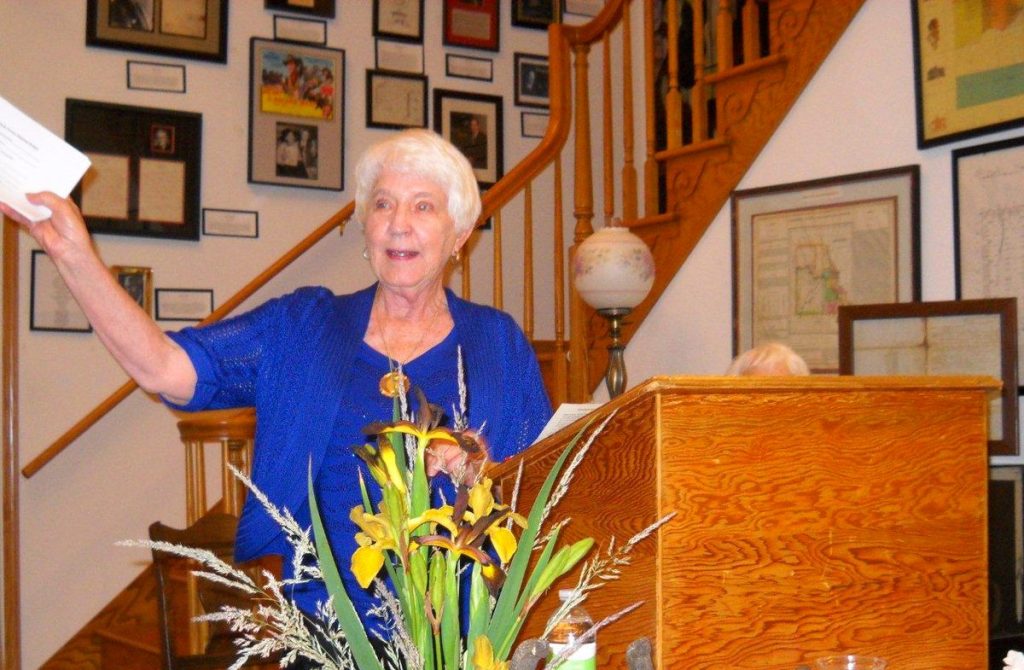
Soon-to-be president of the Nodaway County Historical Society, Alice Hersh, speaks during the Society’s 2015 banquet. Hersh will replace former president Dr. Michael Steiner.