Regent Richmond issues plea for higher NW salaries
TONY BROWN/DAILY FORUM
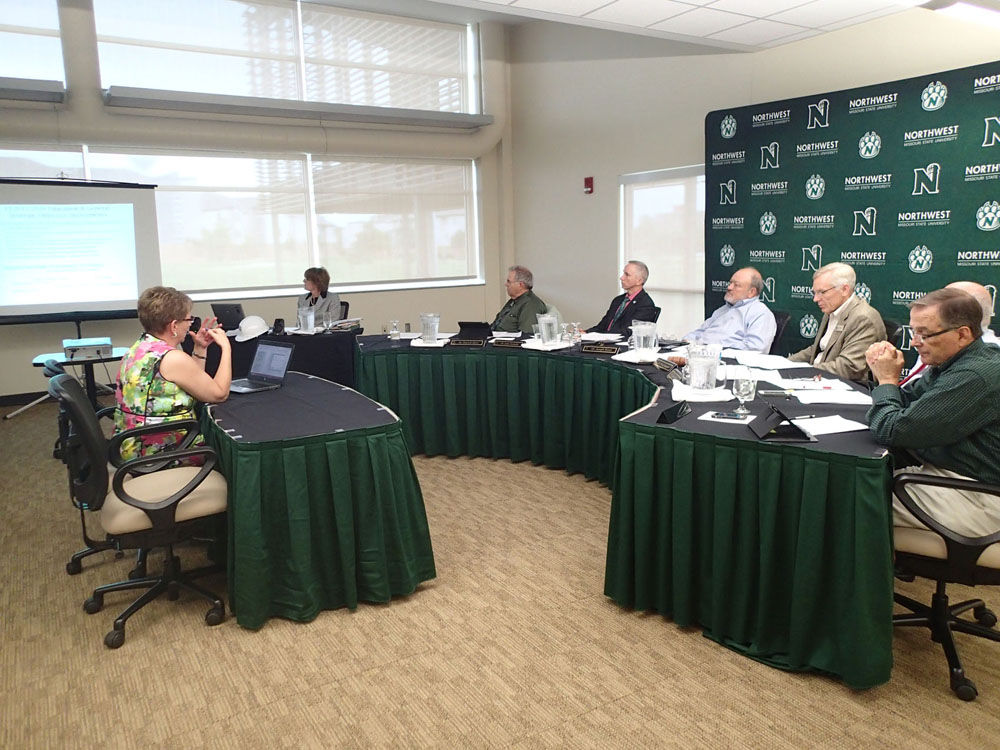
Stacy Carrick, vice president of finance at Northwest Missouri State University, outlines the school’s fiscal 2016 budget during Friday’s Board of Regents meeting. The spending blueprint for the new fiscal year, which begins July 1, includes $30 from the state of Missouri, about a third of Northwest’s education and general operations budget.
The Northwest Missouri State University Board of Regents on Friday unanimously approved the school’s general and auxiliary services budgets, a $118 million revenue and spending blueprint that includes a 1.3 percent cost-of-living increase for university employees and a 1.19 net percentage increase in state core appropriations.
President John Jasinski told the governing board that his administration has continued to make affordability a high priority, pointing out that undergraduate tuition will increase a mere 0.8 percent during the coming fiscal year that begins July 1. Tuition for graduate student will rise 1.5 percent.
The general budget, which includes salaries and spending for academic programs, totaled $90.9 million dollars, up from $87 million for the current fiscal year. Of that amount, $55 million comes from student tuition and fees, $31 million from the state and a little less than $5 million from other sources.
On the expense side of the ledger, Northwest pays out nearly $37 million a year in salaries, $14 million in benefits and almost $39 million for operations that include everything from classroom instruction to health insurance and building maintenance.
The $27 million auxiliary services budget is made up mostly of student-paid room and board fees, which will increase next year by slightly more than 3 percent.
Prior to listening to a budget summary by chief financial officer Stacy Carrick, the regents heard from State Rep. Allen Andrews, whose 1st District includes Maryville. They also took the opportunity to offer several comments and questions regarding the Legislature’s declining support for higher education.
State universities like Northwest, on average, receive less than 35 percent of their total operations budgets from state appropriations, down from a high of more than 70 percent in the 1970s.
Regent Joseph Bosse mentioned an ongoing discussion in Illinois about the possibility of essentially turning state universities into private institutions.
Bosse said he was not voicing support for such a scheme, but wondered how low state funding could fall before Northwest and other schools start considering other options.
“How much can you cut without losing people, services and everything else?” Bosse asked.
Andrews responded that he understood Missouri’s colleges and universities need more cash, but added that finding new revenue is difficult in an economic climate still clouded by the Great Recession.
“Everything comes down to whether we have a robust economy,” Andrews said.
Jasinski told the lawmaker that the net 1.19 percent increase in core appropriations is well below the 5 percent deemed essential by Missouri’s Council on Public Higher Education, and that state universities are hobbled by a legislatively imposed tuition cap tied to inflation and the increasing cost of government regulation.
The president also said more public funds are needed in support of STEM programs designed to prepare students for careers in science, technology, engineering and mathematics.
During the budget discussion proper, Regent John Richmond made a strong plea for higher salaries for Northwest faculty and staff, saying that a series of cost-of-living increases below 2 percent over the past few years is insufficient and will ultimately hamper the recruitment and retention of quality personnel.
“I just think it’s something we should take on,” Richmond said. “You keep telling me we’re behind, so lets make it a priority. I realize you can’t do it all in one year.”
Carrick admitted that salary levels are indeed problematic for Northwest.
“We do have an issue because we are not able to keep pace with the market,” she said.
Richmond said he realized that Jasinski, Carrick and other top Northwest administrators are doing their best to make what dollars they have stretch as far as possible, but added that writing off significant pay raises as an unreachable goal would be a mistake.
“In my experience, if you don’t do right, you end up paying for it,” he said.
On other fronts, the regents approved the creation of a new administrative unit this fall, the School of Health Science and Wellness.
Graduate Dean and Vice Provost Greg Haddock told the board that the school will make it easier to market Northwest’s health sciences programs, which are currently scattered among at least three different departments: Health and Human Services, Behavioral Sciences and Natural Sciences.
The new school will replace the Department of Health and Human Services and incorporate various courses, faculty and resources from the other two entities.
Rather than reporting to a dean of one of Northwest’s three colleges, a school director will answer directly to Provost Timothy Mottet, the university’s chief academic officer.
Haddock said combining health- and wellness-related programs under a single banner will enhance recruitment and give Northwest more flexibility in terms of preparing students for careers in such rapidly growing professions as dietetics, recreational therapy, health education, health care administration and informatics.
Northwest’s current health and wellness programs include pre-professional programs in chiropractic, dental hygiene, dentistry, medicine, nursing, occupational therapy, optometry, pharmacy, physical therapy, speech pathology and radiology
Other degree offerings that could in some fashion come under the new school’s umbrella include nutrition/dietetics, physical education, radiologic science, clinical lab science, biology and psychology.
Haddock said Northwest created similar administrative structures during the recent reorganization of the Booth College of Business and Professional Studies, parts of which have become the School of Agricultural Sciences, the School of Communication and Mass Media and the School of Business.
At the end of Friday’s regular session, the regents closed out the current year by electing Dr. Pat Harr as chair and Gene Dorrel as vice chair. Both will serve two-year terms. Harr and Dorrel succeed former chair Mark Hargens and former vice chair Joseph Bosse.